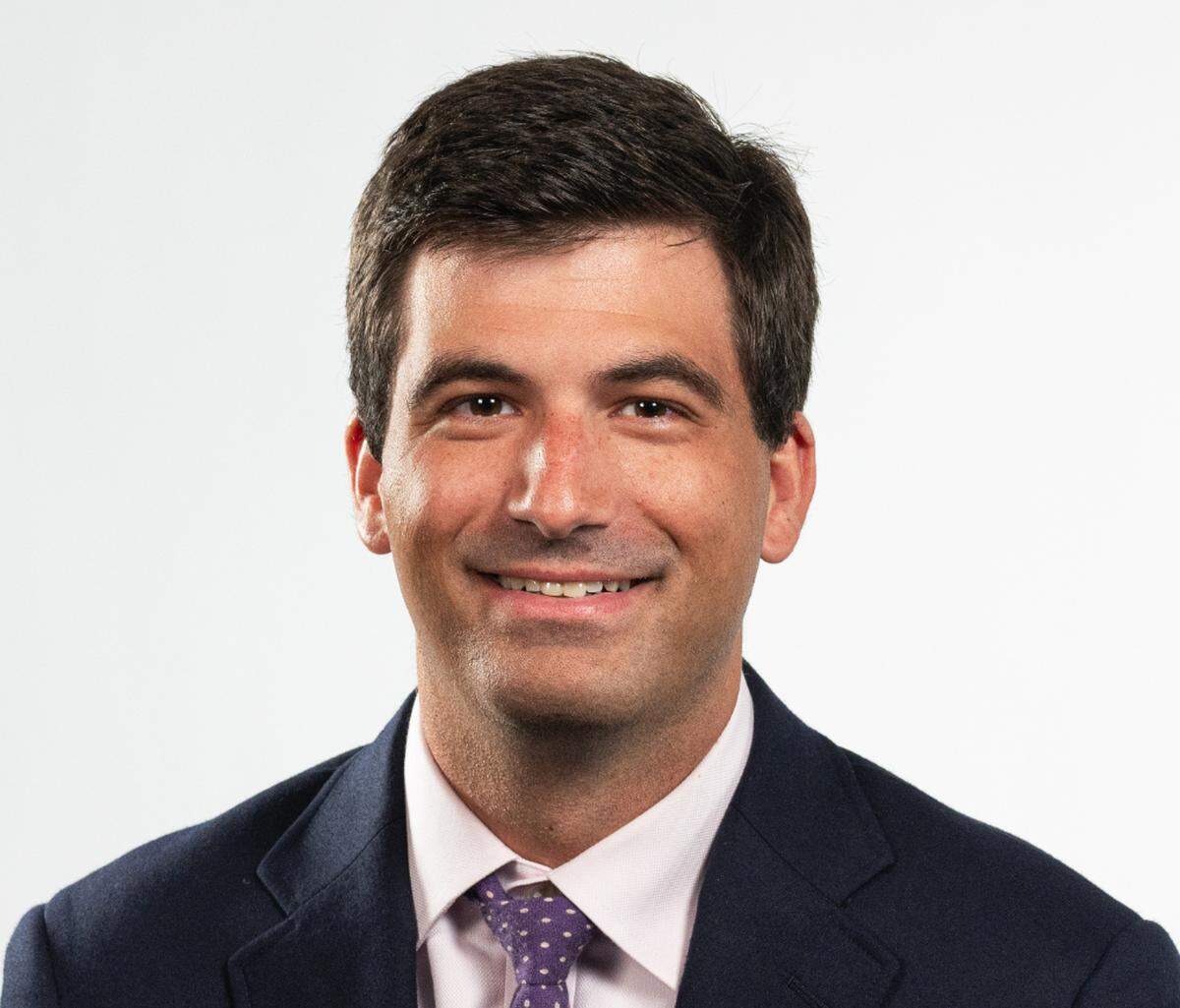
Both Josh Hawley and Lucas Kunce are running populist campaigns. What does that mean?
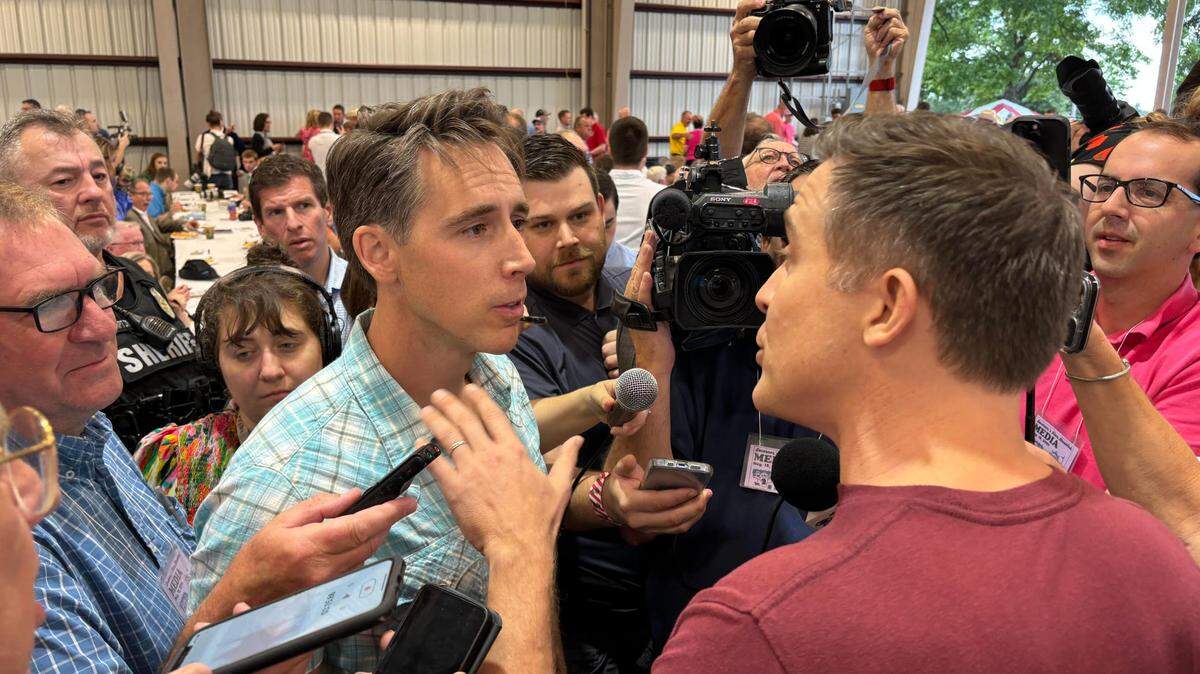
Sen. Josh Hawley and his Democratic opponent Lucas Kunce have spent most of 2024 trying to distinguish themselves from each other in Missouri’s U.S. Senate race. But there’s a common thread running through both of their campaigns — populism.
Hawley, a Missouri Republican, has become a key figure in his party’s burgeoning populist wing. Kunce says he’s running a populist campaign attempting to fundamentally change who has power in the country.
Populism is a loose term – used differently by reporters, politicians, historians, political scientists and sociologists. It is less political ideology and more political perspective, making it possible for two candidates on ideological extremes to both present themselves as the populist candidate in the race.
Both candidates claim to represent the will of Missourians. Both have courted the labor movement and have said they will prioritize workers. Both claim they will take on corporate greed. Both claim the other is a phony.
“Those guys are fake populists,” Kunce said at a campaign event this summer, referring to Hawley and former President Donald Trump. “What populism really is, is it’s about uniting everyday people to go against the system in mass with our combined power to break a system that’s not working for us.”
A day after winning an uncontested Republican primary in August, Hawley dismissed a question about who he believed is the true populist in the Senate race.
“I mean what (Kunce) is, is a guy who is 100% for the radical nutty left wing agenda,” Hawley said. “...I don’t care what label he applies to himself. That’s just nuts.”
Political candidates often use lofty rhetoric that highlights the “common man.” But Kunce and Hawley’s open embrace of populism comes in a political moment informed by distrust and discontent with powerful institutions — highlighting a Missouri that appears to be clamoring for political change.
“Populism can be very important,” said Jennifer McCoy, a political science professor at Georgia State University. “And it usually rises when there’s a general rejection of the political parties as a whole, the whole political establishment, because it’s been unresponsive to the real needs of people.”
What is populism?
Populism can generally be boiled down to three characteristics: anti-elitism, presenting themselves as the voice of the people and speaking in moralistic terms.
There are variations on the theme. One person’s elites may be liberal movie stars, another’s might be conservative billionaire donors. One person’s common man might be a socially conservative farmer in rural Missouri, another’s might be a suburban single mom. But both left-leaning and right-leaning populists tend to take on an “us versus them” mentality.
Neither Hawley nor Kunce perfectly fit the definition of a populist, but both embrace many of its features.
While Kunce has been open about calling his campaign populist, his definition centers on changing the structure of power in Washington than trying to present himself as a moral voice of the people.
Kunce frequently says the federal government as broken and unable to help everyday Missourians. He rails against the fact that lawmakers can trade individual stock, creating the appearance of politicians who are out to help themselves. He claims corporations have too much power over politicians and argues that the federal government should be sending more resources to the state, to help communities that were gutted when manufacturing businesses moved overseas.
“What I stand for is fundamentally changing power in this country, and taking it back for everyday people,” Kunce said. “That’s what I think populism is.”
Kunce and Hawley sometimes sound similar. Both men have pushed for Congress to ban lawmakers from trading individual stock, criticized the government for policies that encouraged businesses to shift manufacturing overseas and showed up to the picket line to support striking workers.
When Kunce was working for an anti-monopoly advocacy group in Washington, he worked with Hawley’s office and at one point provided them with talking points that Hawley used in a committee hearing, according to NOTUS, a non-profit news organization.
But where Kunce often blames corporations and wealthy politicians for not looking out for the interests of working people, Hawley tends to pin the blame on “the left,” an amalgam for progressive coastal elites and “woke corporations.”
When he rails against the left, Hawley often takes on a moralistic tone and injects Christianity into his speeches. In one speech, at the National Conservatism Conference, Hawley embraced Christian Nationalism as he claimed to represent the country’s values of faith, work, family and patriotism.
He said the left – both corporations, LGBTQ activists and liberal politicians – wanted to eliminate those values.
“They expect their preachments to be obeyed. They may speak of tolerance, but they practice fundamentalism,” Hawley said. “Those who resist are called deplorable. Those who question are labeled threats to democracy.”
While Hawley often leans into populist rhetoric in his speeches and essays, his record in Congress appears more mixed. He supported a recent failed effort to expand the child tax credit, but voted against a bill aimed at promoting semiconductor manufacturing in the U.S. The bill, which passed with bipartisan support, helped a St. Charles County plant receive $400 million in federal funds.
“I’m glad to see some of the policy shifts in so far as they may produce more positive outcomes for working families in the state,” said Jeff Smith, a former Democratic state Senator in Missouri. “I can’t say for sure that it’s fake or that it’s real.”
Why populism?
Much of the rhetoric from Hawley and Kunce appears to be a reaction to the ongoing realignment of the country’s two political parties. Missouri – once a top bellwether state – has become a reliably Republican state since the rise of former President Donald Trump, who also often sounds like a populist on the campaign trail.
Over the course of a decade, Trump has helped shift the demographics of the two parties. Suburban, college-educated voters have increasingly voted for Democrats like President Joe Biden while rural, working class voters have increasingly voted for Republicans like Trump and Hawley.
For Kunce to win Missouri, he has to appeal to working class Trump voters, people who are drawn to Trump’s promises to disrupt the status quo in Washington. Kunce has refused to say whether he’ll support Vice President Kamala Harris in November and has said he supports securing the southern border – a top issue for many Republicans.
“He is trying to do that by taking more centrist positions on hot button cultural issues, keeping some distance from the national Democratic brand, which is, frankly, not in great shape in large swaths of Missouri, and emphasizing an anti big corporate world view that may have some appeal in particular to small to mid-sized Missouri farmers,” Smith said.
Hawley, meanwhile, has openly embraced the shifts in the Republican Party. In the 2022 midterms, Hawley said the Republicans weren’t able to win control of the Senate because their policies don’t do enough for working class voters. He was complimented by Teamsters President Sean O’Brien from the stage at the Republican National Convention.
“There’s an argument that a lot of these Chamber of Commerce issues have not helped working people,” said James Harris, a Republican consultant in Missouri. “And then there’s a very easy argument to go ‘is this good policy?’ And I think Josh is a natural at articulating, breaking those things down.”
While Hawley has been quick to adopt the populist language on the campaign trail, Charles Postel, a political science professor at San Francisco State University, bristles at the idea that Hawley would be called a populist.
“I mean, it has, it has no historical resonance,” said Postel, who wrote a book on the history of the Populist movement. “Those people are always conservatives and anti-populists in American history. Always.”
Postel said the Populist Party of the 1890s was an association of farmers and laborers who were focused on advancing their political interests in a moment when they were feeling exploited. They pushed for concrete action on issues like a graduated income tax, an effort to ensure the wealthy were paying their fair share.
There were people who were pushing for social conservatism in the 1890s – similar to the way Hawley has embraced Christian Nationalism – but Postel said those people were rarely considered populists.
“This is how the party of the big capitalists and bankers appeal to workers,” Postel said. “You can’t win elections without some appeal to ordinary people.”