Josh Hawley & JD Vance share an ideology. Will VP hopeful impact the MO senator’s future?
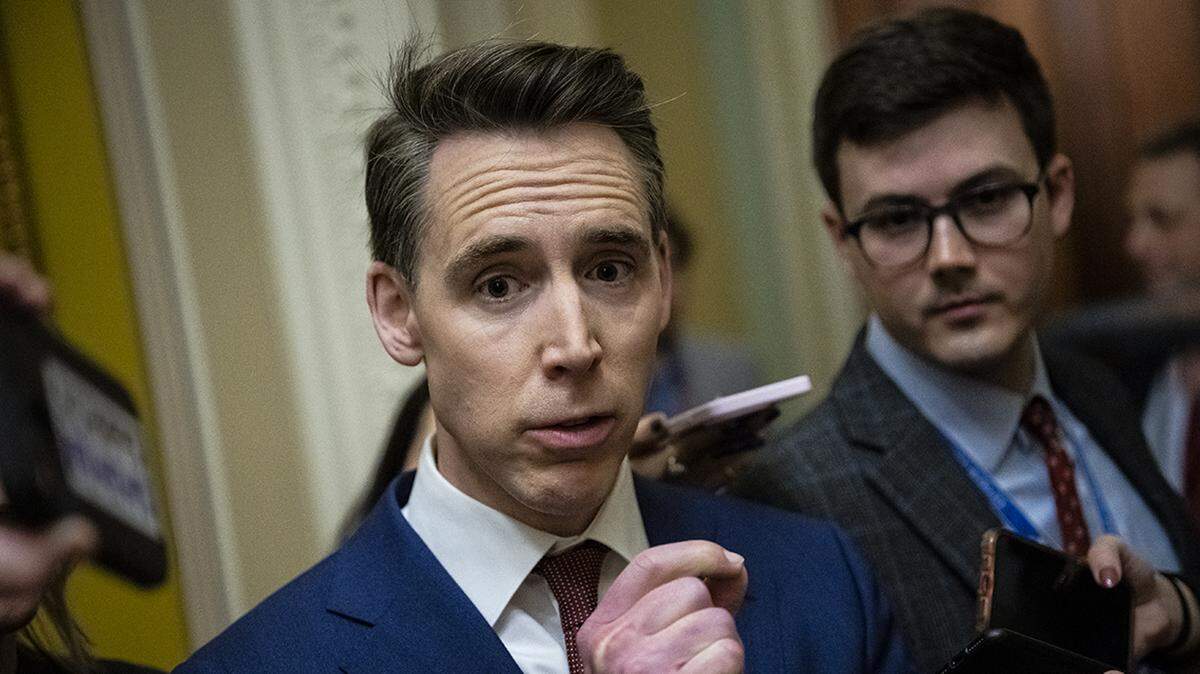
Sen. Josh Hawley watched from home as the balloons fell in Milwaukee at the third Republican National Convention christening former President Donald Trump as the party’s nominee.
Hawley had said two years ago that he wasn’t interested in running for President in 2024, a year ago that he wasn’t interested in being Trump’s Vice President and that month that he wasn’t interested in a cabinet position in a potential Trump administration.
“Being in the Senate is a lot better job,” Hawley said at the Capitol last month. “It’s true. I just thought I could be more effective here. And also, I want to represent my state.”
But as Hawley pulled himself out of the presidential conversation, one of his closest ideological allies, Sen. JD Vance, rose in Trump’s esteem. Just two years after winning a hotly contested Republican primary for Senate in Ohio in 2022 – with backing from Hawley – Vance became the Republican vice presidential nominee.
It was a victory for Hawley’s branch of the Republican Party. In elevating Vance, Trump doubled down on his populist message and indicated that the party’s working-class base was his focus.
But Vance’s rise also means that Hawley, who is seen as a future presidential candidate, is out of the national spotlight while his ideological ally is positioned to become the future of the party.
Hawley does not appear bothered. He says his focus is on representing Missouri, that he likes his independence and has never been particularly interested in becoming vice president.
“This is Trump’s moment, and it’s a hugely important moment,” Hawley said. “Because this moment will alter the trajectory of the future.”
Focusing on Missouri
Hawley was first elected to the Senate in 2018, as one of the first Republican candidates of the Trump era. The Missouri Republican quickly set to work trying to take Trumpism and turn it into a legislative agenda.
He drew national attention for his criticism of the technology industry – particularly social media companies. He was the first Senator to say he would object to the certification of the 2020 presidential election. And he was among the first Senators to oppose military aid for Ukraine, after Russia invaded the country in 2022.
“It’s the first sort of spark of, wow, okay, this is what it might look like on a whole suite of issues ranging from economic nationalism to foreign policy to immigration to culture and more,” said Saurabh Sharma, the president of American Moment, a conservative non-profit. “He was very much a maverick, doing some really interesting things in those early days in the Senate.”
The moves also had the benefit of attracting attention from national media, helping Hawley position himself for a potential presidential run. But when it appeared clear that Trump would run for reelection, Hawley quickly said that he wasn’t interested in running for president in 2024.
Instead, he doubled down on Missouri issues. His highest profile issue over the past two years has been the Radiation Exposure Compensation Act – an effort to get medical benefits for people in the St. Louis area, and across the country, who were exposed to radiation as a result of the federal government’s efforts to develop nuclear weapons in World War II.
As Hawley’s likely Democratic opponent toured the state, seeking endorsements from labor organizations, Hawley, too, attempted to win the support of private labor unions – and showed up to the picket line of striking United Auto Workers.
He later was praised by Teamster’s president Sean O’Brien in a speech at the Republican National Convention, as one of the Republican senators who is trying to make the party more supportive of labor.
“He’s shown political dexterity this cycle,” said Jeff Smith, a Democrat and former state Senator. “The minute he’s running for reelection instead of President, the target is no longer a national Republican primary voter. The target is a Missouri general election voter.”
And, while he has an 11 percentage point lead according to a recent poll by St. Louis University and YouGov, Hawley has been quick to dismiss any speculation about joining a Trump administration should Republicans win the White House.
“I’m running for reelection,” Hawley said. “So I’m not gonna go to the people in my state and say, ‘Please elect me for six more years. And by the way, as soon as I get the opportunity to take a different job in the cabinet, I’m gonna go do that.’ I’m just not gonna do that.”
A new direction
In a speech a week before the Republican National Convention, Hawley laid out his vision for the Republican Party.
He said Republicans should build their policy around an ideology of faith, family and work -- particularly by supporting economic policies that make it easier for families to get by, like an expansion of the child tax credit.
“Today two parents have to work to make the kind of money, with the kind of purchasing power, that one wage got you 50 years ago,” Hawley said, advocating for increased wages to allow parents more flexibility in how they want to raise their families.
Vance has similarly said Republicans should focus on helping families. But where Hawley was advocating for a “family wage,” Vance drew Democratic ire for criticizing single women, calling them “childless cat ladies.”
Hawley called those comments a “poor choice of words,” but doubled down on the idea of helping people have more kids – saying a lot of families want to have children but can’t afford it.
Much of what Vance has talked about on the campaign trail is similar to path Hawley carved out in the Senate – from supporting private labor unions, criticizing large businesses, advocating for states to set policy on abortion rights and arguing against U.S. military support for the war in Ukraine.
“He’s smack dab in the lane that Hawley envisioned for himself in national politics, and he’s even younger than Josh,” Smith said. “And so that’s poison for a guy who wants to be president. And I would imagine that, as much as he’s going to tie himself to Trump, he wouldn’t be too disappointed if JD Vance is not the vice president.”
Populist conservatives argued that Vance’s success doesn’t take away from Hawley’s. They saw Trump’s choice of Vance as a political decision – a rust belt politician who grew up working-class and could help appeal to voters in several swing states – but one that helped move the Republican Party in a more populist direction.
“Trump has done so many great things to the party, but where do we go from here?” said Jon Schweppe, the policy director for the American Principles Project, a socially conservative political advocacy group.
“And having somebody like Vance in there, as opposed to say (North Dakota Gov. Doug) Burgum, right? I think Vance sets us up to be in a position where we can continue Trump’s legacy and continue pushing towards a more socially conservative, economically Populist Party.”
Regardless of whether Trump and Vance win, Hawley is likely to get even more ideological allies in the Senate. Republican candidates in states like Ohio, Indiana, West Virginia and Arizona, are campaigning more like Hawley than like former U.N. Ambassador Nikki Haley.
Hawley declined to speculate on what Vance’s vice presidential nomination meant for his future, though stressed his belief that the Republican Party needs to focus on the working class.
“You’ve gotta think about, where does this lead us in the next 10 years, 20 years, 30 years,” Hawley said. “That’s why I say it’s hard to have this conversation until we see what happens in November. We gotta win in November. If we don’t win in November then, you know, this is gonna look a lot different.”
This story was originally published September 2, 2024 at 6:00 AM.