De Soto residents love ‘small town feel.’ Will Panasonic turn it into suburban sprawl?
Steve Prudden believes things are about to drastically change for De Soto, a Johnson County community that’s long teetered at the intersection of rural and suburban.
Three generations of Pruddens have processed and sold ground beef, bacon and steaks at his local Steve’s Meat Market. With only 6,200 locals in De Soto, the butcher relied on restaurants and grocery stores across the metro area to stay afloat for the last 53 years.
But the fabric of De Soto is about to be forever changed by Japanese electronics giant Panasonic, which is building a massive electric vehicle battery plant on the site of the former Sunflower Army Ammunition Plant just south of K-10. Panasonic expects to hire 4,000 workers for the nearly 4-million-square-foot plant.
“I believe we’re getting ready to explode,” Prudden said.
No one knows how many of those workers might live in or near tiny De Soto. But this community was already changing and growing from the relentless sprawl that has defined the state’s wealthiest and most populous county in recent decades. Locals just celebrated the addition of a Taco Bell, which gave the town a total of four fast food franchises.
Now, locals expect major developments to follow the $4 billion plant to De Soto.
“As far as how much goes where, I don’t know. That’s the big, million-dollar question,” Prudden said. “I think there’s going to be a little of everything. I think we’re going to see the good with the bad.”
Panasonic’s decision to build in Kansas was key to Democratic Gov. Laura Kelly’s successful reelection argument last year. But for De Soto residents, the development has sparked a mix of excitement and trepidation. While many see economic opportunity for De Soto in the massive project, there’s also a fear that De Soto will lose its small town feel. Many people move or stay there because they’d rather live in a small town than a cookie-cutter suburb.
And they fear the plant will transform the community into an extension of sprawling suburbs like Lenexa and Olathe, home to miles of tightly packed subdivisions and big box stores.
For years the Kansas City metro has been expanding westward, along the bustling K-10 corridor. New retail, hotels and housing developments have popped up in green fields along the highway — a trend residents believe will only accelerate with Panasonic’s arrival.
“I believe we’re going to drive down 10 highway, we’re going to leave Lawrence and we’re really not going to know any difference until we get to Kansas City,” Prudden said. “It’s all going to be one big cluster.”
At the same time, local leaders are looking to learn from the trajectory of another massive battery plant more than 1,300 miles away, where Panasonic made its first foray into the American market in a joint venture with electric automaker Tesla.
De Soto Mayor Rick Walker is well aware of the social media naysayers criticizing the project and those worried about its possible downsides. But, a lifetime resident himself, he is confident De Soto can maintain its sense of community while also growing its economy.
“We had 12,000 people working at Sunflower in its peak and we were still a small town,” Walker said. “I think a small town is how you approach it, how you treat your neighbors.”
As residents brace for change, state and local officials know they must act quickly to ensure the small town has the roads, water and other infrastructure necessary to support the sprawling industrial facility.
But that work is already proving painful for some residents.
Janie Widman moved to De Soto from Lenexa a year ago after finishing building a house on a 35.5 acre property she and her husband bought years ago. They wanted wide open space.
“It’s just so peaceful, especially at night when it’s dark skies and the stars are absolutely phenomenal,” she said of her new home.
But she’s already spotted little pink flags near her property portending the work that must be done to build new sewer lines in the area.
“Everybody knows it’s all going to be bygone once we get all this city slicker stuff in here… We wanted to get out of the city and now the city’s coming to us.”
Lessons learned from Reno
As De Soto prepares for its new plant, officials are closely studying what’s happened in Nevada, home to Panasonic’s only other domestic battery operation.
From Reno, it’s a nearly half-hour drive in the desert to get to Tesla’s Gigafactory, which produces more batteries than any plant in the world. A partnership with Panasonic, the sweeping facility encompasses 5 million square feet, with an expansion in the works now.
Located near Lake Tahoe, the Reno metropolitan area is home to fewer than 500,000 people — four times smaller than the Kansas City metro.
Reno Vice Mayor Devon Reese said the isolated location of the plant has caused problems with traffic and congestion. Interstate 80, with only two lanes in each direction, is the primary means for getting in and out of the plant. It frequently backs up for miles, Reese said.
Its isolation also meant locals had to quickly figure out how to feed the thousands of workers at the plant. A trip to the closest McDonald’s would take a half hour each way, so a fleet of food trucks were dispatched to the factory before Tesla invited local restaurants to open outposts inside.
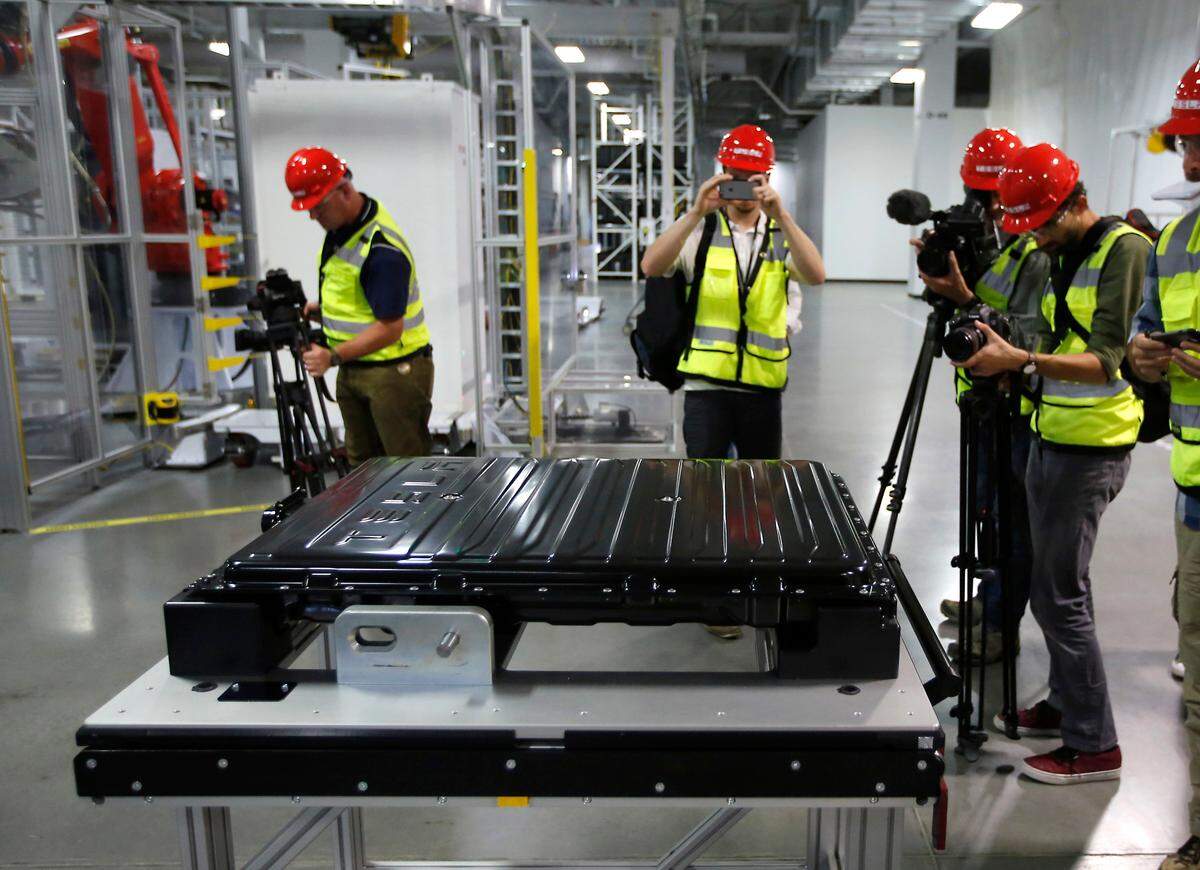
Around the Reno metro, prices for homes and apartments have skyrocketed. Some factory workers lived in college dorms for a time as the stock of homes shrunk.
“We were caught a little flat footed and we continue to struggle,” said Reese, who previously studied in Lawrence and Kansas City and lived in Overland Park.
On balance, Reese says the factory has been positive for his community. But he said political leaders in Kansas should act now to prepare De Soto because Panasonic won’t once the factory is opened.
“The impact of the factory will touch on every aspect of a community’s life,” he said. “Don’t just stick your head in the sand. Because Panasonic is not particularly active in our community or our political landscape.”
Jeff Werner, vice president of corporate and government affairs for Panasonic North America, said the company is working hard to avoid repeating mistakes made at its Nevada plant.
“That was our first foray into a facility of this size,” Werner said. “That’s what really helped us select De Soto in the first place. Just the location, the size of population in the area, the skilled workforce that’s currently there, the educational institutions that already exist in the area. These are the things that went into this large decision making process that we already went through.”’
Panasonic is working with Johnson County Community College and the University of Kansas to develop training programs for workers. In addition to other basics like housing and transportation, Panasonic is also exploring childcare solutions with state and local leaders.
“It’s still in the early days,” Werner said. “But we very much see an important role that we have to play in that. It’s very much to our benefit to have childcare options.”
Mike Kelly, the incoming chair of the Johnson County Commission, said the development underscored existing needs in Johnson County to broadly expand infrastructure in the area, including water treatment facilities and public transportation.
Tantamount to these efforts, he said, will be a focus on thinking about Johnson County’s long term growth, rather than simply Panasonic’s needs.
“We’re going to continue to grow and we would be derelict in our duties to think we can just plan for 650,000 people in Johnson County five years from now. We need to be cognizant of that when we’re making decisions that are 50-year decisions,” Mike Kelly said.
Planning for a new plant
At the start of World War II, the U.S. Army flooded De Soto with new residents.
In 1942, the Army annexed and tore down an entire small town to make room for the Sunflower Ammunition Plant.
Workers arrived in the small farm town by train, living in tents and makeshift trailer camps because there wasn’t enough housing to accommodate them.
Kansas 10 highway originally ran though De Soto’s downtown until the Army rerouted it to go by the plant.
An increase in student population overloaded the school system, forcing the Army to build new school buildings near the plant. The buildings were later donated to the De Soto School District, which still owns the buildings but no longer uses them for classrooms.
“It literally blew this town to pieces because there were so many all of a sudden,” said Kathy Ross, president of the De Soto Historical Society.
The Sunflower ammunition plant left an impact on De Soto that is still felt today.
Some families, Ross said, started in De Soto when the town was founded in 1857 as a farming community. But many only came to town for the ammunition plant “and they think the whole world started in 1942,” Ross said.
He doesn’t believe the same thing will happen when Panasonic opens. It’s a different age. It isn’t wartime. And, this time, locals have years to plan and prepare.
“People are more mobile,” Ross said. “People are going to live where they want to live.”
“A lot of people are going to live in Overland Park and they’re going to drive to De Soto.”
Throughout De Soto, visual signs already exist of the incoming development. Residents have noted an uptick in the building of homes, and construction on K-10 has been ongoing for months.
The area in and around De Soto already lacks enough housing, especially for middle income families that don’t qualify for federal housing aid, said Ryan Vincent, executive director of the Kansas Housing Resources Commission.
Efforts are underway to address the disparity, he said, but it’s unclear exactly where new employees will live and exactly how much new housing is needed.
“Already Johnson County, in particular, had very low vacancy rates and the lack of supply obviously is going to lead to more cost as well,” he said “When you add an influx of thousands of jobs that’s going to lead to even more demand for a scarce resource.”
“Our goal is to make sure that everybody is working on the same front to be able to address the housing needs at the same time that the community and the Department of Commerce are addressing the economic development needs.”
Local officials are developing plans to extend sewer and water services at the site. Many of those costs will be paid for by tax increment financing, an incentive program that allows developers to use future tax revenues to pay for certain development costs. De Soto’s TIF agreement is expected to divert more than $202 million to the plant.
That’s on top of the $829 million in state economic development incentives committed to the Panasonic project. The Kansas Department of Transportation has also allocated another $26 million to build new roads around the plant.
Johnson County has also committed $15 million toward the project – $7.5 million for road improvements and $7.5 million to help fund a new fire station near the plant.
De Soto doesn’t have its own fire or police department. The Johnson County Sheriff’s office provides local patrol for De Soto; the city says it has no plans to end that relationship.
It’s something Kevin Tempel, a former Kansas City police officer who moved to De Soto after retiring, values about the community.
“It is very comfortable to not see police cars patrolling around and shining their spotlights down alleys and things like that because that means there’s not any problems,” Tempel said.
As the plant’s walls go up, many are wondering whether the already bustling K-10 can carry even more traffic with thousands of workers driving to De Soto each day.
Doug Bach, a former Wyandotte County administrator who is now contracting with the Kansas Department of Commerce, is coordinating conversations as Panasonic prepares to come to town. He said the Kansas Department of Transportation is looking into a study on whether K-10 needs to be expanded between Kansas City and Lawrence.
“They want to look at it and make sure it’s the right move for them to take in terms of the number of lanes or what kind of lanes you want to make,” Bach said.
He said there are also discussions about public transit options through the Kansas City Transit Authority and ride share programs.
Equally as important to the physical infrastructure needs are the plant’s human capital requirements. In a time of record low unemployment, local leaders are already in talks with Panasonic to ensure it can attract the workforce it needs to operate the plant.
“If Panasonic is to come in and be successful like we want them to and be successful generation after generation like we want them to .. they need to be able to get a labor force to their facility,” said De Soto City Administrator Mike Brungardt.
Getting ready for a new era
In November, when Panasonic broke ground on the Sunflower site, executives presented the De Soto school district with a $25,000 check as a sign of their commitment to the community.
“That’s just the start,” Werner, the Panasonic executive, told The Star. “Community engagement is extremely important. We are going to be there for a long, long time.”
While school officials anticipated a $4 billion investment from Panasonic, their long term planning has long included expectations that the Sunflower Ammunition Plant site would be cleaned up and redeveloped.
“It’s 9,000 acres of undeveloped land,” said Superintendent Frank Harwood. “There aren’t that many large tracts of land that have a single owner, which makes it more desirable for development.”
Voters in the school district passed a $5 million bond issue in 2018 allowing the school to purchase additional land for new schools in the future.
Harwood said the two high schools in the district can still take on about 1,000 more students but said new elementary schools may be needed soon.
“Although we have some capacity, will the capacity be in the right places?” he said. “We would see this as the beginning of kind of a growth boom that stalled in the 2000s.”
By the time Tom Kuhn moved to De Soto in the 1970s, the ammunition plant was a regular part of life. Many of his classmates had family members who worked at Sunflower, referred to by locals as “the plant.” He moved back in the 1990s and now coaches De Soto High School’s drumline.
Kuhn sees the new plant as an undeniably good thing for the community, even as it has him considering moving further to the outskirts of town to maintain his own peace and quiet and ability to play the drums without disturbing the neighbors.
“Everybody talked about the plant and it was just a fixture of Americana,” he said. “Now we’re going to get another one that is a fixture of Americana in the modern day.”
“The only difference is one was there to help the war effort and this one’s here to bring jobs back to America.”
While some residents on social media express a variety of concerns about the plant, from noise of construction to fears of increased crime, Mary Jo Cline sees an opportunity.
Cline, a member of De Soto’s parks and recreation board, hopes for more shops and restaurants in the downtown area, expanded programs from the city’s parks and recreation department and more green space to make De Soto more walkable.
“The land is there, it’s going to be developed anyways,” Cline said.
“For us we see it as a positive impact to hopefully help with that. To have more green space, more things that will allow for the revitalization of downtown.”
The city is betting that the plant will bring in new tax revenues that could help fund projects like new walking and biking trails. Walker, the mayor, said it could also help drive the demand needed to recruit more stores and restaurants to a town that just a handful of years ago wasn’t home to a grocery store.
The city has sent out a community survey and is forming a citizen advisory board to guide those decisions. And Walker maintains that local officials and residents will guide what comes next for De Soto.
“We do expect change but it’s the change that we can choose,” he said. “The things that can benefit our town the most we can seek to attract those.”
This story was originally published January 8, 2023 at 5:30 AM.