One of the hottest housing markets in Johnson County fears losing ‘small-town feel’
When she stops to think about it, Wanda Riedhart realizes she’s approaching a milestone: She’s about to mark eight years of serving pancakes, patty melts and pork tenderloins at her Wanda’s Roadside Cafe in De Soto.
On the spot, she decides a celebration is in order. Her hands resting on a stained Dickies apron, she yells across the small dining room at customers sipping coffee or sopping up runny egg yolks with toast. They better come in this Saturday.
“Come on in and get appreciated,” she shouts. “Customer appreciation. Probably sweets and stuff.”
The last eight years have been good to 66-year-old, violet-haired Riedhart, who runs the breakfast and lunch spot with a few family members. And they’ve been good to De Soto, population 6,443. From her restaurant in the two-block downtown, she’s witnessed an influx of new residents, homes and businesses to the the town nestled between Kansas 10 highway and the Kansas River in northwest Johnson County.
De Soto is quickly becoming a larger player in the wider boom story that has defined the county. The city’s population is growing. New homes are going up all around town. And housing prices have soared — outpacing the rate of growth in all other parts of the Kansas City metro.
“The growth has just been outrageous,” Riedhart said. “We have so many regulars here, but I can go a whole day and have all new people.”
Inside Wanda’s, it feels more like the heart of a middle-of-nowhere rural community than some booming suburb. A sign in the 11-table establishment advertises peach and buttermilk pies (all made from scratch, of course.) In one corner, school bus drivers enjoy their daily gossip as they kill time between morning and afternoon routes.
By most accounts, folks in De Soto have welcomed its growth. The larger tax base helps support city services and schools. And new residents have spurred the addition of new restaurants, a coffee shop and even a yoga studio.
Still, people like Riedhart are clear: They don’t want their town to become some sprawling vanilla suburb.
“I’m kind of afraid we’re going to start becoming the big city,” she said, noting she lived in bigger cities before De Soto.
That hasn’t happened yet, but the town is changing quickly.
De Soto fights some of the same battles that plague rural communities. Access to broadband internet is still a challenge. The city didn’t get its big box grocery store, Harps, until 2016.
At the same time, city officials must grapple with the same issues faced by fast-growing suburbs, like how to pay for the infrastructure that supports new growth.
Now at a crossroads, De Soto leaders find themselves confronting the community’s very identity as it teeters between rural America and suburbia. They want to grow, but not too much.
“There is charm to our smaller community,” Mayor Rick Walker said. “The challenge will be to maintain that small-town feel while attracting more growth.”
Johnson County’s hidden boom town
After months of searching for a home in the right price range in Johnson County, 29-year-old Myles Wilcox finally convinced his wife to take a drive out to De Soto.
Wilcox, an athletic trainer at Blue Valley North High School in Overland Park, and his wife are nearing the end of a lease on an apartment in Lenexa. But they have struggled to find a newer home under $350,000, let alone one that stays on the market long enough for them to schedule a tour.
“You know, $400,000 is only going to get you so far with a home in Kansas City,” Wilcox said. “It’s so expensive to buy or build in this area.”
After hopping off of K-10 and driving through De Soto, Wilcox saw a glimpse of the recent growth. New homes are rising from lots that have sat vacant since developers declared bankruptcy in 2008.
“We realized that building a home in De Soto was possible. The price range, the floor plan, everything about it was just perfect,” Wilcox said. “And K-10 and K-7 are right there, so it’s just an extra 10-minute commute.”
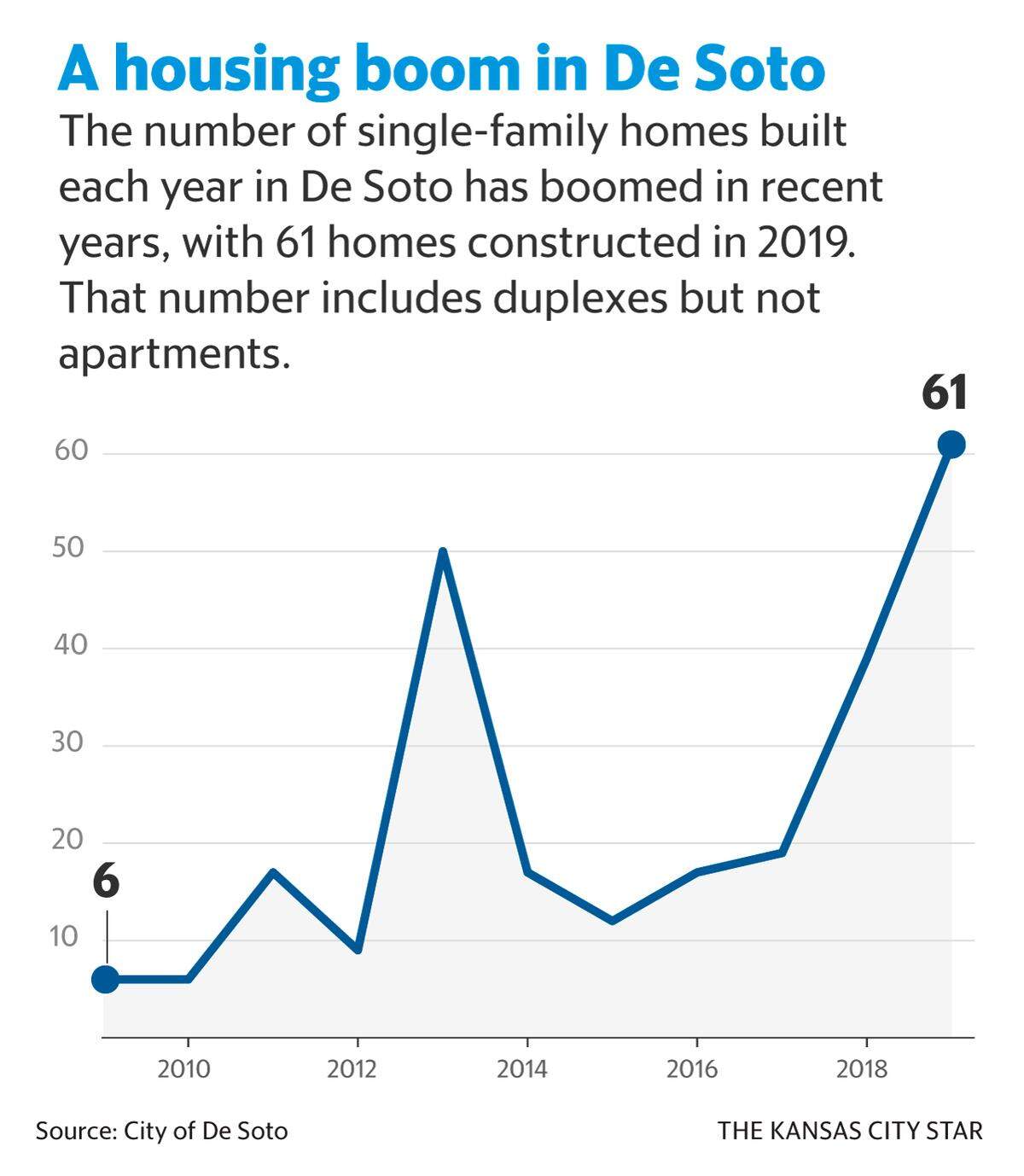
The number of single-family building permits approved each year has more than tripled in the past decade, with 61 homes constructed in 2019 — the city’s all-time record for housing starts. Leaders attribute the growth to the city’s recent efforts to slash home construction fees.
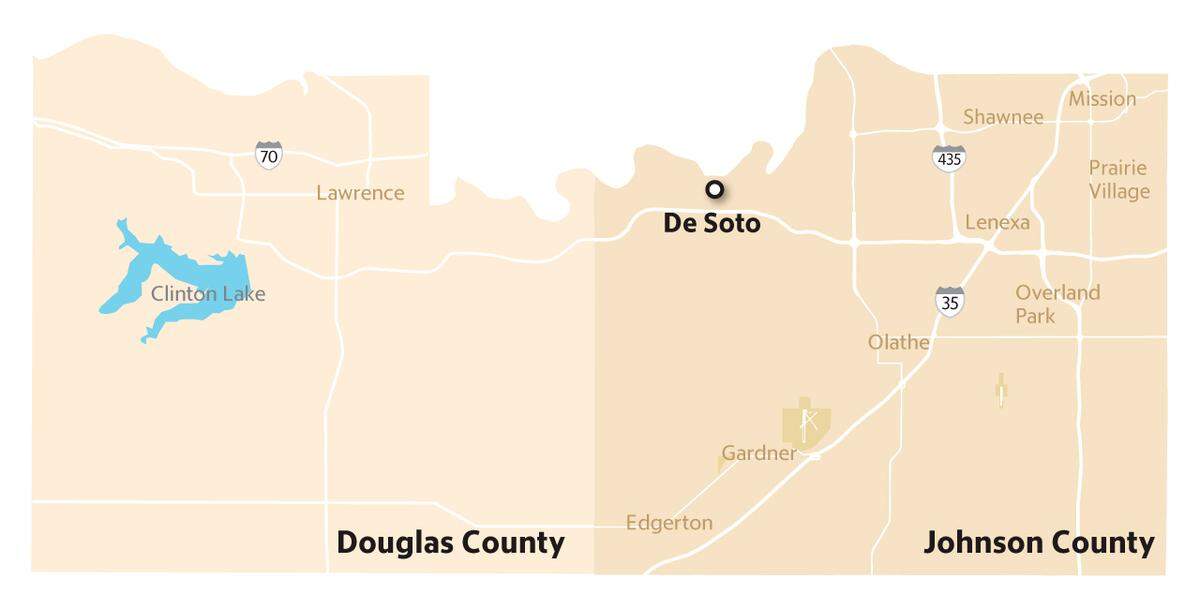
With rising home prices and an overall housing shortage throughout Johnson County, De Soto’s $350,000-plus homes are selling as fast as they are built — or often before construction begins. With cities like De Soto — and Gardner to the south — embracing more rooftops, a growing number of residents and development dollars are flowing into once sparsely populated western Johnson County.
“The whole corridor east of K-7 is almost built out, so most of our new growth is really taking place south of Shawnee Mission Parkway and west of K-7. That includes the western portion of Lenexa all the way to De Soto and unincorporated Johnson County,” said Alvie Carter, assistant superintendent of the De Soto school district, which reports a modest 1-2% growth in enrollment each year.
The De Soto Chamber of Commerce last year projected some 650 more people would move in by 2021. But now the group thinks the town has already surpassed that figure. They’ll know for sure when Census figures are released.
In the meantime, De Soto’s mayor says the town remains a bit of a hidden gem, separated from heavily populated suburbs of the county by green pastures and fresh air.
“An ongoing challenge is that a lot of people still don’t understand that De Soto is part of Johnson County,” Walker said.
Changing attitudes about growth
This isn’t the first time De Soto has witnessed a housing boom.
In the early 2000s, expensive homes were popping up on estate-sized lots — so many that City Administrator Mike Brungardt said the city tried to slow down the growth with new regulations.
“The attitude wasn’t very favorable toward residential growth,” Brungardt said. “The thought was, it’s coming, it’ll take us over and we need to slow it down.”
But years of stagnant commercial growth reversed that.
“Six to eight years of crippling recession really changes attitudes about whether economic development is a good thing or a bad thing,” Brungardt said. “Before the recession, we really just wanted industrial and commercial growth to bring jobs, retail opportunities and sales tax. But we had the realization that if you want those amenities, you’re going to have to have the population to support it.”
That meant adding housing: for the city’s industrial workers, teachers and commuters. The city and Economic Development Council asked developers why they weren’t building in De Soto. The answer, like elsewhere in Johnson County, traced back to the high cost of land, materials and fees.
“The permit fees were as high as anybody else in the county. The materials all cost the same,” Walker said. “But it was harder (for builders) to get the same price for a house in De Soto than in Overland Park, Olathe and Lenexa. So we had to help out the market.”
A few years ago, the city launched its housing incentive program, reducing or eliminating fees for permits and other steps associated with new construction. Brungardt said that for the typical $400,000 home, fees dropped from $10,000 to $2,500, on average.
Those incentives made it possible for dirt to finally move at defunct subdivisions that were platted before the recession, contributing to the city’s record year for home construction, he said.
This corner of Johnson County may see even more growth once the U.S. Army completes the lengthy cleanup of its 15-square-mile Sunflower ammunition plant. County officials envision redeveloping that World War II-era facility just south of K-10, currently the metro’s single largest undeveloped tract of land. The county wants to see new commercial and residential growth there, along with a 3,000-acre park and a “community in a park.”
Last July, Army officials said cleanup on the site isn’t expected to wrap up until at least 2028.
Why it’s cheaper in De Soto
Even as prices go up, many view De Soto as a relative bargain.
In November, the average sales price of a Johnson County home was $363,762, according to the Kansas City Regional Association of Realtors. That’s significantly higher than the average price in De Soto of $299,484, though that figure represented a 22% increase over November 2018.
That’s a big draw as prices for homes across the Kansas City metro accelerate at rates faster than boom towns like Denver, Nashville and Austin.
C.J. Garrett, a real estate agent and developer, has been building homes in De Soto’s Cherokee Woods subdivision, which he recently purchased after another developer’s efforts stalled years ago. He said most of his homes are listed at about $300,000.
“We’re really selling the affordable housing type dream, if you will,” he said. “Everything else new starts with a ‘5.’ So if we can offer something at $300,000 or close to, it allows us to offer new homes for the working people.”
So far, four teachers have bought homes in the subdivision. Across the metro, new home construction has lagged, so De Soto’s burgeoning market has added much needed inventory to the mix.
Garrett says some people think the town is too far away from the core of the metro.
“But the reality is once people come out here, more people than not will make the 15-minute drive to save $200,000,” he said.
He said lower land prices have helped keep home prices down. Lots can be had for close to $40,000 here, compared to more than $100,000 in places like Olathe and Overland Park.
De Soto’s small population also offers an advantage as buyers here can qualify for USDA-backed loans, which often come with little or no money down, said Kris Johnson, a De Soto resident and real estate agent. Those loans aren’t available in larger markets.
Many families find it a good middle point between, say, Olathe, and Lawrence for spouses who commute in opposite directions. Many people go as far as Topeka for work, she said.
“We’re just used to driving,” Johnson said.
Census data shows De Soto residents commute an average of 26.4 minutes each way to work.
And most people don’t think much of making a 10- or 20-minute trip to shop or eat. She said De Soto makes for easy access to Lawrence, The Legends and Oak Park Mall. But it has the small-town charm that those places might lack.
“It’s a slower pace,” she said. “People hang out at McDonald’s. You kind of get used to what you have.”
Barriers to continued growth
Even with a building boom, city leaders worry that De Soto’s housing stock is growing increasingly too expensive for working-class families — a problem faced in much of Kansas City and Johnson County.
The De Soto city administrator said new homes frequently fetch $350,000 to $450,000. Even one side of a duplex can cost $300,000.
“Nothing we’re building now can be classified as workforce housing,” Brungardt said. “A husband and wife with two kids, combining $100,000 of income, they’re not buying that.”
De Soto needs starter homes and affordable housing to retain and grow its workforce. “Now hiring” signs have plastered company windows for the past couple of years. The town is home to major employers Engineered Air, which makes heating, air conditioning and refrigeration equipment, and Huhtamaki, which makes Chinet food packaging.
“Big industrial companies in town have trouble finding a workforce because housing is lacking in De Soto,” Brungardt said. “And if you’re making $12 an hour, you can’t drive 30 minutes a day, you can’t afford a vehicle or gas that will get you there. So you have to live in town.”
The issue is especially important in De Soto, where incomes are lower than much of Johnson County. The town’s median household income was $51,461 in 2017, according to American Community Survey data from the Census. That number is almost double in nearby Olathe at $97,054. And incomes are significantly higher in Shawnee ($81,964), Overland Park ($78,217) and Eudora ($72,447).
De Soto’s City Council approved tax incentives for the 130-unit K-Ten Apartments complex, which was announced when Harps grocery store began construction. With rental rates between $850 and $1,300 per month, the apartments are a more attainable option for teachers and industrial workers.
The city is also trying to keep workers around after their shifts end. In March, voters will decide whether to issue $3 million in bonds to fund park and trail improvements.
And De Soto is in the middle of a citywide fiber optic build-out, bringing more reliable internet to some parts of the city for the first time. Previously, students needing Wi-Fi to do homework would sit on the sidewalk outside the library after hours or huddle in McDonald’s.
“It was like last century here in De Soto,” Brungardt said. “People would move to a beautiful house with a higher price point, call and find out there’s no internet. No one would dream you’d move into a house like this in Johnson County, Kansas, USA, and you can’t get internet.”
But the biggest challenge now is charting a course for future growth.
“It’s really about how big you want to grow,” City Councilwoman Lori Murdock said. “People want a small town. So it’s about not overgrowing where we don’t have that personal feel anymore. We still want to go to the grocery store and run into people you know.”
Leaders are focused on redeveloping empty buildings and filling in vacant lots already served by the city’s existing infrastructure. They also hope to revitalize the downtown and attract more shops and other businesses.
Aside from Wanda’s Roadside Cafe, the small downtown strip is home to the Italian antiques store Mercato and Grandpa’s Old Ford Garage. In 2018, KJ’s Pizzeria opened up downtown, along with Cause coffeehouse, a nonprofit that donates all proceeds charity.
But even with more retail options, De Soto remains a solidly small town.
There are only a handful of restaurants. With no movie theater or bowling alley, entertainment options are limited. And some people here would kill for something as ubiquitous as a small brewery.
Still, something big just opened up right off K-10.
The new establishment was rumored well before the news was confirmed. Its late December opening was anticipated for months and talked about feverishly on a De Soto Facebook page that touts more than 3,200 members — nearly half the town’s population.
To celebrate the town’s latest addition, moderators changed the profile picture on the page.
It now features the Burger King logo, Whopper and all.