Who’s raising, spending more in Kansas governor’s race between Kelly and Schmidt?
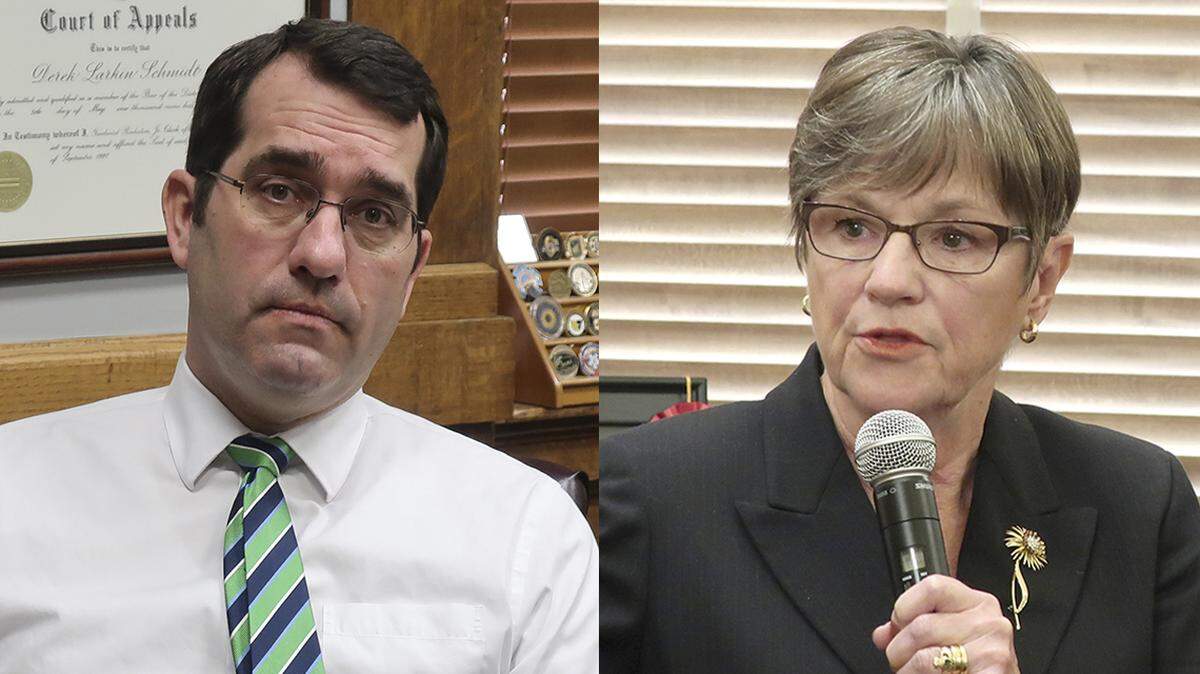
Kansas Democratic Gov. Laura Kelly has raised $1.5 million for her re-election campaign this year, more than double what her Republican opponent, Kansas Attorney General Derek Schmidt, raised during the same period.
Schmidt, whose only major primary opponent dropped out 10 months ago, took in $707,279.02 between Jan. 1 and July 21.
The Aug. 2 primary will formalize Kelly and Schmidt’s status as their party’s nominees, setting up an intense fall campaign season. Schmidt reported $1.5 million cash on hand, compared to $1.3 million for Kelly, giving Schmidt — at least for the moment—more money to spend in the months ahead.
Primary elections are often a tough period for gubernatorial campaigns because candidates must spend money defeating challengers from their own party, sometimes leaving the winner financially depleted heading into the general election. Schmidt avoided this, allowing him to conserve resources and blunt the impact of his soft fundraising compared to Kelly. He’s spent about $509,000 this year.
Kelly’s campaign frequently calls her “one of the most vulnerable Democrats” up for re-election this year, a decision that’s translated into donations. In turn, those donations have fueled more than $2.1 million in spending this year. The last incumbent governor to run successfully for re-election, Republican Sam Brownback, had spent roughly $870,000 at this point in 2014.
But money is not a guarantee of campaign victory. While Democrats and Republicans in modern Kansas history regularly trade the governor’s office, Republicans have structural advantages that help their candidates, such as a significant lead in registered voters and a large party apparatus that can aid nominees.
Kelly’s campaign promoted her fundraising numbers as evidence that Kansans support her achievements in school funding, securing new business investment and reducing taxes. Kelly’s campaign manager, Shelbi Dantic, said the fundraising record “proves that Kansans are looking forward to her continued, steady leadership.”
“Governor Kelly is the proven, middle-of-the-road leader who gets things done for Kansas,” Dantic said in a statement.
Schmidt campaign manager C.J. Grover said the campaign finance report reflects that Kansans are disappointed by Kelly and want Schmidt’s vision for the state. He recently called for eliminating taxes on retirement income.
“Despite Laura Kelly and her liberal dark money allies spending more than $5 million dollars on false and misleading advertising, the momentum is clearly on our side,” Grover said in a statement.
In Kansas, $15.4 million of media – including TV, radio and digital – have already been pre-booked for the general election, according to tracking firm AdImpact. The bulk of the spending is likely geared toward the governor’s race because it will be the state’s marquee race in the fall, though AdImpact didn’t provide that level of detail.
TV ads have already been running for months on both sides, however. Ads from the Kansas Values Institute have sought to link Schmidt to Brownback, while ads from Get Families Back to Work, which shares an address with the Republican Governors Association, slam Kelly for saying “bring it on” in regards to a recession; Kelly’s campaign says she was referring to state government being financially prepared.
An additional potential complication in the race is state Sen. Dennis Pyle, who is running a hard-right independent campaign for governor. Pyle was a Republican until earlier this year, but switched his party registration in order to run.
As an independent, Pyle needs 5,000 signatures to qualify for the ballot. He has until Aug. 1 to turn in the signatures.
Pyle, who announced his campaign on June 7, reported raising $35,950.