Republicans turned rural Missouri deep red. But will they send Eric Greitens to the Senate?
READ MORE
How this rural MO county became deeply Republican
Lincoln County shows how Missouri became a Republican stronghold and the question voters face if former Gov. Eric Greitens is the GOP nominee for U.S. Senate.
Expand All

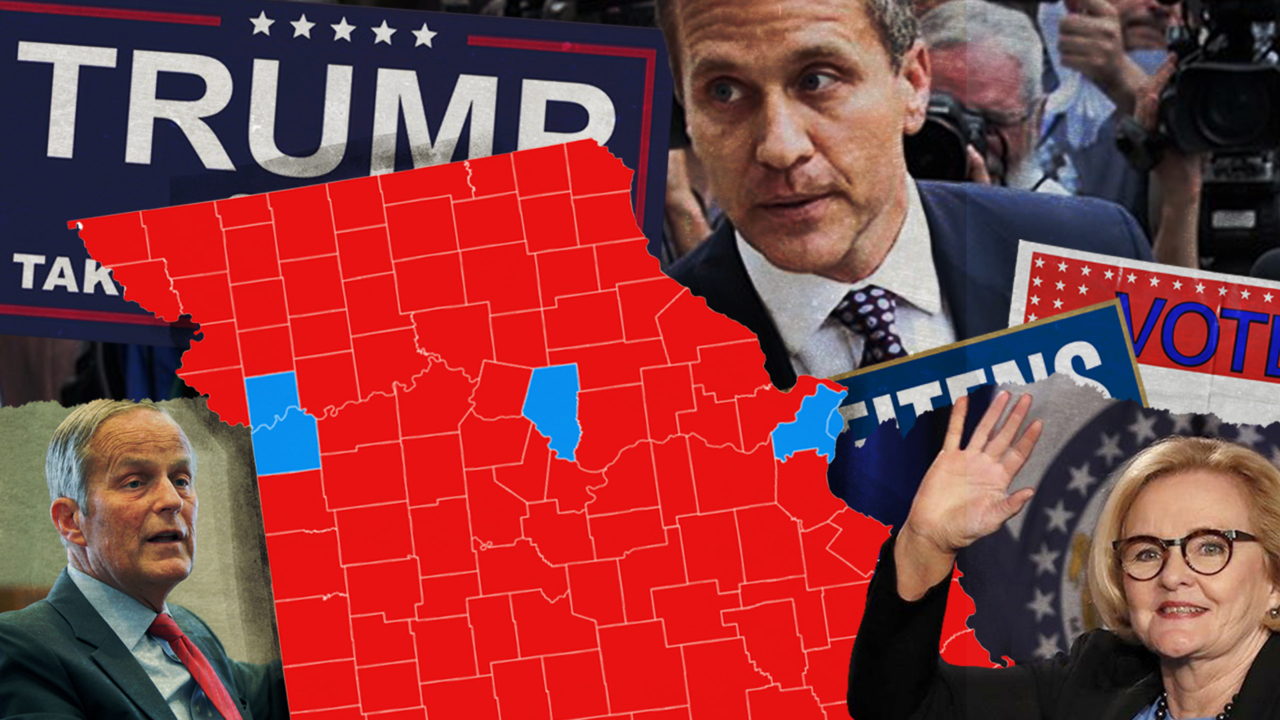
Lincoln County, like much of Missouri, is deep red now.
But it wasn’t always like that.
Kevin Bishop once ran for office as a Democrat. But by 2006, he was the county’s Republican assessor. He’s held the position ever since, even running unopposed the last time he was on the ballot.
“It’s just shifted so much now — it’s almost to the point now that if you’re a Democrat, that’s two strikes against you,” Bishop said recently from his office inside the red brick county courthouse in downtown Troy.
But has it shifted so much here and throughout the ruby red state that Democrats stand no chance of winning the U.S. Senate race this November, even against a Republican candidate whose record of scandal has some in his own party asking him to drop out?
The Senate election may serve as the biggest demonstration yet of Lincoln County’s — and Missouri’s — growing loyalty toward Republicans and disdain for the other party.
Or it could be its biggest test.
In 2012, Republican Todd Akin’s Senate campaign collapsed after he spoke about “legitimate rape” on a talk show, allowing Democrat Claire McCaskill to win re-election. Today, a much longer trail of controversy and alleged misconduct follows Eric Greitens, who has a shot at capturing the GOP nomination in August.
The former governor could end up proving just how red Missouri has become in the past 10 years. Republican control of Missouri is now so strong that even a race featuring a candidate widely considered toxic still might not result in the same thumping that Akin took.
The evolution of Lincoln County provides a vivid case study in why — and the potential outer limits of Republican loyalty that could still end up working against Greitens.
For decades, the county was one of just a handful of bellwether counties across the country that correctly voted for the winner of the presidency every four years. Democrats held a strong grip on local offices but voters were much more willing to cross party lines for federal office.
Now it’s hard to remember such a time.
The Star spent two days in Lincoln County speaking with residents, in addition to interviewing Missouri officials, political leaders, candidates and others intimately familiar with the state’s politics. What emerges is a portrait of a county — and a state — that appears to be nearing the endpoint of a long transition to Republicanism and is unsure just how far it goes.
The first crack in Democratic control in Lincoln County appeared in 2000, when voters elected a Republican county commissioner. It was the first time voters had elected a Republican county official since 1921, the St. Louis Post-Dispatch reported at the time.
Republicans worked steadily to chip away at Democratic control of other offices. In 2008, the county finally lost its bellwether status, ending a streak dating back to the 1960s. As the nation elected Barack Obama, its first Black president, the almost entirely white county went for Republican John McCain.
Then came Donald Trump, accelerating a move to the right that had already been in motion for years. In Lincoln County, Trump received 75% of the vote in 2020, up from 72% in 2016.
“I think Trump attracted more people in middle America because he spoke to them in a sense that ‘hey, this guy cares about us, he’s not afraid to speak his mind,’” Bishop said.
Statewide, Republicans have now won two consecutive races for governor, the only time that’s happened in at least 30 years. Democrats hold just one statewide office — auditor — and it’s possible they will lose that race in November.
The ongoing Senate race has produced a large field of GOP candidates, any one of whom would almost certainly move the seat in a harder-edged direction than retiring Sen. Roy Blunt.
Greitens was himself a Democrat until becoming a Republican in 2015. The former Navy Seal-turned-governor — who in 2018 resigned amid allegations that he sexually assaulted and blackmailed his former hairdresser — is unlike any other candidate in the race. He faces new allegations of domestic violence made by his ex-wife and is by far the most divisive candidate in the field.
Bishop said the recent allegations against Greitens had left a “bad taste.”
Still, “the true Trumpers really like him because he had the same kind of mindset,” he said.
The kind of Democrats that used to vote in this rural eastern Missouri county are largely gone. They went by a few names: Truman Democrats, New Deal Democrats, Blue Dogs. Whatever the label, today most of them are either Republican or dead.
While characters and circumstances may change, a version of Lincoln County’s story has played out across much of Missouri, with devastating long-term consequences for Democrats.
Areas where Democrats were in control, or at least competitive, have given way to solid Republican control. The GOP takeover in Lincoln County over the past two decades reflects Missouri’s larger rightward march, as a state once known as a political weathervane now firmly points in one direction.
To win, ‘you’ve got to be Republican’
Lincoln County is the first truly rural area once you leave St. Louis heading northwest. The largest city and county seat is Troy, with a population of about 13,000. Cuivre State Park, filled with camping sites and hiking trails, sits in the middle of the county.
The county is 95% white, according to the 2020 Census, a figure largely unchanged since 2000. Residents said the area is heavily Catholic.
“If you’re going to run for office, you’ve got to graduate from the local high school, maybe be Roman Catholic and maybe have a street named after your family,” Gary Grunick, president of the Lincoln County Republican Club, said.
“But now you’ve got to be Republican also or you’re probably not going to be elected.”
It’s the kind of area Greitens — or any Republican for that matter — needs to win in a general election, and preferably by a big margin.
Janet Maloney, president of the Lincoln County Democratic Club, suggested Greitens would at least win the Republican primary locally, if for no other reason than name recognition.
“People know who he is,” Maloney said.
It’s possible Greitens won’t win the GOP nomination, but it’s a crowded field. Thirty percent of the vote could easily be more than enough to win. Greitens won the 2016 Republican primary for governor with just 34.6% of the vote facing three other major candidates. This time he’s facing five.
What polling is publicly available shows a tight general election race if Greitens is the nominee. It’s not yet entirely clear how the new allegations have affected Greitens’ support and what impact the overturning of Roe v. Wade would have on the race, if it happens.
Regardless, if Greitens is the nominee, Republicans across the state would have a pivotal decision to make.
Many Republicans see Greitens as a uniquely toxic candidate. Not only do the allegations of sexual assault and domestic violence offend a number of voters, but he has also faced other scandals, from his office’s use of auto-destructing messages to campaign finance violations.
“I know a lot of friends who are very conservative, high propensity voters, who would not vote for him,” said James Harris, a Jefferson City-based Republican consultant critical of Greitens.
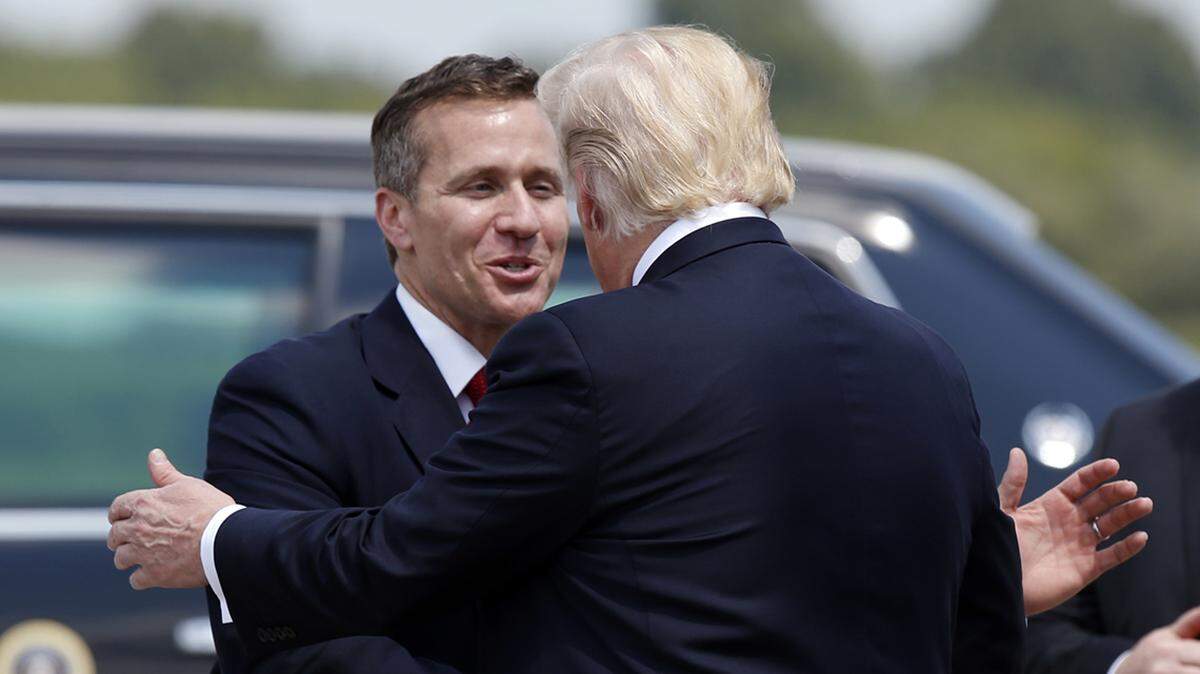
Greitens campaign manager Dylan Johnson dismissed the criticisms.
“These are the same establishment RINOs who believe that being America First is a bad thing. Governor Greitens has the grassroots support from everyday Missourians who have seen what weak leadership looks like. They want an America First U.S. Senator who will go to Washington to fight for conservative principles, not a feckless wannabe empty suit who will cave to President Trump’s enemies,” Johnson said in a statement.
“The only damage being done to the Republican Party is weak establishment RINOs who are hostile to President Trump and the movement he has built.”
The last Missouri Republican to lose a Senate general election, Akin, was unable to clear even 40% of the vote in 2012. His support collapsed after he told a talk show: “If it’s a legitimate rape, the female body has ways to try to shut that whole thing down.”
A decade later, the idea that the remark toppled a GOP Senate campaign is almost quaint. Trump won after the “Access Hollywood” tape in which he bragged about sexually assaulting women.
But other high-profile races have still been lost more recently after allegations of misconduct. In 2017, Republican Roy Moore lost a special election in Alabama to a Democrat after multiple women accused him of sexual assault.
Few expect Lincoln County to go blue in November, even if Greitens is the nominee. But there’s a difference between earning 61% of the vote in the county, like Republican Josh Hawley did in 2018, and something closer to 48%, which Akin received in 2012.
That kind of narrower margin — repeated in rural counties across the state — could potentially be decisive for the Democrat, who appears likely to be either Lucas Kunce, Trudy Busch Valentine or Spencer Toder. Big wins in Missouri’s urban areas, combined with victories in suburban areas and narrow losses in some rural areas would go a long way to helping a Democrat win the race.
In a conversation before the allegations of domestic violence against Greitens, Grunick said Republicans in the area tend to be “80-20” on candidates: approving of 80% and not liking 20%.
Greitens — and his name calling — falls into Grunick’s 20%.
“All of his opponents are ‘RINO Republican establishment.’ I mean, man, that doesn’t endear him to me,” Grunick said.
Trump has yet to endorse in the race and it’s not clear if he will. Donald Trump Jr. is supporting Greitens, but Trump himself has made positive comments about Rep. Billy Long that fall just short of backing him.
New York Times reporters Jonathan Martin and Alex Burns write in their new book, “This Will Not Pass,” that the former president opposes Greitens not because of his misdeeds, but because he resigned.
Carol Boyer, a Lincoln County resident and member of the Missouri Republican State Committee, shared a similar thought.
She said she didn’t support Greitens in the 2016 gubernatorial primary, but got behind him after he won. Something doesn’t sit right with her this time around, however.
“He resigned. He didn’t stand and fight,” Boyer said. “Trump fought. They did everything in their power to take Trump out. Trump’s a fighter and he’s going to fight for the people.”
Race ‘still plays a role’
Almost to a person, Republicans in Lincoln County tell a nearly identical story about the area’s political transformation, describing how longtime Democrats switched sides and Republican newcomers spurred a political makeover.
“They felt like the Democratic Party left them,” said Michael Jacobs, a public defender in Troy and a Republican candidate for associate circuit judge.
In the story, Democrats began realizing they weren’t all that different from Republicans.
“For the most part, people get along in terms of we all believe in God, people go to church on Sundays,” Jacobs said, adding “they get along on the social issues, for the most part.”
Then Trump came along, acting as an accelerant and proving exceptionally popular in the county.
The Democrats that used to populate Lincoln County supported labor unions (GM has long operated a plant just down the road in Wentzville), were socially conservative and often religious.
Party loyalty also ran deep in families. The result was strong Democratic control over local offices but a greater willingness to cross party lines in federal races, helping cement the county’s bellwether status.
Troy’s downtown, with its boutique shops and red brick courthouse, remains a throwback to that earlier era. Drive closer to the edge of town, however, and the evidence of growth becomes apparent in new and new-ish housing developments that would fit easily into any Kansas City or St. Louis suburb.
Talk to residents and you’ll quickly encounter someone who moved from St. Charles or St. Louis. Often, they sought some kind of refuge — whether from the bustle of city life or high taxes.
Grunick, Troy’s municipal court judge, is a former Judge Advocate prosecutor and defense attorney in the Air Force who retired from the military in 1994. He had been living in St. Charles before he moved to Lincoln County about 15 years ago, but owned property in Lincoln beforehand.
“They’re coming in from other places and a lot of them are conservative young people,” Grunick said of newcomers today.
Others cite a different explanation. One Democrat, who refused to be quoted because he feared retribution, attributed the area’s growth in part to white flight from the St. Louis metro area.
With few exceptions, local residents generally don’t point to race to explain the area’s political transformation. Still, even in an almost totally white community, race regularly crept into discussions.
Dozens turned out for a talk on the dangers of critical race theory during the April meeting of the Lincoln County Republican Club at Troy Holiness Church, for instance.
Lincoln County also falls into the St. Louis media market, so coverage of Democratic Rep. Cori Bush is significant, though the area is represented by Republican Rep. Blaine Luetkemeyer. Bush, a Black woman and one of the most left-wing members of Congress, continues to use the phrase “defund the police,” and has championed eviction moratoriums, direct pandemic aid and other policies popular with liberals.
Boyer called Bush a disgrace to the state and said voters need to get rid of her.
“She doesn’t represent anything. She represents St. Louis, and I’ll put it bluntly, the Blacks, because that’s where she came from, Black Lives Matter,” Boyer said during an interview at her home outside Troy, where a Trump flag flies near the road.
Boyer emphasized that she only judges people by the content of their character, referring to Martin Luther King Jr.’s “I Have a Dream” speech.
Lincoln County is more white than Missouri as a whole, but both have experienced relatively little racial change over the past two decades. Missouri is about 83% white now, compared to 85% in 2000.
“One contributing factor has been racism and that still plays a role,” Kenneth Warren, a political science professor at Saint Louis University, said as he described Missouri’s rightward drift.
Missouri’s stable demographics and other elements had formed a “perfect storm” for Republicans to make gains, he said. And parts of the national Democratic agenda haven’t been received well in much of Missouri, he said.
Can Democrats come back?
Turning Lincoln County and other deep red areas of Missouri reliably blue again, or at least purple, would take years, maybe decades.
For the past four to five years, the Republican Club has tried to have a presence at every possible local event, Grunick said. It sells Trump stuff to raise money, once selling $1,700 of Trump merchandise in under three hours at a Christmas festival, he said, underscoring the former president’s popularity.
For the most part, Republicans in Lincoln County either ignored or downplayed the ways the Republican Party, especially under Trump, had moved toward the political extreme or broken norms. Criticism, if any, was muted.
“I wish he would have shut up on Twitter,” Bishop said.
Robynn Kuhlmann, a political science professor at the University of Central Missouri, said changes in Missouri in part reflected decades-long national efforts to integrate Christian values into the Republican Party in the wake of the Roe v. Wade decision in 1973 legalizing abortion nationwide.
Beginning in the ’80s, the party made itself much more attractive to evangelicals, Kuhlmann said. “You also have the Republican Party itself finally, after it made gains in the 1990s, doing a really good job of being organized at the local level,” she said.
Over the years, Boyer turned her focus time and again to educating people on the Republican platform, telling them that as a Christian and a conservative, there was no other party she could belong to.
“The conservative country people started realizing, ‘Whoa, what in the world are those Democrats doing?’” Boyer said.
Regaining ground will take multiple election cycles, said state Rep. Crystal Quade, the minority leader in the Missouri House.
A Democrat from Springfield, located in the Republican powerhouse of southwest Missouri, Quade acknowledged that in rural Missouri, it’s not about Democrats winning — not yet, at least — but about having candidates who run legitimate campaigns, backed by party resources.
Rural Missourians do support Democratic values, she said, pointing to statewide passage of Medicaid expansion, the repeal of Right to Work and other progressive ballot measures that wouldn’t have been successful without at least some degree of rural support.
“It’s about having those conversations on the ground, knocking on doors, talking to voters, and having these regular candidates talk to them about those issues that matter to their communities,” Quade said.
In Lincoln County, Fletcher King, chairman of the county’s Democratic Central Committee, knows they face an uphill fight.
Locally, Republicans have a substantial financial advantage over Democrats. And he doesn’t dispute that Democrats have been hurt locally by the perception that the party nationally had moved to the left.
“We’re doing the best we can,” he said. “We’re trying to turn the situation around.”
The Star’s Daniel Desrochers and Kacen Bayless contributed reporting
This story was originally published May 8, 2022 at 5:00 AM.