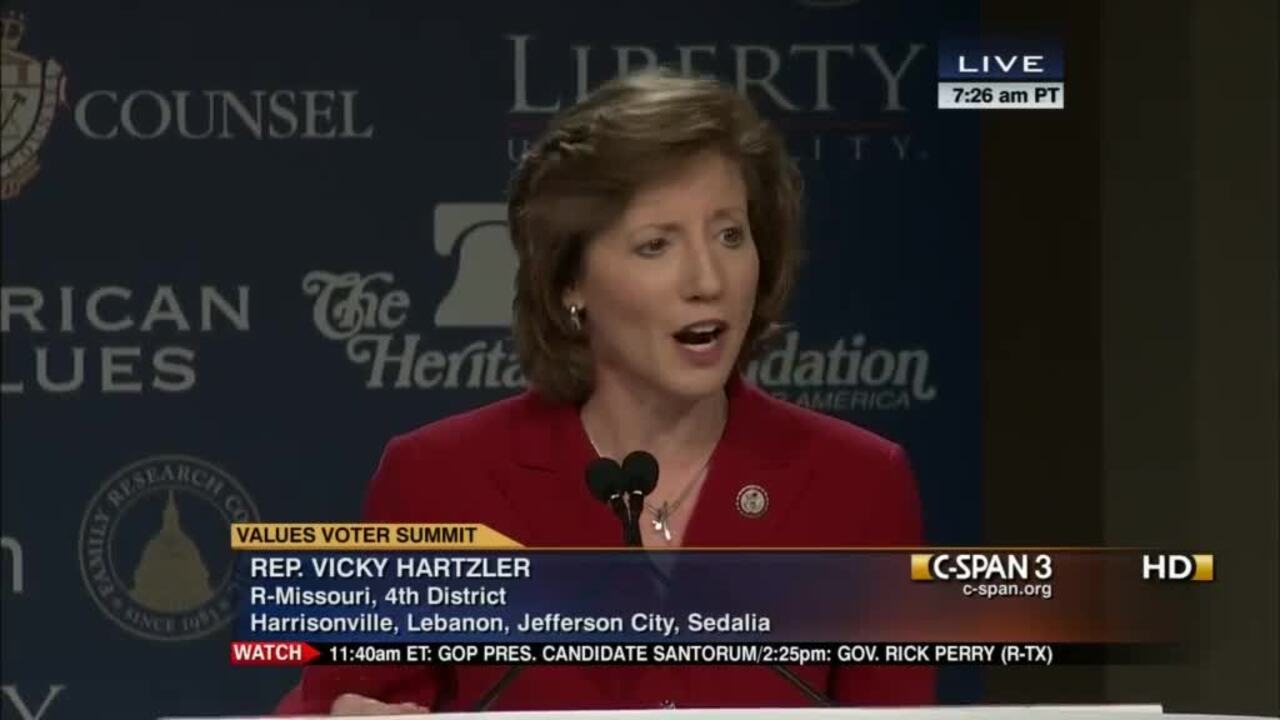
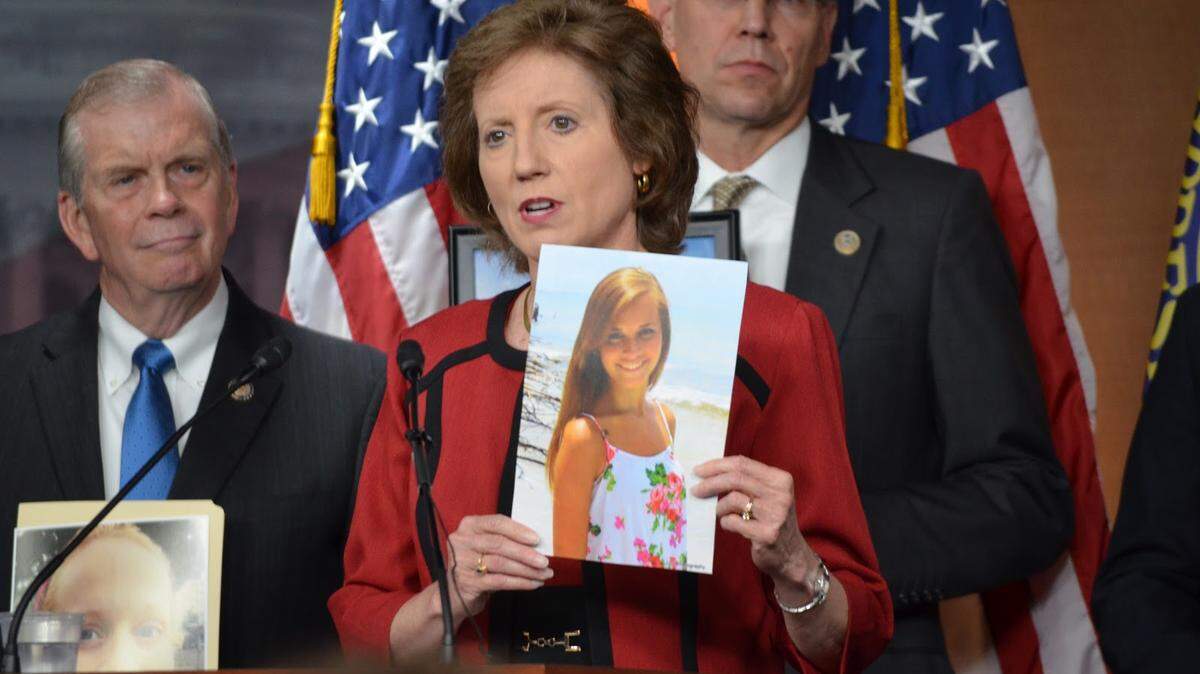
Running God’s way: Can Vicky Hartzler’s ‘conservative biblical values’ win a Senate seat?
READ MORE
How Vicky Hartzler’s faith guides her U.S. Senate campaign
Congresswoman Vicky Hartzler is running for U.S. Senate in Missouri and has built her political career on her conservative Christian values. Some say it has harmed LGBTQ people.
Expand All
Vicky Hartzler’s story starts with a prayer.
It’s 1969 and Vicky Jo Zellmer is 9-years-old, a little girl in Archie, Missouri. One day while she’s praying, asking God for a bike and good grades and thanking him for loving her, a question enters her head: “How come you’ve never told me you love me?”
She feels bad and she shuffles down the hall to her father, who’s sitting in an armchair. She explains what happened. He tells her she has sinned because she’s been trying to run her own life and tell God what to do. He asks her if she wants God to be the Lord of her life and to do things His way.
She does.
There’s another prayer at the beginning of another Vicky Hartzler story. This time it’s 1994 and she’s been asked to run for the Missouri House of Representatives. She’s not sure. She has a life, teaching high school home economics and coaching track in the Belton school district. Her husband, Lowell, who she met at the University of Missouri, farms and runs an agriculture supply store. And so she prays. One Sunday, as she’s singing at church, lyrics appear on an overhead screen: “...Draw me unto you and let us run together.” She runs and she wins and she hasn’t lost an election since.
Over more than 11 years in the U.S. House of Representatives and six before that in the Missouri House, Hartzler has always attempted to run God’s way.
Supporters say faith is her political north star, a guide for the decisions politicians are forced to confront in an institution often speckled with immorality. Opponents say her frequent references to her faith are in the service of a political agenda, one that has specifically brought harm to the LGBTQ community.
Hartzler is not so much at the forefront of the modern religious right as she is a loyal Christian soldier in their larger battle for the soul of America. She’s ridden the wave of the movement, gaining power as the Republican Party has grown more heavily dependent on its conservative Christian base.
Now, she’s picking up momentum in the Republican primary for U.S. Senate in Missouri.
Hartzler was running in a distant third before she was endorsed by U.S. Sen. Josh Hawley, before she launched a statewide ad attacking a transgender swimmer at the University of Pennsylvania, before former Gov. Eric Greitens was accused of physically and emotionally abusing his family.
She’s done the state’s Lincoln Day circuit with her opponents, U.S. Rep. Billy Long, St. Louis Attorney Mark McCloskey and, sometimes, Attorney General Eric Schmitt. Greitens is seldom seen.
Her campaign’s internal polling has her one percentage point ahead of Greitens, matching an independent survey by the Trafalgar Group last month. An internal poll by Schmitt’s political action committee has her in third.
Hartzler says she views politics as a ministry. Quoting Romans 13, she’s urged other evangelical Christians to ask God if he’s calling them into politics because she sees it as a way to serve both Him and others.
“I really enjoy being able to help people, and be a voice also just for our conservative biblical values that our country was founded on,” Hartzler said. “So I, as a Christian, I read my Bible and pray every day and ask for guidance and wisdom and a heart for the people that God has enabled me to serve.”
Taking the country back
Prayers often kick off political occasions. You hear them at party fundraisers, at campaign rallies, at city hall meetings, county commission meetings, in statehouses and in Congress. The Boone County Lincoln Day dinner last week started the same way.
“Father, we pray for the right candidates in the Congress of the United States of America, in the state and in every area, that God, that there will be people that you raise up to do what’s right in the sight of God, that the fear of God will come again in our nation and the fear of God will be upon every candidate, and the ones that you have ordained from the foundation of the world, to take our Senate, to take our House of Representatives back.... and once again, God will be exalted in our nation, and that people will know who our God is, what we stand in, and what we stand for, for righteousness will prevail.”
The prayer taps into what seems to be generally agreed upon within the base of the GOP, where red MAGA hats and Let’s Go Brandon bumper stickers prevail — that the country has gone off the rails and Republican candidates will set it back on track. In other words, they’ll take our country back.
At her campaign launch last summer at the Frontier Justice gun store in Lee’s Summit, Hartzler, too, said she wanted to take our country back. She said the nation is in a “winner-take-all contest for the heart and soul and the future of America,” echoing Pat Buchanan’s watershed speech at the 1992 Republican National Convention, one considered so extreme that some allies of then-President George H.W. Bush felt it cost him re-election.
What Hartzler would like to take the country back to is a little less clear.
Pressed on what her ideal of America would look like, she gave a version of her campaign pitch: an America where the government works for the people and not against them, where they have freedom to live their lives without the government telling them what to do, freedom to live their faith openly without judgment, a strong national defense and a strong economy based on free enterprise.
But it didn’t explain what she means by wanting to take the country back. When pushed, she brought up the Pilgrims, saying they came to America to live out their faith openly and where the Bible was the standard for how people lived, where people treated their neighbors as they would like to be treated.
“And we need to go back to that,” Hartzler said. “And I think faith is going to be is key to that, that people once again recognize Jesus Christ is the basis for freedom and for love and for our country.”
Hartzler does not identify with the Christian nationalist movement, which can be described as a fusion of conservative Christianity with American civic life, according to Andrew Whitehead, an expert in Christian nationalism at Indiana University-Purdue University in Indianapolis.
But some of her language strikes notes directly from the heart of the movement.
The history of white Christian nationalism in America can be traced back to the Pilgrims. One of the earliest written examples of American Christian nationalism comes from the grandson of two men who helped establish the Massachusetts Colony — Cotton Mather, who was later heavily involved with the Salem Witch Trials.
His 1702 book, Magnalia Christi America, contained elements of the three biblical stories Yale sociology professor Philip Gorski says form the foundation of a Christian nationalist identity: that America is the Promised Land and its our right and duty to seize the land God granted to us; the End Times story, the book of Revelation, that the country is in a battle of good versus evil; and the racial curse story, that the offspring of Ham are condemned to a life of bondage.
Religion and politics have always been closely related in America. But the Religious Right and Moral Majority — the political movements we associate with the Christian right as we know it today — formed in reaction to the Civil Rights and gender and sexuality revolutions of the 1960s.
As the geographic centers of the political parties shifted over time — the Northeast became more Democratic, the South more Republican — the GOP became more reliant on the white Evangelical Christian vote.
“Right around 1994 with Newt Gingrich’s Contract with America and with the Republican takeover Congress, a lot of southern districts switched from Democrat to Republican,” said Daniel Williams, a history professor at the University of West Georgia. “And when they did, so most of the new Republicans that were coming in, even if they weren’t evangelicals themselves, tended to be elected with strong evangelical support.”
Hartzler launched her first campaign for office in 1994, running as a Republican in Cass County. She won re-election in 1996 and 1998 and tended to focus on issues like agriculture and education in the statehouse. She rarely made much news, but pushed for things like lower taxes, increased road safety and preventing crime.
She didn’t really wade into the culture wars until 2004, when Republicans across the country were mobilizing against same-sex marriage. Hartzler took a role as spokeswoman for the state constitutional amendment to define marriage as between a man and a woman. She campaigned widely, debating gay rights activists with a highlighted bible.
As the Republican Party’s base became home for conservative evangelical voters, Hartzler’s political career thrived. She was elected to Congress in 2010 as part of the Tea Party wave, displacing Democratic U.S. Rep. Ike Skelton, a 30-year incumbent who chaired the powerful House Armed Services committee.
But as Hartzler has risen through the ranks of the party, her movement has lost ground in the culture war Buchanan declared in 1992.
Americans are less likely to go to church or consider religion very important in their lives than they were in 2015. There’s widespread public support for gay rights, including same-sex marriage. While legal battles over abortion have started turning in conservatives’ favor after a sustained push to reshape the federal judiciary, public opinion hasn’t moved much since the U.S. Supreme Court’s landmark 1973 decision that ruled there is a constitutional right to an abortion.
“I think the Christian right has been frustrated at their inability, even with political victories, to really win lasting culture war victories,” Williams said. “And as a result, that image of battle works just as easily when there’s a Republican in the White House, as it does if there’s a Democrat.”
God is love?
Hartzler’s legislation has long been a reflection of her Christianity. At campaign stops, she talks about filing an amicus brief in a case involving Trinity Lutheran Church, where the U.S. Supreme Court ruled that Missouri had violated the first amendment by not providing a grant to the church so it could resurface the playground at its affiliated school. She speaks most years at the March for Life in Washington D.C. and believes abortion should only be allowed if the life of the mother is at risk.
She sees her role in Congress to bring attention to ideas like faith-based rehabilitation for addiction, or legislation that would allow active members of the military who are under 21 to rent a hotel room.
But she’s gained a reputation for something else — her anti-LGBTQ stances.
“She appeals to darkness in people, disguised as her faith,” said Doug Gray, who was the spokesman for the campaign to defeat the Missouri constitutional amendment on marriage. “And she has built her professional political career on the backs, and frankly the lives, of LGBTQ people.”
In Congress, she opposed the Department of Defense’s decision to eliminate the Don’t Ask, Don’t Tell policy that allowed LGBTQ people to serve in the military as long as they didn’t mention their sexual orientation or gender identity. She pushed back on the Obama administration’s decision to stop defending the Defense of Marriage Act, which the U.S. Supreme Court struck down in 2013. She has called the Department of Defense’s decision to pay for gender reassignment surgery too costly and harmful to troop readiness.
Over time, she has fallen out of line with public opinion on those issues. In 2011, when Hartzler took office, 48% of Americans believed that same-sex marriage should be allowed. In 2021, that increased to 70%, according to Gallup. A majority of Americans support allowing LGBTQ troops to serve, although support for transgender service members dropped by five percentage points between 2019 and 2021, according to polling by Gallup.
Hartzler does not see herself as anti-LGBTQ rights.
“It’s not I’m anti anything,” she said. “It’s what I’m for, which is the biblical view of marriage, and the biblical view of male and female. But I acknowledge that this is a very personal issue, very difficult issue that people are struggling with. And I don’t discount that at all. So I think it’s something that needs to be handled with sensitivity, and compassion.”
Hartzler handled the issue with a television ad that attacked Lia Thomas, a swimmer at the University of Pennsylvania. It showed a photo of Thomas and her name before she transitioned, a practice known as “deadnaming,” and said she’d fight to “protect women’s sports.” The spokeswoman for the National LGBTQ Task Force, called it “as transphobic as you can possibly get.”
Re-posting the ad to Twitter got Hartzler’s campaign account suspended. To rejoin, her campaign would have to voluntarily take down the ad. They have refused and have remained barred from posting on the site.
Penny Nance, the president and CEO of the Concerned Women of America, said Hartzler was an early champion of the issue, speaking out against transgender athletes before it gained energy in conservative circles.
“She took that position before other people realized how important it was,” Nance said.
Many Americans, and Republicans in particular, appear wary of transgender people, who make up around 0.6% of the adults, according to a 2016 study by the Williams Institute.
Only 34% of all Americans and just 10% of Republicans believe transgender athletes should be allowed to play on teams that match their gender identity.
When it comes to broader acceptance of transgender people, 32% of all Americans and 54% of Republicans said more acceptance was very or somewhat bad, according to a February poll by Pew Research Center.
When she brings up the issue at campaign events, it gets a cheer. As conservatives pass laws at the state level that prevent transgender kids from playing sports that match their gender identity, or try to implement policies that send child services after parents who allow their child to transition, or ban books from school libraries that mention sexual orientation or gender identity, or pass laws that could put a chilling affect on teachers mentioning their same-sex partner in a classroom, the conversation moves to talk radio and cable television where it gets amplified even farther.
Gray said he gets so mad he chokes up when he thinks about the ad, because of how it makes transgender people who may just be watching television feel when they come across it.
“To build anything on the backs of, currently, trans individuals, and knowing what their families go through every day, is just probably the lowest of the low,” Gray said.
The percentage of high school teenagers who report feeling sad or hopeless has increased significantly since 2015. It’s up for all groups — women and men, white and Black — but even more common among LGBTQ teens, three quarters of whom reported feeling persistently sad or hopeless in 2021. LGBTQ youth are more than four times likely than other teens to attempt suicide, according to the Trevor Project.
When asked how she balances expressing her views on the issue and the harm that it causes people, Hartzler didn’t back down.
“You have to address what the issue is at the moment,” Hartzler said. “And right now we have individuals who have been interjecting themselves into female sports and demanded to compete on women’s teams. And the women are being silenced.”
Running God’s Way
At one point in an interview with the Kansas City Star after she spoke at a Concerned Women for America conference, Hartzler paused to ask if this entire article would focus on her faith.
She wanted to point out that her campaign is about more than that. That the biggest contrast she thought she had with the other candidates was her record on foreign policy and her service on the House Armed Services Committee. She felt that she has been tougher on China than everyone in the field — to the point where she was sanctioned by the Chinese Communist Party. It has won her admirers.
“I think, as a woman, it is really important that you stand firm and that you’re willing to stand up for your values, even when it’s not popular, “ Nance said. “But she does it in a way that’s dignified. She does it in a way in which she brings people to her side.”
But to separate Hartzler from her faith is impossible.
In her 2007 book, “Running God’s Way,” she calls Absalom the first politician and uses his effort to siphon power from King David as a textbook example of how to operate a political campaign (she does recognize that Absalom was a bad guy and urges people to use the methods of Absalom while possessing the heart of David).
To drive through rural Missouri is to see God. He’s on the billboards that line the highway. He’s in the marquee at flower shops and auction sites. He’s in the bumper stickers on the car in front of you as you wind down a back road. He’s in the churches that dot the landscape and the crosses in the cemeteries.
“The thing that I really appreciate about Vicky is she has a true north in terms of principles,” said Philip Dooley, a pastor who has volunteered for Hartzler’s campaigns. “And her faith guides those principles. And we see that faith played out every day in her decisions and in the way she does her job in Congress.”
Hartzler mentions her faith at campaign events and — she denies this — told a Lincoln Day dinner in Randolph County that she was the candidate closest to God.
That was according to St. Louis attorney Mark McCloskey, who was also there, and who texted Rep. Billy Long about it. That set Long off, because, he said, how could Hartzler know what was in the hearts of other candidates? How could she know that when his family found out his child had cancer they prayed that it was Hodgkin lymphoma and not Non-Hodgkin lymphoma because the former is easier to treat. When the doctor called to say it was Non-Hodgkin, they were crushed.
But they kept praying and got another call an hour later that said the earlier diagnosis was a mistake. It was actually Hodgkin lymphoma and Long says tell that to anyone who doesn’t believe in the power of prayer.
“Some people wear their religion on their sleeve and others don’t,” he said.
This story was originally published April 17, 2022 at 5:00 AM.