Kansas poised to approve state board of education maps splitting KCK into three districts
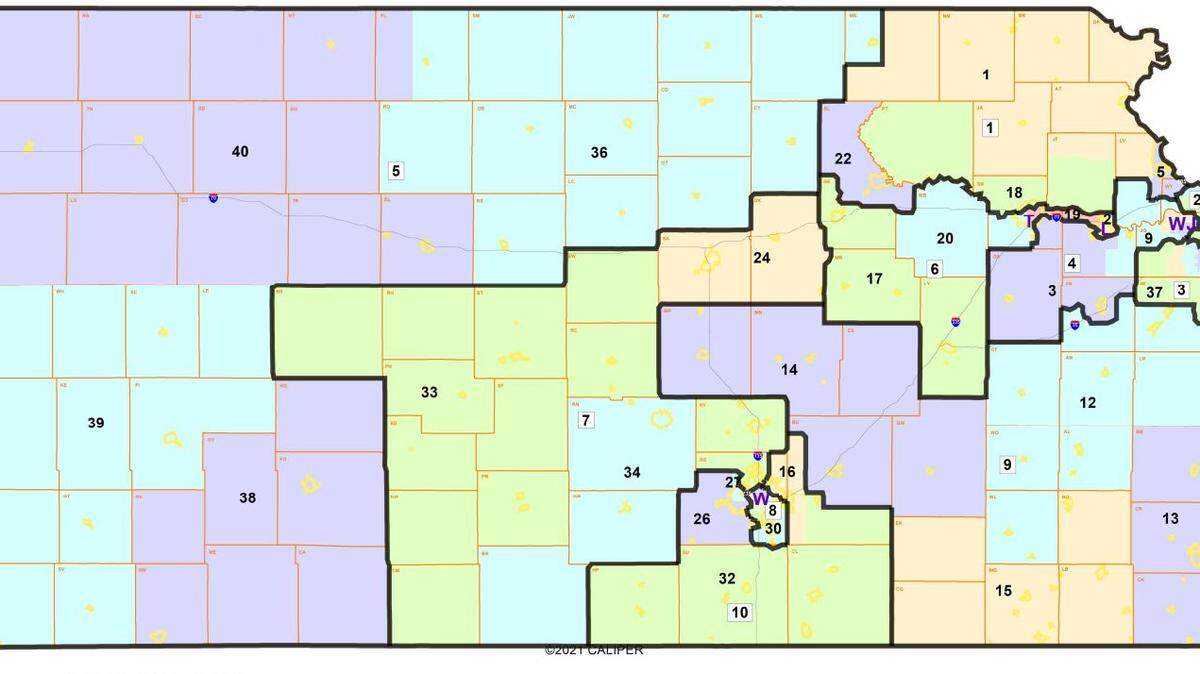
The Kansas Legislature is poised to approve a map aimed in part at bringing more conservative voices to the Kansas State Board of Education, splitting Wyandotte County into three pieces in the process.
The Kansas Senate voted 32 to 8 Tuesday to approve new district lines for the panel, over board member complaints that the map was a “gerrymander” that dilutes representation for students in the Kansas City, Kansas, school district.
The new map represents a second attempted partition of the state’s most diverse county, following the split approved by Republican lawmakers in the congressional redistricting process. That measure, which would separate the county along Interstate 70 between two districts, is the subject of multiple lawsuits in Wyandotte County district court. The current state board map splits Wyandotte into two districts, the proposal breaks it into three, branching two into rural parts of Kansas.
Senate President Ty Masterson called the existing education board “monolithic” in thought and said he hoped a new map would draw out a more ideologically diverse slate of candidates.
The State Board of Education is comprised of ten members elected for four-year terms. The board hires the state’s education commissioner and sets broad standards for K-12 schools while local school boards are responsible for curriculum.
The Legislature has clashed with the State Board of Education in recent years as it has become more involved in curriculum issues that the board views as outside its lane. A more conservative board would potentially be more friendly to the GOP-controlled Legislature.
The new boundaries could also change the board’s direction amid a state-and-nationwide wave of conservative concern over COVID-19 measures and classroom instruction related to race. The current board voted unanimously in July to issue a statement that Critical Race Theory was not in Kansas’ educational standards and was misunderstood by those seeking to ban it.
“I’d love to have more conservatives run because you’re starting to see, particularly after COVID, how important education is and how important that board is in the process,” Masterson said.
Senate leadership said they plan to add the map to a bill that includes new House and Senate legislative boundaries. All three maps are redrawn every 10 years to account for changes in population recorded by the Census. State Board of Education maps are drawn by combining Senate districts into 10 board districts. Once passed, the maps would need Gov. Laura Kelly’s signature and court approval.
The proposed Board of Education map, titled Apple 7, places four of the 10 districts in the Kansas City area with three splitting up Wyandotte County and two stretching into more rural areas to the West.
In a short floor debate Tuesday Sen. Pat Pettey, a Wyandotte County Democrat, expressed her disappointment at the decision.
“When I look at my county, the smallest county in the state, being divided between three districts for the State Board of Education it raises a lot of concern,” Pettey said.
The changes, Board Chairman Jim Porter said, could harm representation for students in the Kansas City, Kansas, school district.
“There is a significant difference between Kansas City and Blue Valley,” Porter said.
“School districts that have low poverty rates have unique challenges, those that have extremely high poverty rates have unique challenges.”
It will be difficult, Porter said, for a single board member to represent the interests of such varied districts.
Masterson, however, argued that it would be impossible not to draw together school districts with different interests because of how large the districts are. He pointed to testimony on Congressional maps about the similarities between Wyandotte and Johnson Counties as justification.
“Was the irony not lost on you guys too, yesterday, how they said that KCK and Blue Valley are very different?” he said.
The lines are drawn in a way that leaves four current members living in the same district as another incumbent. Two of those incumbents are Democrats.
“The senate president said he wanted to play politics with the 500,000 school kids from Kansas,” Porter said.
The new map, Board members said, risks politicizing the panel and returning it to days when the state became a “national laughing stock” because of the board’s changing position on the teaching of evolution in schools.
“Kansas has been the laughing stock of the United States before and I could certainly see that era return,” said Melanie Haas, a board member who represents parts of Johnson and Wyandotte Counties. Her new district is combined with another current member.
This time, however, the elections to the board would be focused on diversity and equity initiatives and inclusion for the LGBTQ community, said Janet Waugh, another Kansas City area board member.
Though there is no evidence Critical Race Theory is taught in Kansas schools it has become a catchall term for race and equity content amid a wave of parental concern about curriculum. The Senate has passed a “parents bill of rights” that would give Kansas parents the ability to review and object to material in public classrooms.
“The first year I served we went through evolution and that one really was very partisan and I’d hate to see us go back there,” Waugh said. “Not that it’ll be evolution it’ll probably be CRT and other issues that.”