Will Johnson County growth harm Kansas GOP supermajority? New maps retain close races
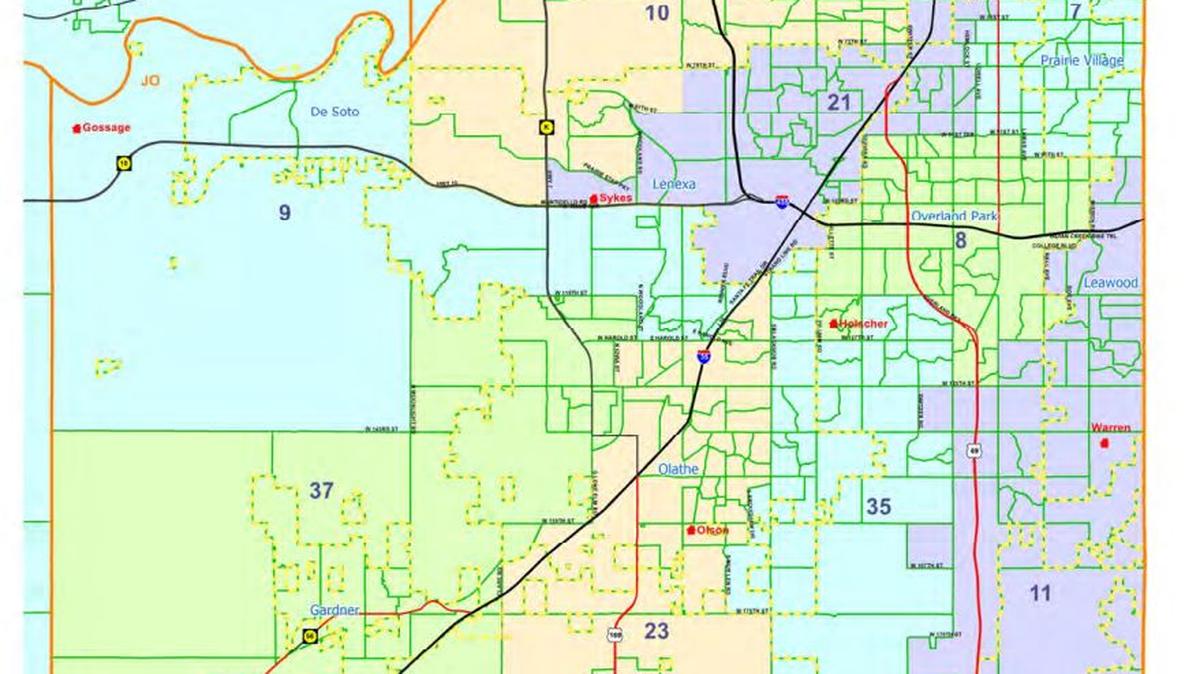
A Kansas Senate committee advanced redrawn district maps Tuesday that appear to favor most incumbents.
But in Johnson County, tight margins indicate Republicans’ grasp may grow more tenuous if the county continues to shift blue, political observers say.
Drawn by leadership of the GOP supermajority, the maps appeared to retain the existing political breakdown in the Senate. But even as Republican-held districts in Johnson County were redrawn to the south and west to pick up more GOP voters, the county — among the fastest growing in the state — remains a battleground.
The breakdowns are emblematic of Republicans’ growing problem in Johnson County, which shifted politically to the left following former President Donald Trump’s 2016 rise.
“We definitely see where the heart of Johnson County is trending bluer, and I think where (Republicans) drew it is trying to look at how do we keep this ‘trending more purple’ at bay for as long as we can,” Senate Minority Leader Dinah Sykes, a Lenexa Democrat, said. “I think they know it’s inevitable, but how can we keep our stronghold and supermajority as long as we can?”
The map comes as part of the once-a-decade redistricting process, where the state Legislature redraws district lines based on changes in population recorded in the census.
House Republicans have also unveiled their map, which adds three new Johnson County House districts. The map’s consequences are still unclear, though, and top lawmakers say changes are still possible. Lines were adjusted to draw House Speaker Ron Ryckman in a district alongside second-term Republican Megan Lynn.
An analysis from the Campaign Legal Center predicted that the new Senate map would keep the current balance of 29 Republican seats and 11 Democratic seats. Six of those seats would be swing districts, with four leaning Republican and two leaning Democrat.
Four of those swing districts are in Johnson County, even as Senate Republicans said they aimed to make districts less competitive.
“There were a lot of red-leaning districts … that were strengthened, and when you do that you also strengthen a lot of blue districts,” Senate Vice President Rick Wilborn, a McPherson Republican, said.
In southern and eastern Johnson County, margins, including in a newly drawn district, remained tight even as reliably Democratic seats grabbed more Democratic voters in an effort to make the seats less competitive.
The long-term prospects for the region, Senate President Ty Masterson said, will likely depend on national politics.
“Johnson County seems to have all these kinds of radical swings,” Masterson, an Andover Republican, said. “Coming from south central Kansas, I don’t fully understand Johnson County. Clearly there could be issues there in the future as population shifts.”
In the existing map, Republican Sens. Kellie Warren and Mike Thompson already occupied tight districts, winning their 2020 elections by five points or less in districts won by Biden in the presidential election. The new districts tightened the margin to a separation of less than 1 point between Biden and Trump in 2020.
Republican Sen. Rob Olson won his Olathe district by 6 points in 2020; his new district would have gone to Trump by just 4 points.
A new Senate district, drawn to the west of Warren’s in southern Johnson County would have favored Trump in 2020 by just 2 points.
The districts were drawn in a way that allowed those lawmakers to grab more Republican voters. Warren and Olson’s districts in Leawood and Olathe were drawn to the southern border of Johnson County. Thompson’s in Shawnee was drawn to the western border.
“They have those long vertical districts so I think they’re trying to salvage what they can,” said Brian Amos, a political scientist at Wichita State University.
Olson and Thompson, however, said presidential numbers from 2020 aren’t indicative of a broader potential problem in the area.
2020 was a strong year for Democrats riding the wave brought by President Joe Biden against Trump. The real test, Thompson said, will come in 2022 and again in 2024 when a Democrat is in the White House.
“I think some of that data is probably skewed because there are a lot of Republicans who didn’t like Trump,” Thompson said.
Olson noted that in tight districts like his, down-ballot Republicans performed better than the president.
“I think a lot of it is who is that person that people can relate to,” Olson said. “People don’t always agree with me but they relate to me.”
This story was originally published March 15, 2022 at 3:57 PM.