
Can Missouri refuse to enforce certain federal gun laws? State Supreme Court will decide
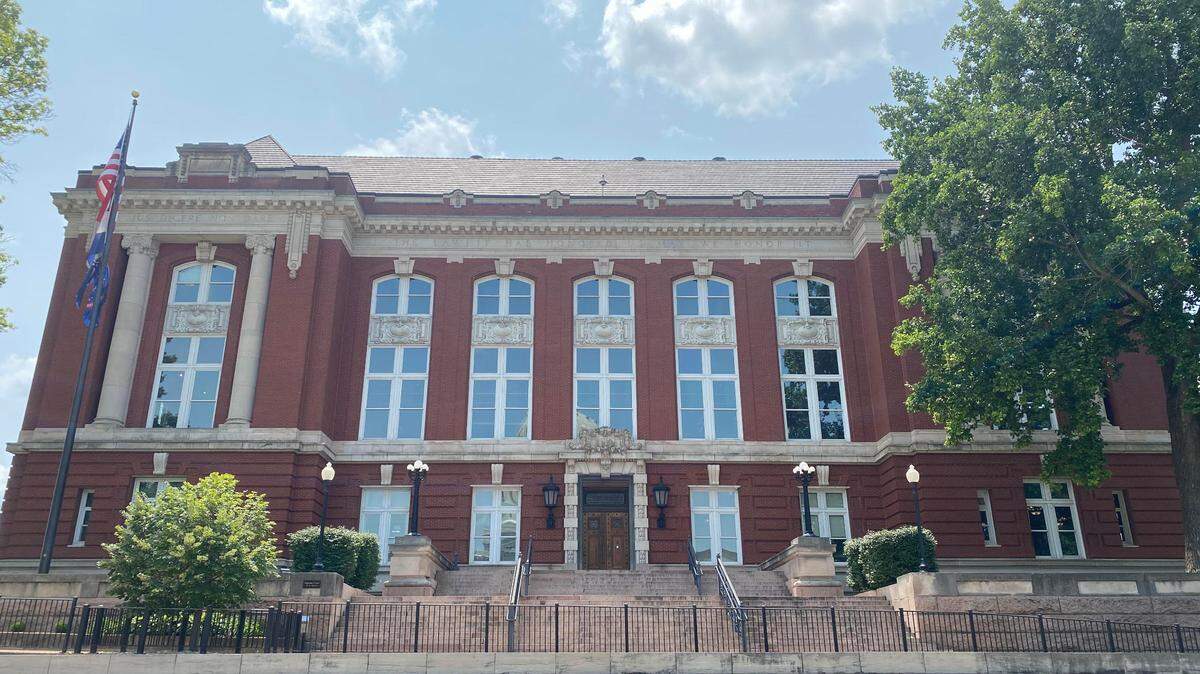
Jackson County, the city of St. Louis and the Biden administration asked the Missouri Supreme Court on Monday to halt the 2021 gun law that prohibits state enforcement of certain federal firearms restrictions.
The lawsuit, brought against the state last year shortly after Gov. Mike Parson signed the measure, argues that the Second Amendment Preservation Act (SAPA) is hindering local law enforcement efforts.
The high court will decide whether to declare the law unconstitutional. It could also pause enforcement of the statute temporarily to allow litigation to proceed.
SAPA was a victory for GOP politicians and gun rights activists when it passed last year, buoyed by lawmakers’ desire to push back on gun control measures promised by President Joe Biden’s administration. SAPA declares certain federal gun laws “invalid” if they do not have an equivalent in Missouri statutes and prohibits local police from helping federal agents to enforce them.
Under SAPA, police departments are subject to $50,000 lawsuits from private citizens who believe their Second Amendment rights were violated.
Since its passage Missouri police have halted a variety of routine practices that involve either firearms or the federal government. They include withdrawing from joint efforts to enforce gun or drug laws, cutting off the Bureau of Alcohol, Tobacco, Firearms and Explosives from shell casing information gathered at crime scenes and, in some cases, barring officers from even talking to federal agents without permission.
Robert Dierker, attorney for the local governments, told judges on Monday that the law was an “unintelligible statute.”
“Any fair reading leaves a person of ordinary understanding completely at sea as to what federal laws and regulations are forbidden,” he said.
Arguments before the high court Monday were largely focused on procedural issues.
The local governments were rejected last summer by a Cole County judge who ruled they already had an ability to fight the law — through individual lawsuits against police, brought by those who believe their Second Amendment rights were violated.
Dean John Sauer of the Missouri Attorney General’s office told the Supreme Court judges Monday that they should stick with that ruling, which he called “unshakeable.”
A handful of individual SAPA lawsuits are pending, he said, and that local governments needed to litigate them before bringing the case to the state supreme court.
Dierker said relying on individual lawsuits’ outcomes would result in “multiple inconsistent rulings” across the state on what policing practices would be allowed under SAPA.
The U.S. Justice Department (DOJ) joined the case to argue that the law “has posed substantial threats to public safety” in the loss of state and local cooperation on some criminal investigations.
“That all makes it harder to investigate crime at the front end” before a decision is even made on whether to bring a federal or state charge, said Jeffrey Sandburg, a DOJ attorney. “There are people who want to cooperate with us, but they’re mindful and are making judgments on the spot about what might potentially put their agency’s budget at risk.”
The Missouri Police Chiefs Association has asked lawmakers to amend SAPA during the current General Assembly’s current session to clarify what partnerships or practices are allowed, but GOP leadership has indicated a lack of interest.
The group has also sought clarity in its own lawsuit filed last month, which was supported with declarations from nearly five dozen police chiefs across Missouri.
In briefings for the case, the DOJ said Missouri state law enforcement initially refused routine federal assistance in tracing the murder weapon after an Independence police officer was killed in a shootout in September.
The same month, a Missouri State Highway Patrol trooper released a federal fugitive after a traffic stop rather than work with federal agents, the DOJ said. Sandburg did not provide any further details about the incident on Monday other than to say the suspect was someone “passing through” Missouri.
This story was originally published February 7, 2022 at 5:58 PM.