‘There’s no good purpose’: Map carves up Wyandotte neighborhood, angering residents
James Powell stood outside his Wyandotte County home in the chilly air on Wednesday and tried to wrap his mind around the congressional map lawmakers in Topeka were voting to approve at that very moment.
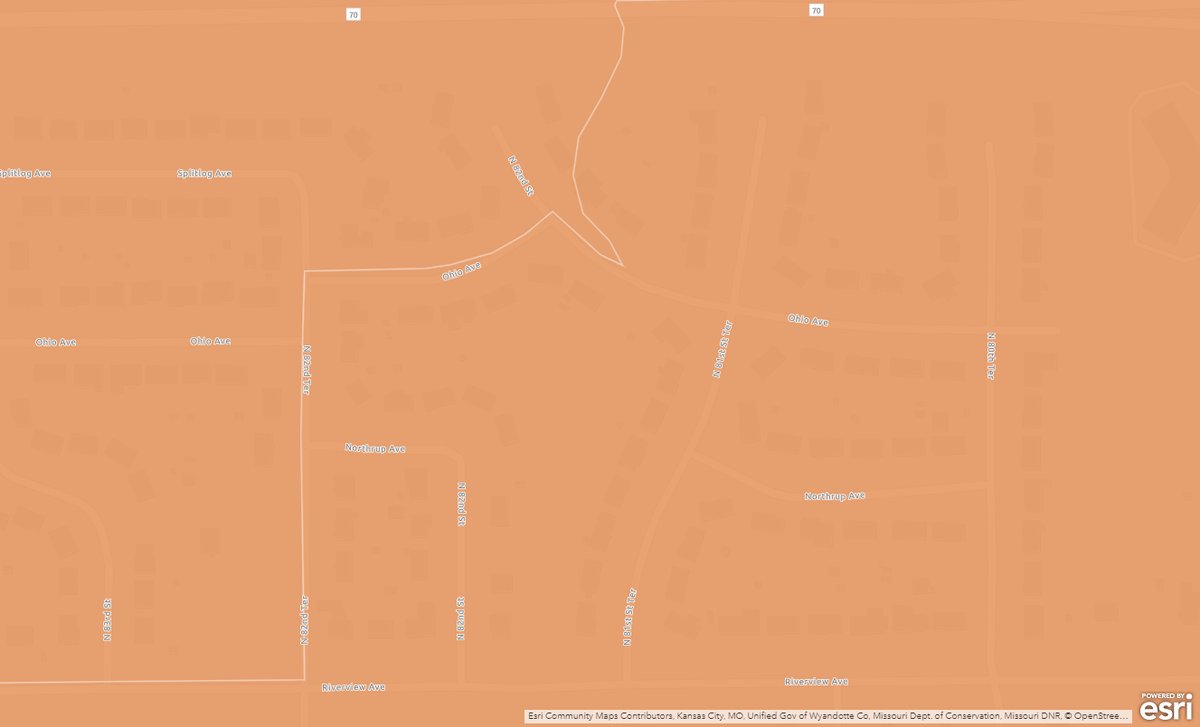
The map, a Republican-backed plan unveiled just a week ago, splits apart his neighborhood, Stony Point, south of Interstate 70 and east of the Kansas Speedway.
Powell has lived in the area, full of modest ranch and split-level homes built as early as the late 50s, for 15 years. Sure, he knew redistricting talks were underway, but he had no idea their solution would be to slice up his street — Ohio Avenue — with such surgical precision.
“It’s fixing something that ain’t broke,” he said. “There’s no good purpose for Wyandotte County to be broken up.”
His side of the street, the southern side, would remain in the 3rd Congressional District, currently held by Democratic Rep. Sharice Davids. His neighbors across the street would move into the 2nd District, occupied by Republican Rep. Jake LaTurner.
The Legislature sent the map, dubbed “ad astra,” (Lawmakers name each map and gave this one a lofty title that is part of the state motto, Latin for “to the stars”) to Democratic Gov. Laura Kelly on Wednesday. The House approved it 79-37 after the Senate passed it 26-9 on Friday.
As lawmakers were casting votes, The Star knocked on doors in Stony Point to get a sense of how residents feel about the plan. A large share of those who came to the door were unaware their streets had become a casualty in the redistricting fight. A few others have kept an eye on the process but weren’t sure what to think.
But most agreed that carving up their neighborhood is wrong.
“I don’t know why they would do that, why they wouldn’t just include the whole neighborhood,” said Robert Medina, who moved to the area around Thanksgiving.
The map is the first adopted by lawmakers this year as part of the once-a-decade redistricting process that redraws the state’s four congressional districts to account for shifts in population. The proposal splits Wyandotte County, traditionally entirely in the 3rd District, into two along an east-west line that roughly follows I-70.
It’s been met with vehement opposition from Democrats and local activists who say it would dilute the power of votes in the state’s most Democratic county, which also holds its largest concentration of minority residents. If the map is implemented, the 3rd would become whiter and less diverse.
Republicans have generally cast the map as a good-faith effort to grapple with population growth in the 3rd and meet the legal requirement of equal districts. Though some have been more open that it could benefit the party — the 3rd would likely become a more competitive under the proposal.
Kelly hasn’t committed to vetoing the map, but said Wednesday she wouldn’t have voted for it if she was in the Legislature. Republicans have already signaled they will try to override any veto.
“I think in the long run what should happen is that they should shrink (the 3rd Congressional District) in a way that maintains that community of interest, the KC metro area, and move some of the more rural southern and west parts into one of the other districts,” Kelly told reporters before official proposals were released.
Real-world consequences
The fate of future congressional elections will likely not hinge on Stony Point. But the ease and speed with which legislators approved maps cutting up the area illustrates the real-world consequences of the hasty process.
The map cuts through Stony Point with no apparent logic other than achieving equal population between the districts. The boundaries run along two streets — east-west along Ohio Avenue and north-south on North 82nd Terrace.
Medina’s house would shift to the 2nd. As he stood outside keeping watch over his puppy — Dottie, born on Halloween — he said he wasn’t particularly politically active and doesn’t “sway one way or the other.”
But dividing the neighborhood doesn’t make sense to him.
The situation brought to mind his childhood growing up along State Line Road where he was constantly hopping between Kansas and Missouri.
“I wouldn’t think they would go down the middle of the street,” Medina said.
Debbie Mendez has lived in Stony Point for more than 40 years and her elderly mother lives nearby. She knew the map was set to split the neighborhood and wasn’t sure how she felt about it, saying she hadn’t read up on it yet.
Mendez was adamant, however, that the process was moving too fast.
“We don’t even know anything about it,” said Mendez, who would be in the 2nd under the plan. “They didn’t even give us time.”
Rodney Droge, who would remain in the 3rd, said he has seen how redistricting worked in the past and doesn’t like it.
In 2012, then-House Speaker Mike O’Neal proposed putting Wyandotte County together with much of the western part of the state in the 1st Congressional District. Western Kansas is mostly rural, with majority-white residents. Wyandotte is among the most diverse counties in the state with more than half of its residents being Black and Hispanic. About 40% of Wyandotte County residents are white, 30% are Hispanic and 22% are Black, according to census data.
The plan ultimately didn’t pass but lawmakers this time around have proposed a similar move for Lawrence.
“I’m like, ‘Well, how do you think that us and Garden City, Kansas, have anything in common?’” Droge asked. “That’s on the Colorado border.”
Neighborhood’s fate not discussed
The division of Stony Point didn’t come up during debate in the House and Senate. Rep. Tom Burroughs, a Kansas City Democrat whose district includes the area, said it was evidence of the “onerous” tactics taken by Republicans.
“This is a challenge that hopefully the courts will address as no community, let alone a neighborhood, needs to be dissected and voices muted because of color, because of socioeconomic standing or by party for that matter,” Burroughs said.
GOP lawmakers used a variety of arguments to justify the split. Johnson and Wyandotte County combined would be 44,000 too many people for a single district. Republicans drawing the map chose to keep Johnson County whole, meaning they needed to split off some part of Wyandotte County.
An easy spot to split, Senate President Ty Masterson said, was along Interstate 70.
The decision, the Andover Republican said, also maintained communities of interest by pairing urban northern Wyandotte County with another urban community to the west, Topeka.
As for southern Wyandotte County, he called it “suburbia” like Johnson County.

“It’s basically suburbia versus real metro area,” he said. “(In southern Wyandotte County) you have portions, you have the Legends and all that. That’s in Wyandotte County and that certainly has a lot more similar interests with Johnson County than it does north of the river.”
The Legends, however, are north of I-70 and will be grouped with the 2nd District, not Johnson County.
Thomas Alonzo, a lifelong Wyandotte County resident, said these comments proved to him that the lawmakers drawing the map simply didn’t understand the community.
“Armordale, Rosedale, Argentine, Turner are all parts of the city that are south of I-70 and those are urban areas, those are not Roeland Park, Merriam,” said Alonzo, who has been an outspoken opponent of the proposed map.
For decades, Wyandotte County has been kept together during congressional redistricting. The split would create problems for the county, said Andrew Davis, a District 8 commissioner for the Unified Government.
“Splitting that vote and saying that our ballots are going to be different means that we can’t consolidate our voting power, which means that we’re unable to advocate for our interests,” Davis said.
A split of the county could also create problems for the Unified Government’s commissioners and elected officials. The reason local politicians have a good relationship with Davids, he said, is because Wyandotte is a consolidated community.
“We only have to advocate and lobby one (member of the) House of Representatives,” Davis said. “If we had to advocate and lobby for two it would create a headache for us, it would create a headache for our lobbyists to figure out what interests we can align with with the second district.”
This story was originally published January 27, 2022 at 5:00 AM.