Kansas City City Council to vote on new district map Thursday. Here’s what’s at stake
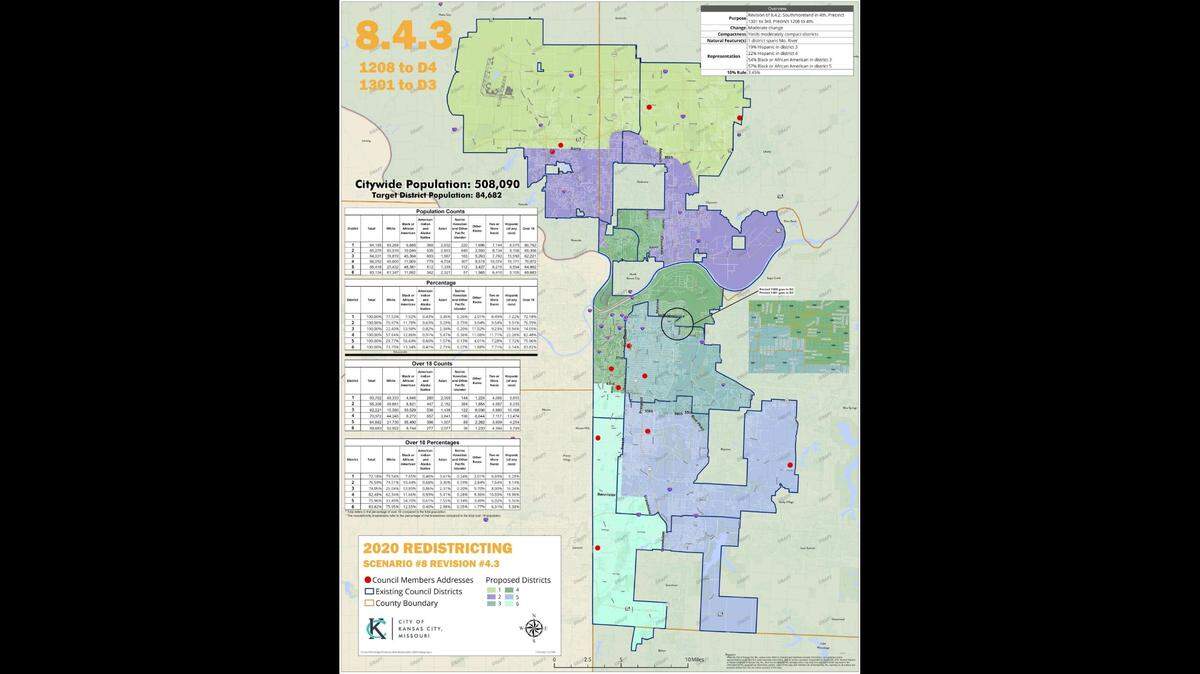
The Kansas City City Council will vote Thursday on a map of new council districts to determine where Kansas Citians will vote for the next 10 years.
It’s the result of three months of debate, research and community input. At times tense discussions between Kansas City council members, economic development organizations and community members who want a stronger voice in the Northland have set the stage for the vote.
Community members who gave testimony to the Kansas City Redistricting Commission and the Special Committee for Legal Review have called for a horizontal line drawn at Barry Road that would separate the 1st and 2nd Districts. They say the change would give them a voice. Those opposed to it said they were worried about a more divided north.
The proposed new map passed out of a lengthy committee hearing in which Northland Councilwoman Heather Hall was the only vote opposed.
The commission received 204 comments from the community. Commissioner Martin T. Rucker said they received more than 50 public comments in favor of keeping the vertical split and more than 30 in favor of a horizontal split.
The City Council, with a deadline of the end of the year to have new maps drawn, will vote on the proposed map Thursday during the 3 p.m. meeting.
The process happens every 10 years based on population changes in the latest Census. Data released in August showed Kansas City’s population climbed to an all-time high of over 508,000 residents, up 11% from 2010. That was largely due to increases in white, Hispanic, Asian and multiracial populations.
What community members want
Commissioner Vicky Noteis, in the committee meeting, said they heard from several community members who felt it was difficult to compete with high growth in other parts of the Northland. A horizontal divide, they argued, would give them more of a voice. A majority of the commissioners, in a 6-3 vote, agreed moving the boundary to address that concern would be a positive change, she said.
“The concerns really ended up being about balance and representation and fairness and trying to respect communities of interest wherever possible,” Noteis said.
Lucas Rodriguez, who spoke at the committee meeting, said the map would create a “safe district for a diverse pool of poor and working class people who have been waiting for an opportunity to be heard.” He said the map was not divisive, but instead was inclusive.
“One thing I saw was anytime someone was opposing the horizontal map, they were trying to say that me or the people who were wanting a horizontal map, their language was targeting us as not real Northlanders,” Rodriguez told The Star. “Trying to say that we’re not from the Northland.”
Jenay Manley, a leader with KC Tenants who testified at the meeting, has been a Northlander for the last 30 years and said that all of the power and wealth is concentrated north of Barry Road, where some want the new district line drawn.
“We are asking for a horizontal split not to create division in the Northland, but to uplift voices in the Northland, to create possibility in the Northland,” Manley said.
Patricia Bordallo Dibildox, who uses she/they pronouns, said in a phone call that the horizontal change would “give people a fighting chance” when running for office.
“One of the things I’m feeling the most right now is how much out of the way the Northland representatives have gone to not listen to us,” Bordallo Dibildox, 28, said. “I feel like the Northland representatives are proving our point with how we’re being treated in this process. I don’t feel heard or acknowledged in the most basic sense by them.”
Now 28, she’s lived in the Northland for 20 years. She said in testifying to the redistricting commission she felt heard in a way she had not before.
“Their whole argument is that people in the Northland don’t actually want this and they have this incredible Black woman leading the commission saying I am a Northlander,” Bordallo Dibildox said.
Commission chair Stephenie Smith said during the meeting that there has been a “misnomer and a further act of dismissing people who are part of the Northland who may not have been historically seen as Northlanders.”
In a letter submitted to council members by the Urban Council, leaders wrote that “the map unites socio-economic communities of interest in the north land via horizontal rather than vertical configurations of council districts 1 and 2.
“The horizontal configuration enhances electoral opportunities for heretofore disaffected residents of the moderate income and ethnically diverse neighborhoods south of Barry Road. Giving voice to those citizens will make this a better city.”
The opposition argument
The four Northland council members — Hall, Kevin O’Neill, Teresa Loar, and Dan Fowler — have voiced strong opposition to the proposal. Two of the three Northland representatives on the commission also strongly opposed the new map.
Rucker said the three dissenting votes, including himself, were the result of the largest changes coming in the Northland.
In the committee hearing, he said they were against the change because the population growth in the north would be unbalanced, lead to additional school district splitting, would discourage inclusion and diversity, and create concern over the distribution of the Public Improvements Advisory Committee dollars.
“We don’t want to see Barry Road become the new Troost,” Rucker said.
Smith, the Northland commissioner who supports the horizontal split, said that there’s been a “false narrative” comparing the horizontal line at Barry Road to the Troost Avenue divide. The Troost divide was the result of systemic racism, she said, and if the city does not want the same thing to happen along Barry Road that it needs to create policies to prevent that.
Rucker said that while he doesn’t want to take away from the lived experience of those in support of a horizontal divide, there were other ways to make improvements.
“We don’t feel like a horizontal split would accurately represent the Northland,” Rucker said.
Hall during the meeting held up a stack of papers in each hand, one visibly stacked higher than the other, and said that those were comments she received in favor of keeping the vertical division.
Deb Hermann, a former council member and CEO of Northland Neighborhoods, Inc., echoed concerns that the proposed horizontal divide “is creating another poor district. … By creating another low income district, I just don’t understand what’s trying to be achieved.”