Kansas City Redistricting Commission to recommend a horizontal divide of the Northland
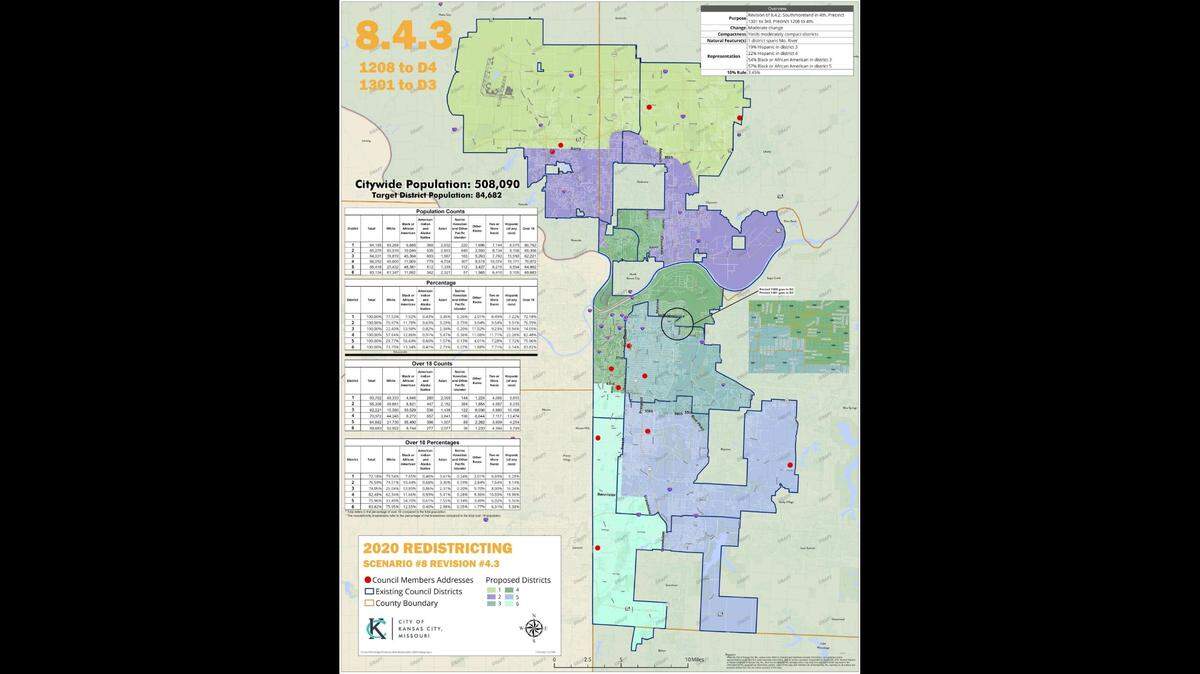
The Kansas City Redistricting Commission voted Monday to recommend a new map of City Council districts, one that drastically changes the boundaries of the Northland districts, to council members in December.
Commissioners voted 6-3 in favor of the map that would create a horizontal divide at Barry Road between Districts 1 and 2 instead of a vertical line.
The commission, whose members were appointed by Mayor Quinton Lucas, was given the task at the beginning of September to draw new council district lines — a nine-month task shortened to just weeks when Census data that was due in March wasn’t available until August because of the pandemic.
The new lines determine which of the six the council districts Kansas Citians will live in for the next 10 years. The process happens every 10 years based on population changes in the latest Census. Data released in August showed Kansas City’s population climbed to an all-time high of over 508,000 residents, up 11% from 2010. That was largely due to increases in white, Hispanic, Asian and multiracial populations.
The law requires that maps be drawn so that districts are as close to equal in population as possible.
At Monday’s meeting, the commissioners narrowed the remaining maps to two before deciding which one to recommend — the one with the horizontal divide or the other keeping the vertical divide. Other districts also had changes to their boundaries, but none as dramatic as the Northland districts.
Their goal: to provide for equality in the political process.
They’ve met weekly since September and have held five public meetings on potential new maps to gain community insight. Members of the public could also submit feedback virtually. The first three meetings were held in the north, central and south parts of the city. Of the last two, one was held in the south and the other was held near downtown for both the central and north parts.
Two of the three Northland representatives, as well as a District 6 representative, voted against the change.
A horizontal dividing line was discussed early on in the commission’s process, but fell out of discussion until a community meeting where commissioners heard from the public who were in favor of the horizontal divide.
Mike Kellam, who represented District 1 and is vice president for business development with McClure, an engineering firm, said during the meeting he was concerned about “gross underrepresentation” based on projected population growth between the proposed districts, with District 1 growing faster and putting District 2 at a disadvantage. He said he thought that growth would be better managed through vertical lines.
“I think having the horizontal creates opportunity for division and noninclusive collaboration,” Kellam said, adding that it creates competing interests.
Martin T. Rucker, District 2 and construction industry owner of Martin T. Rucker Development, said the commission was tasked with redrawing the lines by making minimal changes.
“Redrawing the entire Northland is a lot of change,” Rucker said. “Drastically changing 38% of the city based off of what a few people have said in one part … just doesn’t seem like the right thing to do.”
Commission chair and District 1 representative Stephenie Smith supported the horizontal change.
“It may be with this option, this horizontal option, that we can have more relevant development opportunities and advocacy in the midst of developing for people within this newly constructed second district,” Smith said.
She added later: “As a Northlander myself, the challenge that change may have in the consideration of moving from vertical to horizontal line, I think that’s a worthy opportunity for the greater good of our city.”
Smith said after the meeting that she wants people to know that “their voice matters.”
Madison Hays, who shared her concerns at a recent public meeting as a community member living in the Northland, said she doesn’t feel represented in her part of the city.
“The reason why a lot of us Northlanders came down was because we’ve been feeling unheard and unseen in Northland representation,” Hays told The Star recently. “It just feels like people don’t realize that poor and working class people exist in the Northland. There’s this common attitude that everyone who lives in the Northland is wealthy and white.”
Cokethea Hill, CEO of BLAQUE Kansas City and former District 5 councilwoman, said that all of the representatives have had to think about their districts differently. She said when it seems some want to stick to the status quo that the voice of the people can feel lost.
“People will not be happy either way,” Hill said, adding that the City Charter must be reviewed. “None of us want anyone to feel like they are unrepresented or not heard or that their lives changed.”
She said she hopes they can talk more about how the lines can bring people together to improve Kansas City.
Vicki Noteis, District 4 and former director of city planning and development for Kansas City, said resources in newer areas of Kansas City are pitted against older neighborhoods.
“There’s a whole section of that in the Northland that hasn’t been able to garner some of the resources to be able to compete,” Notes said. “I think that’s something that Kansas City has to continue to come to grips with.”
Pedro Zamora, representing District 4 at-large, said change is always going to happen.
“There should be a new Kansas City,” Zamora, president and CEO of the Hispanic Economic Development Corporation, said. “And it has to start with this commission making the right decisions.”
The recommended map has a Black population of almost 54% in Districts 3 and almost 57% in District 5 as well as a Hispanic population of almost 19% in District 3 and 22% in District 4. One of the commission’s focuses was to increase the chance for political representation for the Latino community.
In both of the maps being considered, District 6 was left a little light with 83,134 people.
“None of us got what we wanted,” Chris Lewellen, District 6 investor and restaurateur, said. “That’s a sign of a good negotiation when nobody comes out happy.”
As part of its recommendation to council, the commission will also recommend a review of the City Charter and the number of council districts and its at-large seats. Smith said it’s important for the commission to look at how people can have better representation.
It will present its recommendation to a City Council committee the week of Dec. 6. Council members do not have a legal obligation to follow the recommendation.