A bill to make duck boats safer advances in U.S. Senate, two years after MO tragedy
Long-stalled legislation to improve passenger safety on duck boats, a type of sightseeing vehicle involved in a 2018 sinking on a southwest Missouri lake that killed 17 people, passed out of a U.S. Senate committee on Wednesday.
The Duck Boat Safety Enhancement Act of 2019, which was introduced by Sen. Josh Hawley, a Missouri Republican, moved out of the Senate Commerce, Science and Transportation Committee with no dissenting votes. The measure now heads to a vote by the full U.S. Senate.
The bill requires the U.S. Coast Guard to enact several regulations on operators of duck boats, which are World War II-era vessels that travel on land and water. The regulations would require the ducks boats to:
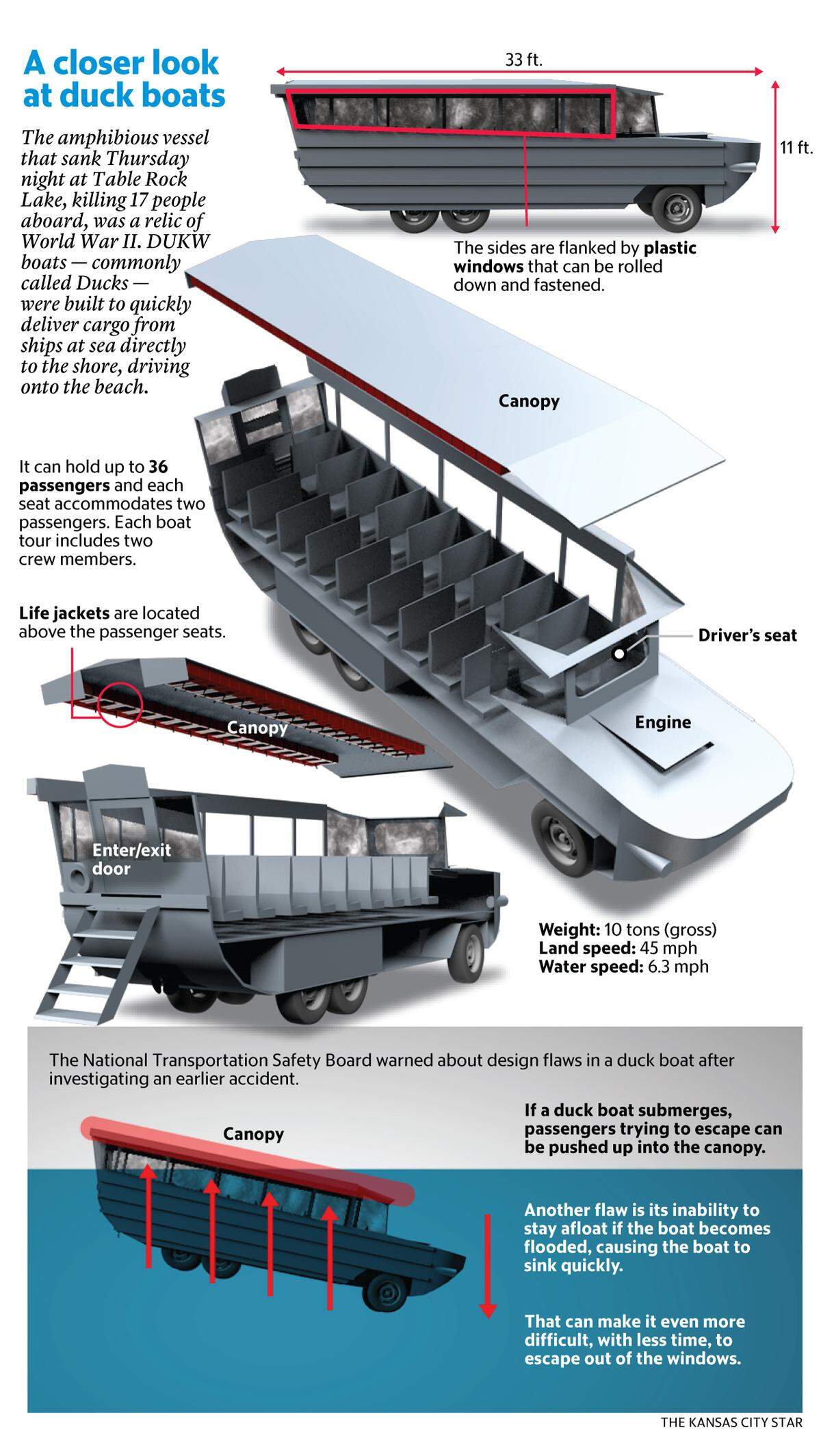
▪ Have what’s known as reserve buoyancy to help the vessel remain afloat if it floods;
▪ Remove overhead canopies while on water, or install canopies that don’t stop passengers from getting out if the boat sinks;
▪ Require passengers to wear a flotation device while on water if there is no canopy;
▪ Install at least four electric bilge pumps to force water out of the duck boat.
The bill also requires operators to check a National Weather Service forecast before starting up a duck boat and equip each vessel with a weather monitor radio that’s automatically activated by a warning from weather forecasters.
The regulations were proposed in direct response to a disaster on Table Rock Lake near Branson on the evening of July 19, 2018, when a duck boat with 31 people on board took a lake tour as a severe thunderstorm approached.
Winds in excess of 70 miles per hour whipped up waves on Table Rock Lake and caused a duck boat operated by Ride the Ducks to sink, killing 17 people on board.
The presence of an overhead canopy and side curtains were said to have restricted passengers from escaping as the duck boat took on water and started to sink.
It was the worst duck boat disaster on water since a 1999 incident in which a vessel sank on an Arkansas lake, killing 13 of the 21 people on board.
The National Transportation Safety Board investigated the 1999 disaster and issued several recommendations to the U.S. Coast Guard to improve duck boat safety, including some that are now part of Hawley’s bill. Neither the Coast Guard nor Congress took up those recommendations.
Earlier this year, the NTSB issued its final report on the Table Rock Lake tragedy. It said lives could have been saved had those safety recommendations resulting from the Arkansas incident been followed.
A federal grand jury in 2019 brought criminal indictments against the captain of the duck boat that sank, as well as two Ride the Ducks employees on duty that day, accusing them of putting passengers at risk by launching a water tour on Table Rock Lake as a severe storm was on its way.
The defendants in that case — Kenneth McKee, Curtis Lanham and Charles Baltzell — have pleaded not guilty to the charges and deny wrongdoing.
The government’s case against the three defendants is in jeopardy after a magistrate judge in September recommended dismissing the indictments, saying that federal courts have no jurisdiction over the matter because Table Rock Lake is not a “navigable” waterway, meaning it doesn’t support commerce like shipping.
The distinction raised by the magistrate judge is important: If Table Rock Lake is not navigable, then the charges brought by the federal grand jury cannot apply, although Missouri state prosecutors could take up the matter if they wished.
On Oct. 9, the U.S. attorney for the western district of Missouri filed a lengthy objection to the magistrate judge’s recommendation. The judge handling the case has not yet issued his final ruling on the matter.