‘It’s eating up my income’: JoCo residents say property taxes could force them out
Carol Hein was looking forward to spending the rest of retirement in Roeland Park — in the house she has lived in for 38 years, surrounded by mature oak trees and well-maintained Cape Cod homes.
She doesn’t want to leave her two-bedroom ranch-style home, which is a lasting reminder of her late husband and the first years they lived together as newlyweds.
But now 74, Hein is questioning how long she can afford to live in Kansas’ wealthiest county, where home values continue to skyrocket — pushing up property taxes year after year.
The value of Hein’s home, off Roe Avenue by R Park, has jumped by nearly $68,000 in the past five years, with her annual property taxes rising $750. This year, she saw a 6% appraisal increase, which followed last year’s 10% increase.
Trying to make ends meet, she now works as a crossing guard, chaperoning Rushton Elementary School students across the street each day.
“I’m working as a crossing guard to basically pay my property taxes,” she said during an after-school shift last week. “It’s eating up my income. At some point I won’t be able to pay the taxes. That’s what it’s going to come down to.”
Dozens of longtime Johnson County residents said they are facing a similar decision: Continue aging in place — to be near family and the amenities the Kansas City suburbs are known for — or leave, cash in on the rising home prices and try to escape the increasingly heavy burden of property taxes.
About 200,000 homeowners have received county appraisal notices in the mail, with 87% seeing an increase. The vast majority of homeowners saw appraisals rise 10% or less compared to last year, according to the appraiser’s office.
But across Johnson County, especially in the northeast and outer southern edges, many residents told The Star that their home values have risen between 12% and 20%. And that follows years of similar increases.
Those new appraisals will affect 2020 tax bills that go out late in the year.
Angie Grady said the value of her home in Mission has jumped by $100,000 since she bought it in 2013. This year, she’s facing a home appraisal increase of more than 14%.
And while that’s resulted in higher property tax bills and mortgage payments each year, she’s mostly concerned for her two children, both young adults trying to afford rent in Johnson County.
“All these appraisals going up and up have driven rent prices up to the point that they can’t afford to live in the area,” Grady said. “I’m kind of concerned we’re pricing ourselves out of new home buyers.”
That’s a concern echoed across Johnson County, with homeowners saying they feel a lack of control and don’t see an end in sight to the rising bills. They worry that their communities are rapidly changing, no longer affordable for the young families and retirees who flocked to the area.
And many are pleading for relief.
“Unfortunately, it’s pushed out some good neighbors who are living on a set income,” Roeland Park homeowner Mike Wolfe said. “It’s always worrisome to see the folks go who built this neighborhood and made it what it is.”
Changing character
Sitting in the dining room of her 1950s-era home, Lisa Veglahn said she is relieved to be living in one of the last “untouched” neighborhoods in Prairie Village.
The Countryside East neighborhood, off 63rd Street between Nall and Roe avenues, remains mostly 70-year-old Cape Cod homes, but within a couple of miles, several of those original homes have been torn down and replaced with large houses priced at $700,000 to more than $1 million.
A couple of years ago, the City Council voted on regulations to try to curb excessive new building, in hopes of maintaining the character that has defined Prairie Village for decades. But Veglahn is still waiting for the day when she walks out on her front lawn to look up at a McMansion next door.
Areas of Johnson County where tear-downs have been most common are seeing some of the biggest spikes in home values. Many residents said that has been especially frustrating as they pay for repairs and work to maintain their older homes.
“You see a lot of old homes that have been torn down and developers are doing a lot of new builds. When that happens, that will up the overall value in the area. It raises the overall value of the entire community,” Johnson County Appraiser Beau Boisvert said.
Property appraisals are an estimated value of what a home is worth. Appraisals are tied to what comparable houses have sold for within the neighborhood.
On average, home values in parts of Prairie Village, Roeland Park and Mission rose as much as 10% this year.
Last year, Veglahn said her home appraisal rose by 21%. This year, she’s facing another 8% increase. And that has resulted in her property tax bill creeping up each year, to nearly $400 a month.
“I struggle as a homeowner because at some point I’m probably going to downsize. I want there to be a good market value when I sell my house,” Veglahn said. “But I don’t know that I could afford to live here once I stop working, as a retired person, if the taxes keep going up the amount they are. That would be a significant cost.”
The extent to which an appraisal change will affect a homeowner’s property tax bill depends on where they live, due to the various tax rates throughout the county.
For example, in 2019, a three-bedroom, 1,700-square-foot Prairie Village home built in 1948 saw a 9% increase in its appraised value, pushing it up to $291,000. That year, the homeowner’s annual property taxes went up $345, to $4,275.
By comparison, a four-bedroom, 2,200-square-foot south Overland Park home built in 1984 saw a 5% appraisal increase, resulting in a home value of $282,000. Its annual property taxes went up $106, to $3,721.
“The northeast was really the gateway to Johnson County at one point. That was kind of the brand,” said Johnson County Commissioner Becky Fast, who represents the northeast district. “You get your first house with your family in Mission or Roeland Park, then move south to larger suburbia. But now for young professionals, young families and fixed-income seniors, it’s really tough in the northeast.”
Residents like Veglahn fear the foundation of northeast Johnson County communities could permanently change.
“I am grateful for what my taxes pay for in Prairie Village. I love the parks. I love the schools. I love knowing that when I’m out of town I can call the police department and they’ll drive by and make sure everything is fine,” she said. “But I don’t want to see Prairie Village being a place that isn’t appealing to young people or where older people can’t stay in their homes.”
Homes selling in days
Real estate agent Susan Bowers said it’s not unusual for homes in Johnson County to have multiple offers within days of being put on the market.
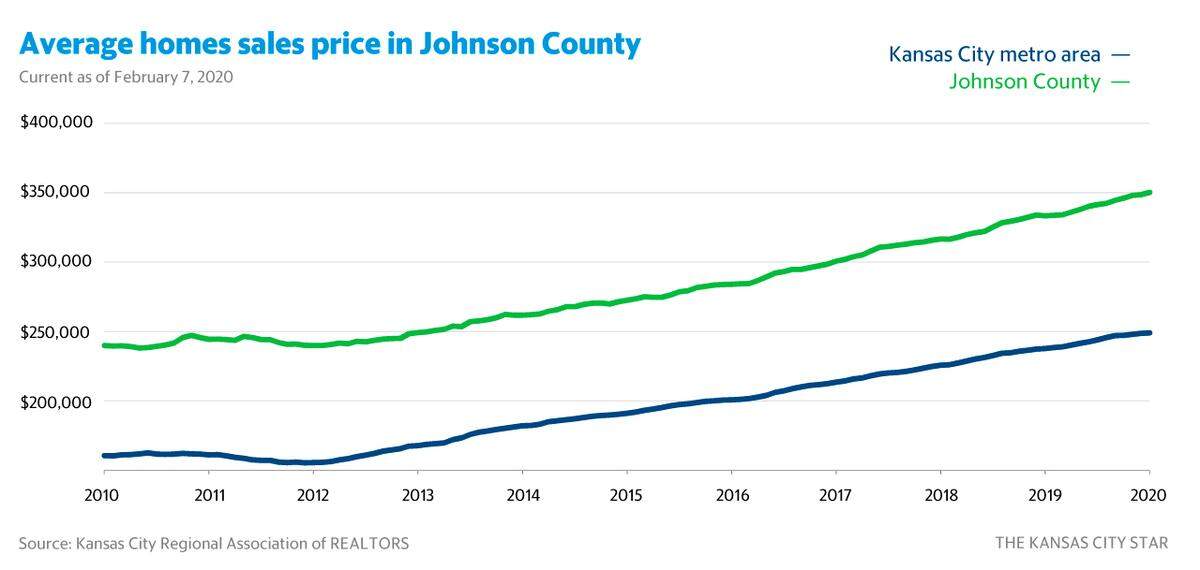
In large part, home values have been increasing because the housing stock is unusually limited. In January, there were roughly 1,400 homes listed for sale in Johnson County, a drop of about 500 from the same month last year.
The median Johnson County home sale price has jumped from $195,000 in January 2014 to $310,000 this year.
“The supply is just so minimal in our county that it’s creating a really hot market,” Fast said. “People in Roeland Park used to often get to negotiate down. But now people are adding $20,000 to $30,000 to be able to even land the house because there are so few on the market.”
That trend has reached the outer most areas of Johnson County as well, where there is more land to develop. In De Soto, a city that had record new home construction last year, the average home sold for $310,000 last year, almost a 19% jump from the year before.
In areas of the county where cities are mostly built out, Boisvert said he’s noticing a drop in permits for new home construction. Permits are down 12% countywide. But, there’s been a jump in apartment construction, with 4,100 units built this past year. Many apartments built throughout Johnson County have been labeled as “luxury.”
The demand for homes under $350,000 is especially high, as the county grapples with a lack of affordable housing. Many residents said they are concerned that the housing market is a barrier to Johnson County being a welcoming and diverse community.
Johnson County and several of its cities have partnered to study the affordable housing market and ways to address the shortage. Meanwhile, the city of Overland Park is examining its zoning codes, hoping to adopt changes that will make it easier for developers to build small-scale, affordable housing projects.
“We need to be intentional about our actions and how they affect people of all socioeconomic levels,” Roeland Park Mayor Mike Kelly said. “We know we’re a stronger community when we allow people to live in Roeland Park if they work in Roeland Park or have built this community and been here their whole lives.”
Homeowners plead for relief
Shocked by their property tax bills, several Johnson County homeowners are asking their cities and county government for help.
Boisvert said appeals are starting to pour in, as homeowners protest. Last year, 6,000 homeowners challenged the county’s appraisal, with about 50% receiving a reduction. So far this year, more than 500 appeals have been filed, which Boisvert said is typical.
Prairie Village City Councilman Tucker Poling said he is hearing a lot of complaints from homeowners who argue their home’s value was decided based on an unfair comparison.
“In my case, I know one of the homes that was used to compare mine sold for what I’m quite certain my house would not sell for. And I’m hearing that a lot,” Poling said. “And I’m hearing a lot of frustration. I very well may appeal mine.”
Boisvert said the goal is to value all houses at the value they would sell for on the open market, compared to homes that have sold and are similar in age, size and quality. Home appraisals are based on an exterior inspection of homes, although homeowners may submit interior photos during the appeal process.
Property owners have until March 25 to file an appeal with the appraiser’s office.
But many, including homeowners like Veglahn who have unsuccessfully appealed, argue that’s not enough. They’re hoping the rising home appraisals mean cities will offer some relief.
In Roeland Park, Kelly said the city recently started a property tax assistance program, hoping to help low-income residents with the additional tax burden. This year, the city set aside $15,000 for rebates to eligible homeowners.
Residents in other cities have called for similar programs, as well as reductions to city mill levies.
But higher property values don’t always mean cities are flush with extra revenue. Several Johnson County cities are facing plunging sales tax collections. Leaders also fear the looming “dark-store theory” of commercial property valuation, which is snaking its way through Kansas courts. Retailers argue their assessed value should be based on an empty store, not the additional value of the business that could be generated. If they prevail, it could lead to a loss of up to 30% of property tax revenue, county officials have estimated.
“I think that’s something really weighing on everyone’s minds,” Poling said. “You’re always trying to tread that line of being responsive to residents and their needs for some type of relief, but also being fiscally responsible with the city budget, looking down the road at things like the dark store theory and potential reductions in sales tax revenue.”
As budget planning season approaches this spring, Poling said he would like to consider lowering mill levies for the neediest homeowners, rather than an overall rate cut.
“I don’t know that an across-the-board mill levy reduction would result in meaningful tax relief for your average Prairie Village family. My concern is the approach disproportionately benefits the wealthiest in the community,” Poling said. “If I’m a homeowner who owns a $200,000 home, and there is an across-the-board mill cut, the tax relief I would get could be one-fifth of someone who owns a $1 million home. I don’t think that’s the most equitable way to approach tax relief.”
He wants the targeted reduction rather than “using a butcher knife when a scalpel would be most appropriate,” he said.
Others are pushing for changes at the state level.
The problem exists across the state as homeowners are increasingly worried about rising property taxes. Kansans pay more than $5 billion in property taxes each year — the 18th highest burden among states, according to a 2019 analysis by WalletHub.
The Kansas Senate voted last month to restrict local governments from increasing the amount of property tax revenue they collect without a vote. They would also be required to hold a public hearing.
Fast is pushing for assistance targeted to seniors on fixed incomes. She wants the state to expand its Homestead Refund program, which provides seniors and disabled veterans a refund based on a portion of their property taxes. To qualify, the total household income must be $35,700 or less, which Fast said does not include enough Johnson County seniors.
But for now, Johnson County homeowners are left to fight their property appraisals and shovel out hundreds more on their property tax bills.
“I think there is a feeling that it’s completely out of homeowners’ control,” Veglahn said from her Prairie Village home. “This is the reality of living here now. But that reality is hard to understand.”
Your property tax
▪ Find out the appraised value and 2019 tax bill on a Johnson County home at jocogov.org/dept/appraiser and click “Property Data.”
▪ Appeals can be filed until March 25 at the above website. Click “General Information.” That area also explains how tax bills are calculated.
This story was originally published March 9, 2020 at 5:00 AM.