
If Greg Orman should win in Kansas, he would hold leverage in Washington
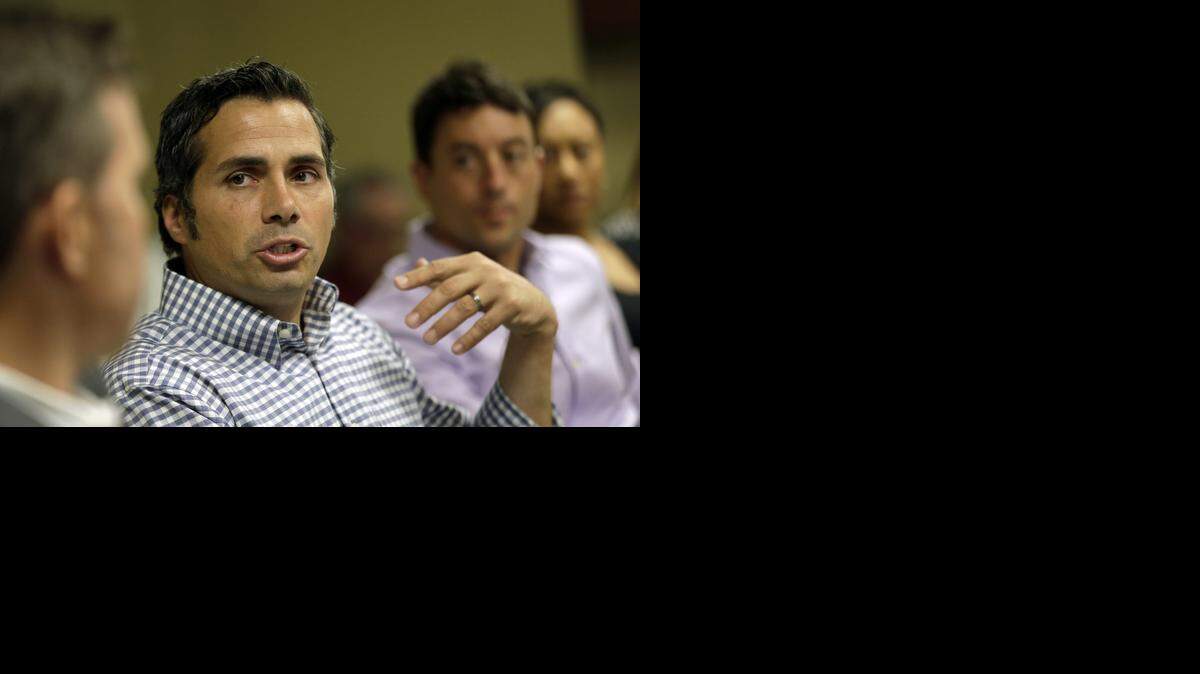
With control of the U.S. Senate on the line, pundits and politicians nationwide have become obsessed with a tantalizing question:
If elected, which party would Greg Orman choose?
The independent U.S. Senate candidate in Kansas is polling ahead of incumbent Republican Sen. Pat Roberts. If he wins, Orman could swing control of the U.S. Senate to one party or the other.
“What will Greg Orman do?” pondered one recent headline in The New York Times. NBC News called the 45-year-old businessman from Olathe “the most interesting man in politics this November.” The Huffington Post even coined a new phrase: “The Orman Factor.”
Orman’s own caginess only adds to the intrigue. He has said he would side with whichever party holds the majority to give Kansas a stronger voice.
But if neither party has a clear majority, Orman said he’ll talk with both sides to determine which is “most committed to solving our country’s problems.”
Such a tiebreaker scenario could bestow Orman with extraordinary bargaining power in negotiations with party leadership — and likely would guarantee him his pick of plum committee assignments.
“He may be the most important guy in the Senate for a few days in January if he gets elected,” said Kyle Kondik, managing editor of Sabato’s Crystal Ball, a nonpartisan newsletter published by the University of Virginia Center for Politics.
Orman might even demand new party leadership. He’s on the record saying both Harry Reid and Mitch McConnell have been too partisan for too long to earn his vote for majority leader.
“If it’s 50 Republicans, 49 Democrats and him,” — Democrats have the tiebreaker vote with Vice President Joe Biden — “he might have the power to say to the Democrats, ‘I’m going to caucus with you but Harry Reid can’t be your leader,’ or to say to Republicans, ‘I’ll caucus with you, but Mitch McConnell can’t be your leader,’” Kondik said.
With Democrat Chad Taylor now out of the race, Orman is under growing pressure to clarify where his loyalties lie.
At a debate earlier this month, Roberts pressed Orman to commit to a party.
“When,” Roberts asked, “are you going to tell us what party you’re going to caucus with?”
Orman never got a chance to respond. The moderator jumped in to say the candidates were out of time and had to move to closing arguments. But the question later showed up in a Roberts Web ad.
Following the debate, reporters asked Orman to clarify. He declined, repeating his pledge to caucus with the majority party, or the one most likely to help the state.
The Roberts campaign is eager to paint Orman as a closet Democrat. But for now, it’s to Orman’s benefit if he can be seen as above the political fray.
Meanwhile, political analysts and columnists scour his past for clues as to which way he’s leaning.
Orman has been both a registered Republican and registered Democrat over the years. He made a run against Roberts as a Democrat in 2007 but backed out of that race before the official filing deadline.
He’s donated to candidates from both parties, but primarily to Democrats at the federal level. Records show he donated $4,600 to then-presidential candidate Barack Obama in November 2007.
Orman recently told The Washington Post that he voted for Obama in 2008 and for Republican Mitt Romney in 2012.
In an interview with The Star earlier this year, he said he identifies closely with moderate Sen. Angus King from Maine.
King is one of two independents who caucus — or coordinate politically — with the Democrats. The other is liberal Bernie Sanders of Vermont.
Orman said in a July 4 interview that he considers King a true independent.
“Angus said he was caucusing with the Democrats because they were in the majority and that was the best thing (for) him to do for his state,” he said.
“Ultimately, the best thing for Kansas would be to caucus with the majority,” he added. “But if we do create an environment where Angus and I prevent either party from having a majority, then I think the best thing for Kansas is to say we’re going to caucus with the party that’s most committed to solving our country’s problems.”
Asked which party that would be, Orman said he didn’t know.
A spokesman for King declined to comment.
It’s all just feverish speculation at this point. Orman has to win first, and even then the chances are slim that the Senate will end up split between 50 Republicans and 49 Democrats.
There have only been two times in history when the Senate has been tied — in 1881 and 2001, said Senate historian Donald Ritchie.
In 1881, Republicans persuaded independent Sen. William Mahone of Virginia to join their party, handing them the majority. Mahone received a basket of flowers from the Republican White House as a thank-you, as well as the chairmanship of the agriculture committee and control over the appointment of Senate officers.
In 2001, when the Senate was tied, Sen. Jim Jeffords of Vermont left the Republican Party to become an independent. He then teamed with the Democrats, tipping control of the Senate to them in what GOP leader Trent Lott of Mississippi described as a “coup of one.”
That was the only time the majority status of the two parties has changed in the middle of a Congress, Ritchie said.
“All the Republican chairmen had to step down from their committees, and Democrats took their positions and became a majority party,” he said.
Republicans were furious, but Democrats rewarded Jeffords with chairmanship of the Environment and Public Works Committee and seats on the prestigious Finance Committee, the Veterans’ Affairs Committee and Special Committee on Aging.
More recently, former Democratic Sen. Joe Lieberman of Connecticut won re-election as an independent in 2006. He sided with the Democrats in return for keeping his chairmanship of the governmental affairs committee. His decision helped give Democrats a 51-49 majority in the Senate.
If Orman ends up playing a decisive role in determining the balance of power in the Senate, he would be expected to leverage the situation into better committee assignments, said Nathan Gonzales, deputy editor of the Rothenberg Political Report, a nonpartisan publication that tracks House, Senate and gubernatorial elections.
“That’s usually the first ask,” Gonzales said.
The Star’s Dave Helling and The Wichta Eagle’s Bryan Lowry contributed to this article.
To reach Lindsay Wise, call 202-383-6007 or send email to lwise@mcclatchydc.com.
This story was originally published September 23, 2014 at 6:44 PM.