
‘Poison’ creatures — with multi-colored bodies — are new species in Colombia. See them
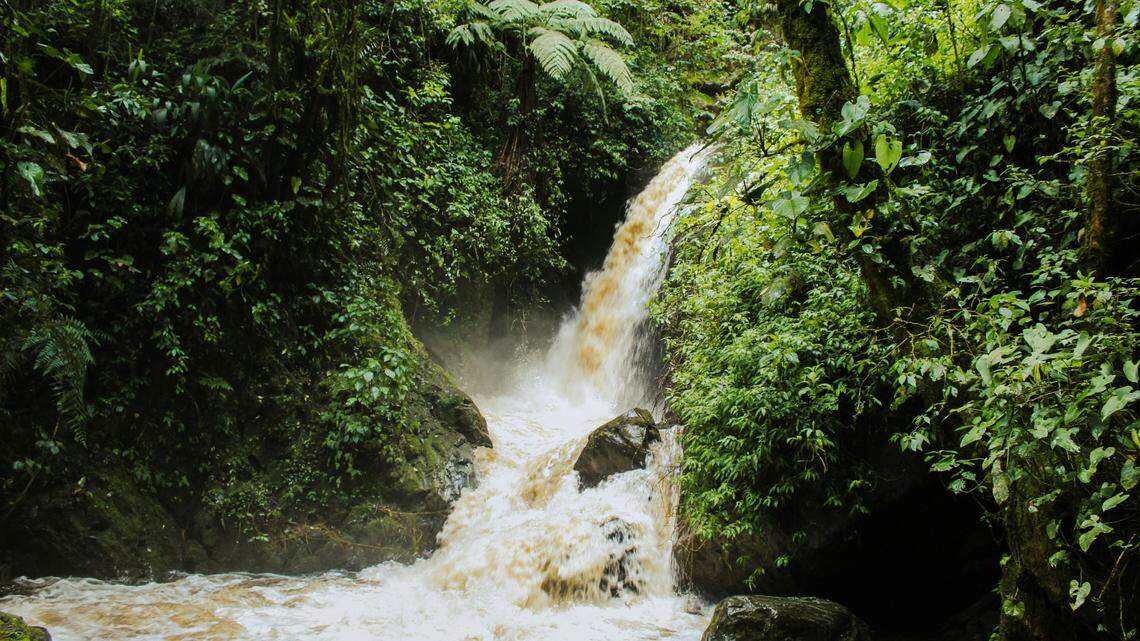
Centuries ago, the Chocó people of modern-day Colombia searched the forest for small but dangerous creatures.
Spotting the animals’ multi-colored bodies against the green landscape, the Chocó pulled out their blowguns and wiped their darts along the animals’ backs, tainting the darts with a deadly poison.
It was this practice that earned the poison dart frogs’ their name, and now, two new species have just been discovered.
In 1978, researchers studied one species of poison dart frog and found that the alkaloids in its bodies that made them poisonous were so toxic they named the frog Phyllobates terribilis, or the “terrible leaf walker,” according to a study published Sept. 16 in the peer-reviewed journal Zookeys.
For decades, terrible leaf walkers were considered just one species, but now, with advancements in technology that can analyze DNA, researchers argue that the frogs lumped together are actually multiple unique species, according to the study.
Between 2009 and 2022, researchers collected specimens of leaf walkers from the Colombian Chocó bioregion, where the species are known to live. They also recorded the advertisement calls of the male frogs in areas around the city of Buenaventura, according to the study.
Differences in the morphology, or bodies, of the frogs and their calls helped researchers identify two new “sister” species of the leaf walkers — Phyllobates samperi and Phyllobates bezosi.
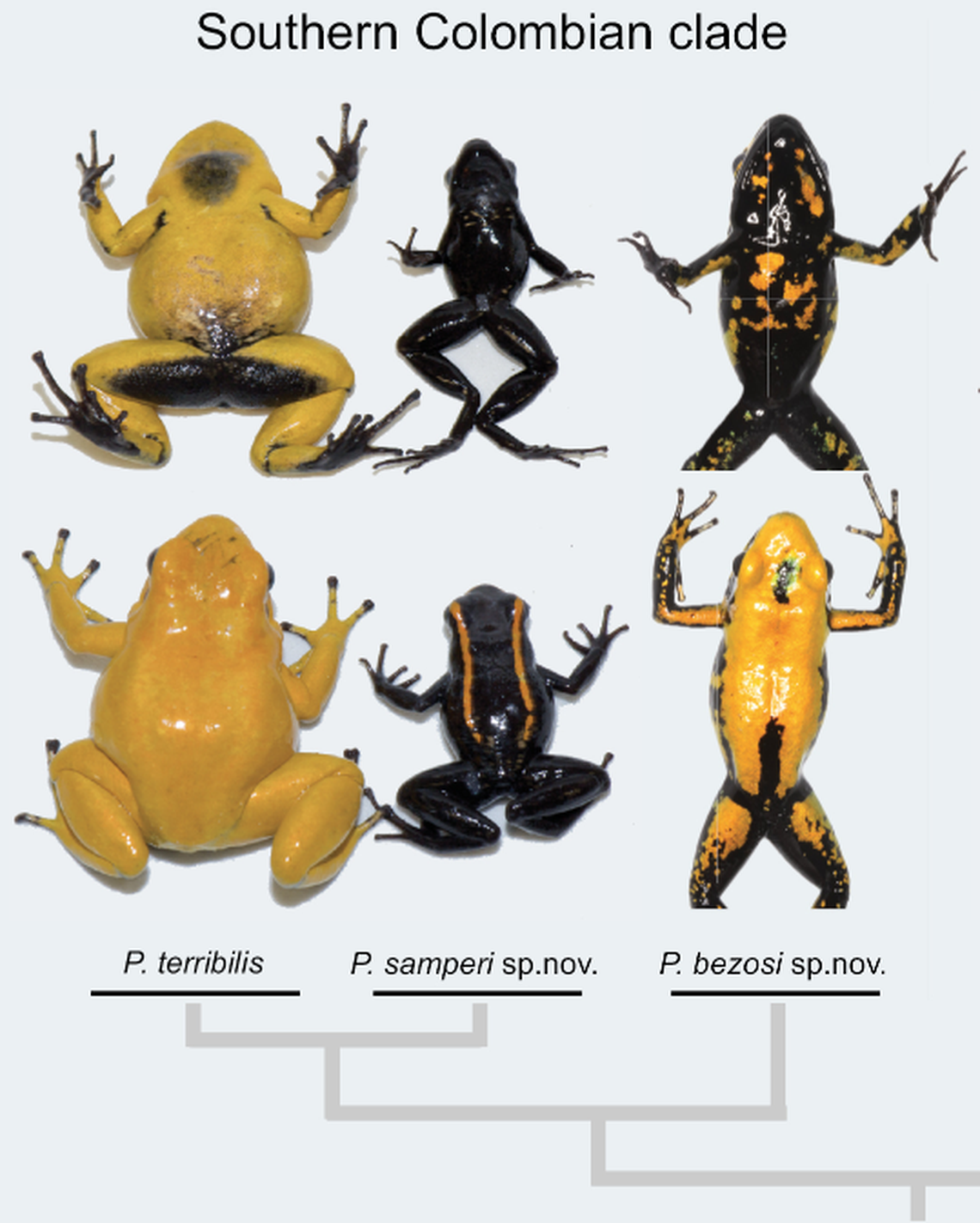
Phyllobates samperi, named after Colombian biologist Cristian Samper, is small to medium in size, about one inch long, researchers said.
Its smaller size and coloration “easily separate” it from other known species, according to the study.
The majority of the frog’s body is “pitch black,” researchers said, with an “narrow golden yellow/orange” stripe running down both sides of its body.
When calling, the frog emits a long series of “trill” sounds, according to the study.
“Phyllobates samperi sp. nov. is a diurnal (active during the day) species that inhabits the understory of tropical humid forests in southwestern Colombia,” researchers said. “From our observations, it thrives well in forests with moderate degrees of disturbance. Adults are found mainly on the leaf litter, near fallen logs, roots, large leaves, and other objects that provide refuge and probably food.”
The frogs were very aggressive when protecting their territory, and at one point while researchers were playing the call of a male P. samperi in the territory of another male, the frog jumped onto a researcher’s leg searching for the “invader,” according to the study.
After females of the species lay their eggs, the males carry the tadpoles on their backs down to the forest floor to grow in temporary pools of water formed by rainwater, researchers said.
While Phyllobates samperi is small and mostly black, the other new species, Phyllobates bezosi, has more yellow coloration and a larger body size.
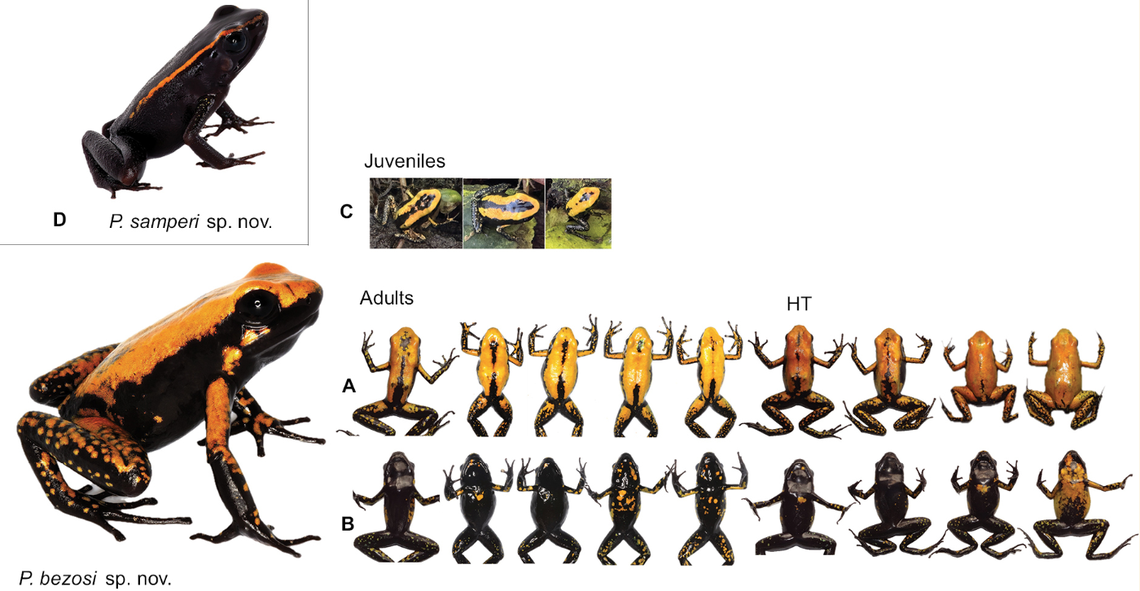
Phyllobates bezosi is “medium-sized,” researchers said, measuring about 1.3 inches long.
The frogs are “predominantly orange to yellow” with “black bands or blotches” that are incomplete, according to the study.
Their underside “can be completely pitch black, with a single golden blotch near the chest, or with a variable number and size of golden blotches,” researchers said.
The males of the species also make a “trill” call, but in single note bursts compared to the long calls of their sister species.
P. bezosi was named after American entrepreneur and Amazon founder Jeff Bezos “for his contributions to environmental conservation, particularly through the Bezos Earth Fund,” according to the study.
The species has only been found along the Garrapatas River, researchers said, and information about the surrounding forest is poor.
“At the moment of writing this manuscript, access to the area is restricted by illegally armed groups that also constrain the movement of local inhabitants,” researchers said. Because of this, researchers suspect there is significant poaching taking place in the area.
Because of environmental threats throughout the Colombia rainforests, researchers suggest listing Phyllobates samperi as “vulnerable” on the International Union for Conservation of Nature Red List, and Phyllobates bezosi as “endangered,” according to the study.
Buenaventura is a city in western Colombia along the Pacific coast. The Garrapatas River runs through the region.
The research team includes Adolfo Amézquita, Fernando Vargas-Salinas, Iván Ramos, Pablo Palacios-Rodríguez, Erika Nathalia Salazar, Michelle Quiroz, Wilmar Bolívar, Diana M. Galindo-Uribe, and Luis A. Mazariegos-H.
This story was originally published September 20, 2024 at 11:18 AM with the headline "‘Poison’ creatures — with multi-colored bodies — are new species in Colombia. See them."
