
Has Trump’s honeymoon period ended? It’s complicated, experts say
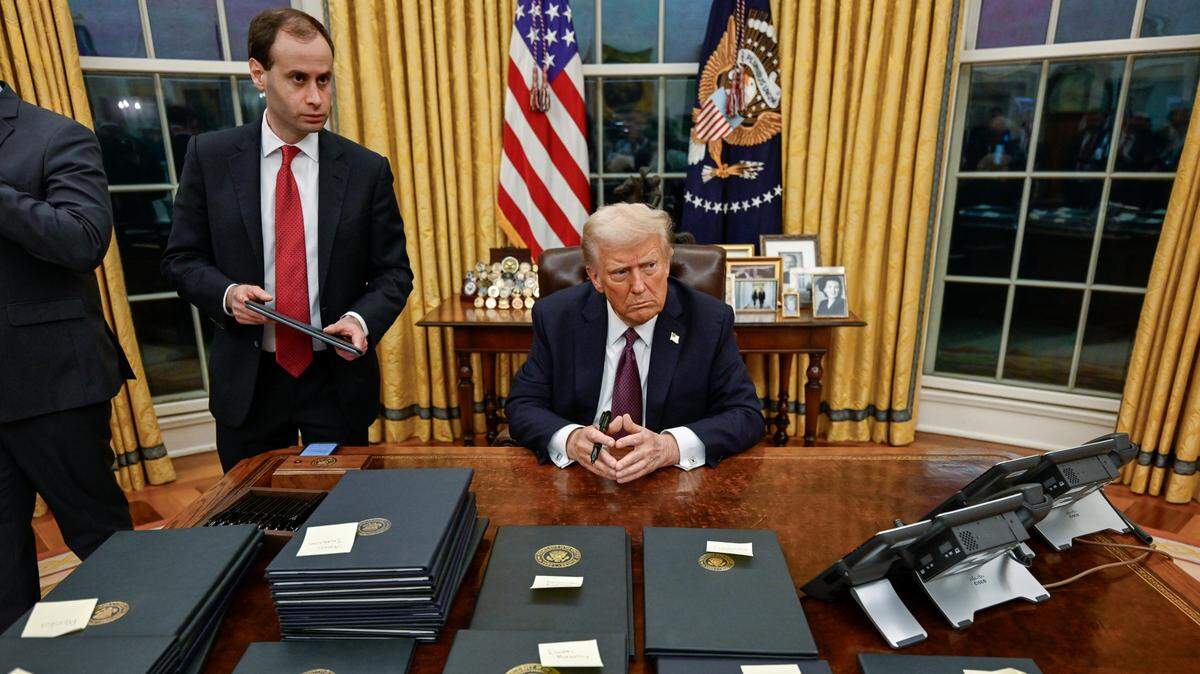
During the first month of President Donald Trump’s second term, he issued dozens of executive orders in an attempt to reshape the federal government. They included pausing U.S. foreign aid, declaring an emergency at the southern border and seeking to overturn birthright citizenship.
This aggressive start has been accompanied by a marked decline in Trump’s approval ratings, raising the question: Is his honeymoon period over?
It’s complicated, according to political experts.
What is a honeymoon period?
A president’s honeymoon period is generally understood to be a window after their inauguration during which they enjoy elevated approval ratings.
Typically, “this is a time when presidents get a lot of legislation passed and appointments approved because of their popularity and support in Congress,” Stephen Ansolabehere, a professor of government at Harvard University, told McClatchy News.
But while honeymoons have an obvious beginning — namely, the first day of a new administration — their ending is harder to pin down.
“There is no set period or definition for the end of a presidential honeymoon period, but I consider it a point when there is a sustained and fairly significant drop in approval ratings during the first months of an administration,” Christopher Borick, the director of the Muhlenberg College Institute of Public Opinion, told McClatchy News.
Others consider the endpoint to be when a president’s approval rating drops below 50%, or when it is eclipsed by their disapproval rating.
Gallup, meanwhile, has suggested the endpoint could be when a president’s approval rating falls below average — with the historical average being 55%.
Has Trump’s honeymoon period ended?
Given there’s no universally accepted endpoint, it depends.
Upon taking office in January, Trump’s approval rating hovered around 50%, meaning, by some definitions, that he never enjoyed a honeymoon, even a brief one.
But, supposing he began with a honeymoon, it does appear to be heading toward the end, political experts told McClatchy News, citing recent polls that show his approval ratings have slipped.
A Feb. 19 Quinnipiac University poll found 49% of voters disapprove of the way Trump is handling his job as president, while 45% approve. By comparison, a Jan. 29 poll found 46% approved, while 43% opposed.
That shift is “nothing overwhelming,” Tim Malloy, a Quinnipiac polling analyst, told McClatchy News. It is “just outside the margin of error, but it’s noticeable.”
Many other polls have also borne out this trend.
According to a polling average from RealClearPolling, Trump’s approval rating on Jan. 24 stood at 52%, while his disapproval rating was 43%. On Feb. 27, these figures were about equal — 49% versus 48%, respectively.
Similarly, according to a FiveThirtyEight polling average, Trump’s approval rating on Jan. 24 was 50%, compared to a 42% disapproval rating. On Feb. 27, these stood at 48% and 47%, respectively.
“Trump’s honeymoon period certainly seems to be showing signs of fraying,” Borick said. “The trend lines on aggregate job approval ratings indicate a modest but real decline in American satisfaction with job performance, with the country almost perfectly split in terms of approval and disapproval.”
Others believe the end is already here.
“I would characterize Trump’s honeymoon period as over,” Joshua Koss, a professor of political science at Eastern Michigan University, told McClatchy News. “While poll aggregators still show Trump’s approval as just barely above water compared to disapproval, the trendline, paired with the projected outcomes of many of his early policies, almost certainly indicates he will be underwater in those soon.”
Paul Beck, an emeritus professor of political science at the Ohio State University, echoed this sentiment, telling McClatchy News that polls “are uniformly showing substantial declines in Trump’s approval ratings.”
He added, “the honeymoon was short and has been foreshortened with the radical moves by the White House and DOGE.”
However, Robert Shapiro, a professor of government at Columbia University, disagreed.
“If we assume he had any honeymoon period at the start, he still basically has it,” Shapiro told McClatchy News. “But I would call it over if there is at least a 5-10 point further drop in his approval rating, such that it is clearly more negative than positive.”
Historical context
Presidential honeymoons used to stretch on for many months and sometimes years, but they have become truncated in recent decades.
President Dwight Eisenhower’s honeymoon lasted 41 months, according to Gallup (using the less than 55% approval rating endpoint). President John Kennedy’s lasted 32 months, and President Richard Nixon’s lasted for 14 months.
By comparison, President Joe Biden’s honeymoon lasted six months, permanently falling below 55% in July 2021.
During Trump’s first term, his approval rating began at 45% and never surpassed 55% — or even 50% — meaning that, by Gallup’s strict definition, he never had a honeymoon.
“Trump’s first term numbers demonstrate how little movement there was among both Democrats (between 4 and 12 percent) and Republicans (75 and 85 percent),” Diane Heith, a professor of government at St. John’s University, told McClatchy News. “It takes a lot in a polarized era for supporters’ approval to decline and opponents’ approval to increase.”
Because of this intense polarization, Shapiro said, “I am not sure we can talk about honeymoon periods the way we used to.”
This story was originally published February 28, 2025 at 10:55 AM with the headline "Has Trump’s honeymoon period ended? It’s complicated, experts say."