
Park Hill unanimously approves new school boundary lines after months of parent pushback
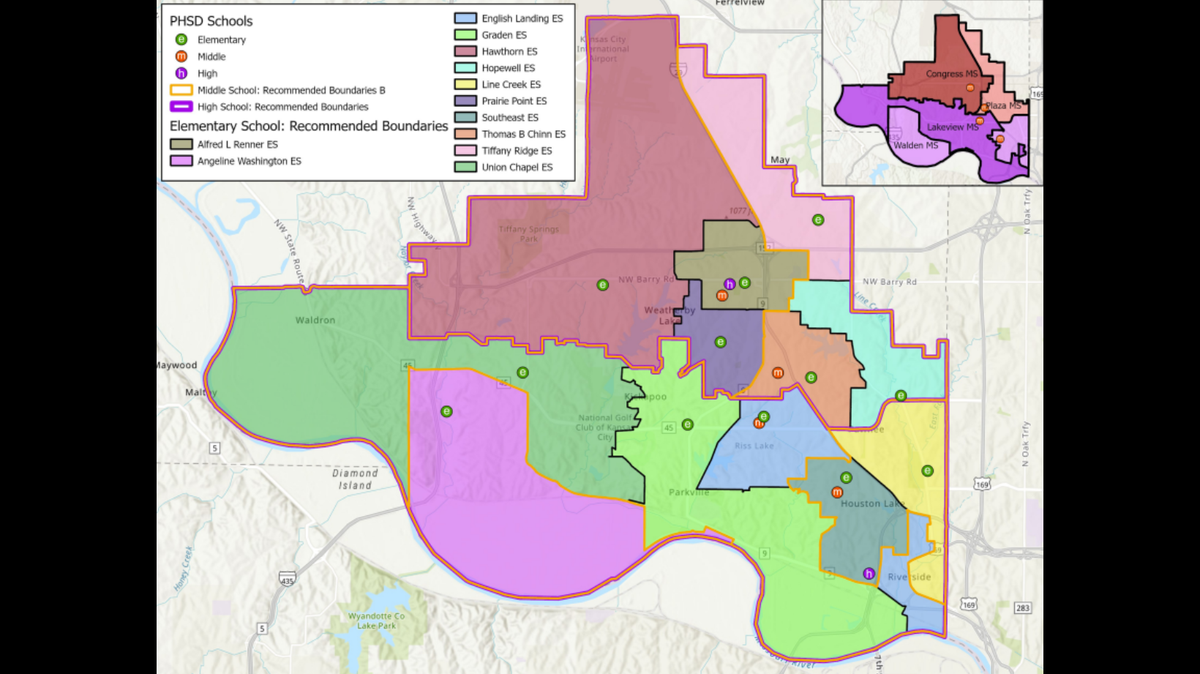
After six long months of hashing out a redistricting plan to accommodate its growing enrollment, Park Hill School District’s Board of Education unanimously approved a final proposal to change some of its school boundaries.
The plan the board approved on Thursday differed from what the district had sent out to parents earlier this week, in the end requiring fewer students to change middle schools. Last Monday, the district shared what was supposed to be the final map with families, which indicated that 400 kids would need to switch schools. However, the recommendation that went before the board on Thursday will only move 90 students, according to Kelly Wachel, Park Hill’s chief communication officer.
The district’s advisory board had created more than 20 variations of boundary maps in the past few months, while simultaneously considering feedback from the public. When deciding how to redraw the boundaries, the district’s guidelines said it prioritized maintaining enrollment and socioeconomic balance in schools across the district, while also considering how far students would need to travel to get to school, keeping neighborhoods together and limiting the number of students who would need to change schools.
The final boundary map will keep elementary school students together throughout the course of their K-12 education in what’s called a feeder model, instead of splitting students from one elementary school among multiple middle schools.
“The evolution of public comment, of the nature of emails and communication that we were getting throughout the course of the past few months, has definitely been a testament to how we’ve engaged and communicated and listened,” said Wachel. “We’re really proud of that.”
.png "park hill redistricting (1).png")
For months, parents and students from Riss Lake, Monticello, and the National neighborhoods have attended school board meetings in large numbers, filling out the public comment section to ask the district to keep students who live in each neighborhood together. Only one parent from a smaller neighborhood around Southeast Elementary School showed up for Thursday’s final meeting on the topic.
Aimee Sanita, a single mother of two students in Park Hill Schools, said she has voiced her concerns about her children being split from their peers through emails, calls and letters when she was not able to show up to school board meetings. Earlier in the week, Sanita sent a five-page letter to the board asking them to not split up her neighborhood. But despite her efforts, all board members voted in favor of the map with little to no discussion.
Sanita said that having relatively few school-age children in her neighborhood meant that her voice wasn’t factored as much as other parents’ into the board’s decision.
“Throughout the whole process, I feel there were lots and lots of comments from big neighborhoods,” she said. “There’s not that many people (in my neighborhood) to make a big protest about it.”
Sanita’s kids will move from Southeast Elementary, which she said is overcrowded, to English Landing, about half a mile away. Sanita questioned the boundaries before the vote, claiming that English Landing is also overcrowded.
Concerns of overcrowding and rising numbers of elementary school students in Park Hill are what prompted the new school boundaries in the first place.
Many of the elementary schools, especially in the southern parts of the district are approaching capacity, with some holding classes in academic trailers, Wachel said. From 2010 to 2020, the population in Platte County grew by nearly 20%, the highest increase out of all Missouri counties, according to U.S. Census data. In Park Hill Schools specifically, the district has experienced nearly a 47% population increase since 2000, according to a population analysis by the district.
Now, its newest elementary school, Angeline Washington, is expected to address the growing needs.
The target enrollment for each elementary school is 450 students, according to Wachel. But she said each is equipped to handle anywhere between 420 to 470 kids. With the new boundaries, none of the elementary schools are expected to be overcrowded.
.png "park hill redistricting (2).png")
The district also approved “grandfathering” clauses, which will allow children to stay at their school if they are in their final year at the school. If a student were supposed to move schools their 5th grade, 8th grade or 12th grade year, the district may allow them to finish their last year at the same school. This does not apply to siblings, and parents will be responsible for transportation if the family decides to keep a student at their current school.
Families with students on individual education plans, also known as IEPs, will be invited to meet with district officials personally to ensure a smooth transition or to decide if individual students will be best at their current schools, Wachel said.
“Everybody loves their schools so much that they don’t want to move,” said school board member Janice Bolin. “I really think everyone’s going to be just as happy at the schools that they end up at.”