
At 90, KC’s Alvin Brooks is appalled by recent gun violence. He offers some solutions
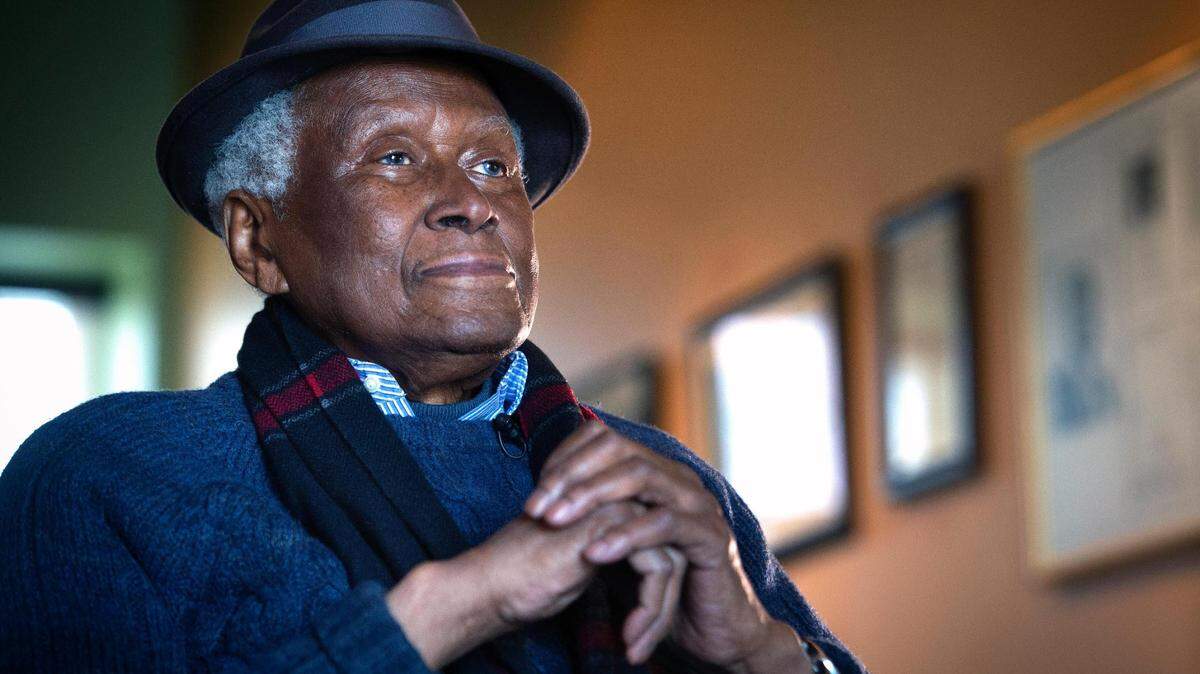
Alvin Brooks has lived a life in Kansas City that is the kind of stuff movies are made about. In fact, Oscar winning filmmaker Kevin Willmott is doing exactly that. Willmott, a screenwriter and University of Kansas film professor, won an Academy award for Best Adapted Screenplay in 2019 for his work on “BlackkKlansman.” He also wrote “Da 5 Bloods” and “The 24th.”
Now he’s working on a documentary film about Brook’s life based in part on Brook’s memoir, Binding Us Together: A Civil Rights Activist Reflects on a Lifetime of Community and Public Service, released in 2021.
Then Star reporter Mara Rose Williams sat down in an interview with Brooks and wrote the following Star story about Brooks, how he came to Kansas City and his contributions to the city in what at that time was nearly 90 years of residency here.
Original Story
The shooting death of Cardell Crawford outside Westport Ale House last weekend hit Alvin Brooks hard.
Crawford, just 24, was a close friend of Brooks’ family.
“He’d been here, to my home,” Brooks said. “It’s painful.”
For a man who has devoted his life to spreading peace, Brooks, now 90, has seen his share of violence. In the wake of a several deaths from gun violence locally, and the spate of mass shootings nationally, Brooks spoke to The Star about his sorrow and his hopes.
“I can recall back a number of years ago, when these two 17-year-old cousins went to a gun show over in the East Bottoms,” Brooks said.
The gun dealer told the underage teens if they came back with the cash, he would meet them later and sell them the firearms. They were semi-automatic pistols that held large clips of ammunition, costing around $750 each.
“They go out and sell some crack, and in two or three days they were back there with the money and (were) sold the two guns, and then they decided to rob a crack house,” Brooks said.
Afterward, the drug dealer put out a hit on them. The two were outside washing their car when they were injured in a drive-by shooting. One was shot in the leg, and the other was shot in the back and was paralyzed from the waist down.
An uncle of the paralyzed boy asked Brooks to visit him in the hospital.
“Those gun shows were really, really ones that unloaded a lot of guns in the community, particularly the African American community,” Brooks said. “That whole thing, ‘well, guns don’t kill, people do,’ well you’ve never heard of a drive-by cutting.”
A safer Kansas City
Now retired, Brooks knows the Kansas City Police Department from the inside. In the 1960s he served 10 years as one of its few Black officers.
He went on to organize the Ad Hoc Group Against Crime in 1977 and served in many roles in city government, including mayor pro tem.
He said his Ad Hoc group found success working with the criminal justice system.
“We try to work very close with the police, with the U.S. Attorney’s Office, the prosecutor, and ATF — Alcohol, Tobacco and Firearms,” he said. “We set up a hotline to call in if there were offenders who were known to be carrying guns, and we got a lot of calls and a lot of names of those who committed violent acts.”
The Ad Hoc Group still has a 24 hour community hotline at 816-753-1111.
“We still receive tips, but also request for our variety of services,” Damon Daniel, the organization’s current president, told The Star in an email. “We also have a youth hotline (816-531-2665). Although today’s youth will utilize social media before they pick up a phone.”
That pervasiveness of social media has also presented a new way for people to advertise their firearms.
“We had people who were ex-offenders who were bold enough to get on Facebook and show themselves with this semi-automatic weapon,” Brooks said. “People would forward that information to us and we’d forward it to the police or to the feds and they’d end up getting arrested.”
It’s key for community organizations to work with the city to reduce crime, Brooks says.
“It’s going to take all of those entities together to (bring) about the change,” Brooks said. “The criminal justice entities as well as citizens.”
The “divisiveness like you have now, between the community and police department” is not indicative of future success, Brooks said.
The best way to reduce gun violence is fixing the education system, he said.
“You can’t have school districts that are not performing or under-performing. That’s where the state government comes in,” Brooks said. “When they allow that to happen, they only allow it to happen in communities of color, poor communities, not only poor communities of color, but poor white communities, they’re victimized also.”
“Education ought to be equal regardless of where the student attends school.”
National gun laws
Brooks was happy to hear about the most recent federal gun legislation strengthening the national background check system for buyers aged 18-21.
“Sometimes I think we put guns before our children,” Brooks said. “Our babies have been killed, and still people are hollering ‘Second Amendment, Second Amendment.’”
After the mass shooting in Highland Park, Illinois, which killed seven and wounded dozens, Brooks hopes Congress will take another look at banning assault weapons.
“The tragedy of all this is that America has become so obsessed with guns,” Brooks said. “The stronghold that the NRA has on Congress at both national as well as state level is embarrassing to us as a nation.”
A ban on certain semi-automatic weapons, such as the AR-15, would not interfere with the Second Amendment, Brooks feels.
“We don’t use the power that we have, the voices that we have, to elect people who are much more understanding and willing to take on the force that be to reduce the violence,” he said. “As long as that happens … 10 years from now, we’ll still be talking about the same thing.”
“Our kids will still be murdered in schools and in neighborhoods, and they will still be shooting up our churches, our synagogues, our mosques, and we’ll still have street violence like in Westport, and other places in this city, which are a microcosm of what’s happening in cities across this nation.”
This story was originally published July 16, 2022 at 5:00 AM.