How did Eddie Cox, a white man, become a top leader of Kansas City’s Black Mafia?
For a brief period in the late 1960s and early 1970s, a crime organization dubbed the “Black Mafia” directed virtually 100% of the drug trafficking and much of the violence and crime on Kansas City’s East Side.
The organization was responsible for 17 murders, if not more, of men and women who refused to cooperate, owed money or who were suspected of being police informants, authorities believed. The group also carried out or organized several bank robberies.
“Gang Trafficked in Heroin and Death,” a headline in The Kansas City Times on July 30, 1971 reads.
On Thursday, a major leader of the group was released from prison early. Eddie David Cox, the man who authorities said set up the crime syndicate and was the “brains” behind its leadership, was set free on an order of compassionate release. He had served 32 years of a life sentence on drug and other offenses.
Cox, a white man, led the Black Mafia along with James Eugene Richardson and James Phillip “Doc” Dearborn.
The Black Mafia’s origins date back to 1969. Cox, who had been paroled a year earlier from Lansing, proposed to Dearborn that they should take over and control the crime on Kansas City’s East Side. The two had served time together in Lansing.
Cox is said to have recruited Richardson, who was released in January 1969 from Leavenworth after serving time for violating the Mann Act. Richardson was a widely known and feared on the East Side.
The three men launched their organization to take over the the drug trafficking and to control criminal activity.
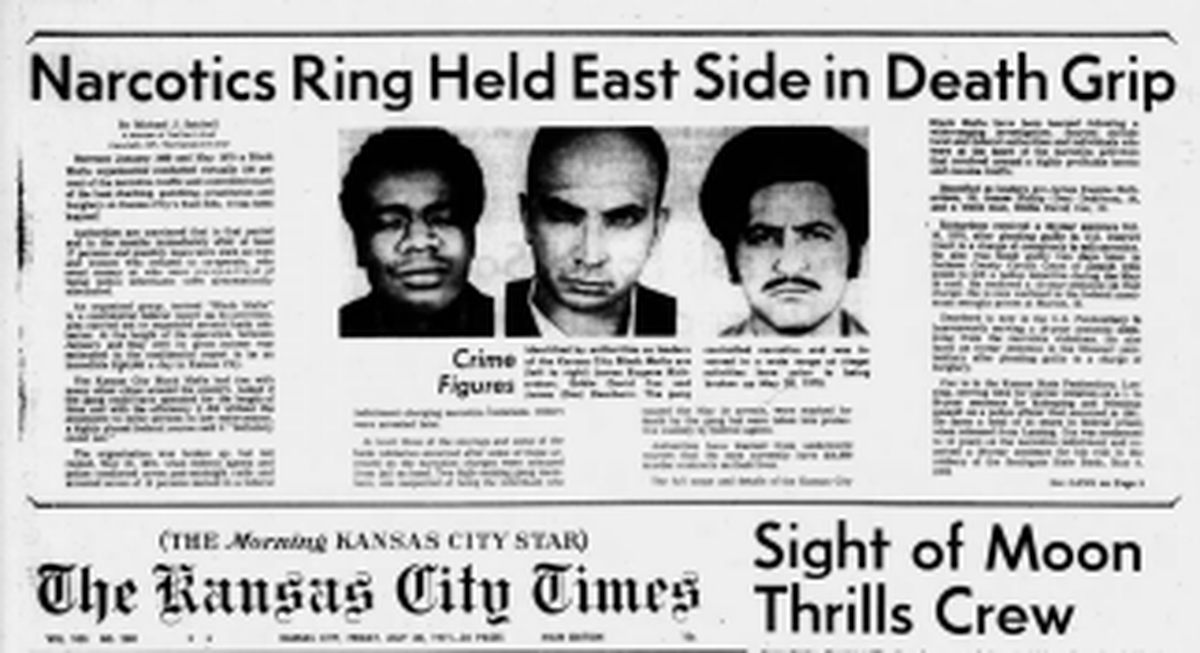
A confidential report for the organized crime section of the U.S. Department of Justice titled “Black Mafia,” said earlier activities by Cox, Dearborn and Richardson were not clear because most witnesses had been murdered or were not willing to talk.
“It was learned the men were engaged in clandestine wholesale narcotics,” the report said. “They were also engaged in crimes of bank robbery, burglary, murder, loan sharking, gambling and prostitution. They had the ghetto area of Kansas City under their complete control through fear, intimidation, violence and corrupt public officials.”
At the height of the operation — January 1970 through May 1970 — authorities estimated that the Black Mafia was taking in approximately $100,000 a day, most of it through narcotics.
The organization was broken up in May 1970 when federal agents and police conducted post-midnight raids and arrested its members.
Leon Jordan murder
The Black Mafia also was tied to the assassination of politician and civil rights leader Leon Jordan.
Jordan, a former Kansas City police officer and co-founder of the black political club Freedom Inc., was gunned down about 1 a.m. on July 15, 1970, outside his Green Duck Tavern at 2548 Prospect Avenue.
For nearly 41 years, his murder was never solved to the satisfaction of the county prosecutor. But a 900-page investigative report released in June 2011 by the Kansas City Police Department revealed the mastermind of the murder and the gunman was James “Doc” Dearborn.
Although indicted in Jordan’s killing in the early 1970s, Dearborn was never tried. He later was fatally shot at a motel near Wheeler Downtown Airport in 1985.
Kansas City police had reopened the cold case following stories in The Kansas City Star in 2010. The police investigation, which mirrored many of The Star’s findings, found that the Italian mafia and the Black Mafia both appeared to have played a role in the conspiracy that led to Jordan’s slaying.
Release from prison
Cox, 86, was released from prison Thursday, according to a legal representative who also served time with Cox in Leavenworth. Cox has spent most of his life in prison, including for convictions of bank robbery and conspiracy to violate narcotics laws.
At the time Cox led the Black Mafia, the federal government described him as a “cold-blooded killer” accused of taking part in at least 17 murders in the Kansas City area. He was also accused of being involved in the killing of a federal narcotics agent in Chicago.
Cox has long been described as a cunning and highly intelligent man. He gained a reputation as one of the greatest jailhouse lawyers in the country.
“He’s as good as many of them and better than some,” a judicial once said when asked how he compared with licensed attorneys practicing in federal court.
“He’s thorough, diligent and concentrates on areas where there conceivably could be a legal question. He doesn’t strike out in all directions as so many inmate writ-writers do.”
Russell Marks, a paralegal helping Cox readjust to civilian life, said Cox helped set him on a good path while they were both in prison. Marks said Cox has spent many years helping other inmates become familiar with the legal system.
He added that for all the bad things from his past, Cox has spent recent years doing a lot of good.
“He was worthy of compassionate release,” Marks said.
This story was originally published July 2, 2021 at 12:00 PM.