Kevin Strickland is serving life for 1978 murders. The guilty men, only witness said he’s innocent.
Just before 9:30 p.m. on a Tuesday, April 25, 1978, a call about a shooting crackled through police radios. Patrolling under the clear and dark sky, officers threw on their emergency lights and sped to South Benton Avenue in Kansas City.
The first officers to arrive found a woman, Cynthia Douglas, 20, screaming, suffering from a shotgun wound above her left knee. Her clothes were covered in blood and brain matter. As they applied pressure to the injury and questioned her, the officers realized she was among four people shot in a nearby bungalow.
Douglas, detectives soon learned, was the only survivor — the lone witness who, aside from the shooters themselves, could tell them what unfolded inside the small, white house at 6934 S. Benton Ave.
Walking inside, detectives saw blood smeared on the door between barred windows. They found a man lying face down in the living room, his hands tied behind his back. In the bedroom, a woman sat on the floor with her hands tied in front of her. A man lay tipped over onto the bed, his wrists also bound, his feet hanging off the edge. Each had been shot in the head.
Outside, about 60 people gathered in the lawn and street, comforting each other as they waited on word of the victims’ identities. News cameramen crouched behind a brown rope police used to guard the crime scene, their lenses watching as investigators searched the stoop.
The acting police chief joined detectives at the scene. So did the top warrant officer from the prosecutor’s office, who was there to oversee legal questions. His presence, a captain said, was a matter of “making sure we touched all the bases.”
“And,” he added, “we’re not perfect.”
Indeed, the investigation would never catch all four of the killers. But it did result in a lifetime in prison for an innocent man, according to two other men convicted in the murders and the only witness.
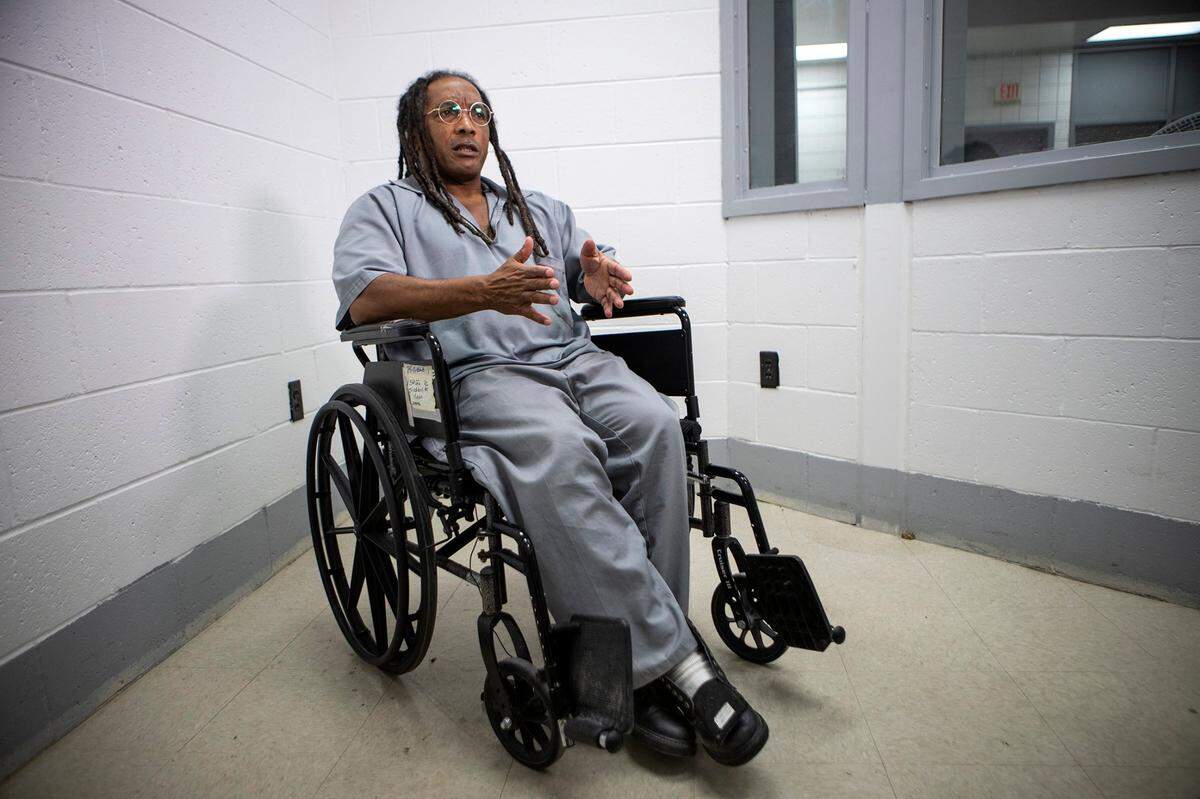
Four decades later, Kevin Strickland, who was 18 when he was arrested, is the only one still in prison. Now 61 and using a wheelchair, he maintains he was wrongfully convicted.
Vincent Bell and Kilm Adkins admit their guilt. Both were convicted, served time behind bars and are now free. Both say Strickland wasn’t there.
Instead, they identified two other men who were involved but never arrested.
“I know because I’m one of the ones who did it, God forgive me,” Bell told The Star.
The testimony of Douglas, who identified Strickland as one of the gunmen, was paramount in the case against him. But she, too, would later say police had the wrong man.
Strickland could not have been put on trial without her testimony, said John O’Connor, now a prominent Kansas City defense attorney who worked on the case at the time as an investigator for the Jackson County Prosecutor’s Office.
“Period, end of story,” O’Connor said. “This case rises and falls on Cynthia Douglas.”
For years, Bell has said Strickland’s time in prison is “for nothing.” He asserted Strickland’s innocence in front of a judge a year after the killings and, in 2013, signed an affidavit saying Strickland did “not commit or know anything about” the crime.
“Who’ll ever know what the man could have been,” Bell said.
The killings
Before Douglas was placed in an ambulance that night, detectives came away with the names of two suspects she knew and recognized: Bell, 21, and Adkins, 19.
She could not, however, identify two other killers who also fled into the night. One had a brown paper sack over his head, she said. The other carried a shotgun and repeatedly told her, “Don’t look at me.”
Ambulance attendants would soon remove the bodies from the home. The identities of the slain were confirmed at the morgue: Douglas’ boyfriend, John Walker, 20; her close friend, Sherrie Black, 22; and 21-year-old Larry Ingram, who rented the bungalow.
In time, Douglas would tell detectives what she could about the shooting, some of which was bolstered by what Bell said in his 1979 guilty plea to three counts of second-degree murder.
That afternoon, Bell and Adkins, along with Terry Abbott, 21, and a 16-year-old boy, went to Swope Park and drank beers.
Afterward, on their way to Bell’s mother’s house, they stopped to talk to Strickland, who lived on the block and was outside. The four didn’t stay long.
Abbott and Adkins later talked about getting their money back from Ingram, who the week before beat Adkins out of $300 using crooked dice in a crap game.
The bungalow was used to throw gambling parties. Another game was set for that night, so the group drove there in two cars.
Douglas, Black and Walker were watching TV, smoking weed and drinking cognac when the four arrived. Three’s Company, a sitcom that began airing the year before, was about halfway over.
The group tied up the victims before ransacking the house. Then they shot each of them.
Shotgun pellets lodged in her thigh, Douglas slumped over with Black, pretending she was also dead.
Douglas listened, waiting for the killers to leave before freeing herself and limping out of the home to search for help. She hobbled over to a 17-year-old girl who was outside, grabbed her and fell to the sidewalk.
“Hide me,” Douglas cried. “They don’t know I’m alive. They think they killed me.”
Later, after Douglas was released from a hospital, she would identify Strickland as one of the killers. Bell and Adkins saw Strickland’s arrest on the news.
“That’s good,” Adkins told Bell. “’Cause they starting off wrong.
“They picking up the wrong man.”
After escaping to Wichita, Bell and Adkins were arrested and brought back to Kansas City to face murder charges.
Throughout the court hearing as he pleaded guilty, Bell insisted Strickland was not with him and the other suspects during the shooting. He proclaimed of Douglas’ identification: “She made a hell of a mistake.”
“I’m telling you the truth today that Kevin Strickland wasn’t there at the house that day,” Bell said. “I’m telling the state and the society out there right now Kevin Strickland wasn’t there at that house.”
The eyewitness
Strickland remembers his first trial ending in a hung jury of 11 to one, with the only Black juror, a woman, holding out for acquittal.
One of the prosecutors, he recalled, came to the defense table and said: “This won’t happen next trial.”
Two months later, an all-white jury convicted Strickland of one count of capital murder and two counts of second-degree murder. He was sentenced to life in prison without the possibility of parole for 50 years.
The most damning testimony at trial came from Douglas. She said there was “no question” Strickland was one of the gunmen, though her testimony at times did not match that of police.
Decades passed. While Strickland languished in prison, Douglas married and became a grandmother. The murders and her testimony disturbed her all those years, and she was working in accounting at the Jackson County Family Court Division in 2009 when she wrote an email to the Midwest Innocence Project.
Its subject line: “Wrongfully charged.”
“I am seeking info on how to help someone that was wrongfully accused,” Douglas wrote. “I was the only eyewitness and things were not clear back then, but now I know more and would like to help this person if I can.”
Strickland, stunned by the turn of events, signed an application for the group to investigate. “This is it,” he thought.
But innocence claims take years to investigate, and in 2015, Douglas died at age 57.
In the intervening years, the Midwest Innocence Project changed administration. Strickland’s case, he recalled, was “shelved and collected dust.”
‘Mistaken, coerced identification’
Until a reporter visited her Kansas City home in November, Douglas’ mother, Senoria Douglas, 83, had not seen the email her daughter sent to the innocence group.
She read it to herself and made a copy. She recalled how, after the shooting, her daughter had to escape to Oklahoma City for protection.
If her daughter believed what she typed in the email, Strickland shouldn’t remain imprisoned, she reasoned. “Let him go.”
Months later, Senoria Douglas and two of her other grown children told The Star that Cynthia had said she was pressured — by whom, they did not know — to identify Strickland.
She was traumatized, they said. She was 20 years old and didn’t know any better. But she later said she had made a mistake.
“All I know is that she said she picked the wrong guy,” Senoria Douglas said. “That came from my daughter’s mouth to me.”
In fact, Cynthia Douglas’ ex-husband, Ronald Richardson, says she told him the same thing. He laid out the details in a 2016 affidavit.
During a police lineup the day after the shooting, detectives told Douglas all she had to do was pick a man nicknamed “Nordy” and “things would be over.”
Strickland went by that nickname, and Douglas had no problem choosing him because she already knew him.
But when she heard Bell’s version of events, Douglas realized she was wrong. At that moment, Douglas approached a prosecutor and told him she should not have picked Strickland.
As Douglas related to Richardson, the prosecutor told her to go away and threatened to charge her with perjury.
Richardson suggested Douglas do the right thing and “let someone know about her mistaken, coerced identification of Kevin Strickland.”
In July, speaking by phone from a Missouri prison where he is serving time for an unrelated crime, Richardson said police exploited Douglas — who watched her best friend die and suffered from survivor’s guilt — when they “coached” her into choosing Strickland.
“They took advantage of this girl,” Richardson said. “The scars, you know, were there years later.”
Richardson is incarcerated at Western Missouri Correctional Center in Cameron along with Strickland. He once apologized to him on Douglas’ behalf.
Before Douglas died, Richardson said, she wanted nothing more than to see Strickland freed.
“Trust me, man,” Richardson told Strickland, “she wanted you out.”
Strickland has maintained he was at his family’s home on the night of the murders, watching television and talking on the phone with his girlfriend.
His brother L.R. has backed him up. Now 64, L.R. remains puzzled that the prosecutor’s office accepted Bell’s admission of guilt in his plea but ignored his assertions of his brother’s innocence.
“It seems like the justice system is cherry picking things,” he said. “Within that, he was saying that my brother was not involved. So, what does that mean?”
Strickland’s girlfriend at the time, who has since married, told The Star that on the night of the shooting, she and Strickland planned out their schedules for the next morning. She would drop their newborn daughter off at his house before a doctor’s appointment, they decided.
“I was talking to him on the phone at the time they said everything took place,” she said. “So he couldn’t be in two places at the same time.”
Other suspects
In the early stages of their investigation, detectives listed as a suspect Terry Abbott, one of the men Bell and Adkins said was with them during the shooting.
But he was not arrested. Adkins has never understood why.
Instead, Abbott left Missouri a free man.
Within a few years, he was arrested for a robbery in Denver and got a life sentence. One of the victims, reached by phone in March, can still remember it like it was yesterday: A gun to his head, being forced to crawl like a dog, getting locked in a room.
Imprisoned in Colorado, Abbott told another inmate “with no uncertainty” that Strickland was innocent, according to an affidavit filed with one of Strickland’s appeals.
Now 63, Abbott remains incarcerated at the Buena Vista Correctional Complex, a prison shadowed by a section of the Rocky Mountains in a small, central Colorado town. He did not respond to letters seeking comment.
Also never arrested for the murders was the fourth assailant, the teenager who brandished the shotgun in Ingram’s house.
The teenager, who is not being named by The Star because he was not identified as a suspect at the time, was mentioned by name a handful of times in police reports.
He and Strickland looked alike: they were both short and had similar features, such as their lighter complexion. Strickland’s brother Roland, 58, said he always thought the two “could have been brothers.”
More than a year after the killings, the teenager was charged in a robbery at a motel. He later pleaded guilty to a lesser felony.
Three years before the murders, the teen had suffered his own traumas.
At age 13, he ducked in the backseat of a car — a block from his home — when someone fired a volley of bullets inside, killing one of his brothers.
Now 59, the man listed his address on a recent traffic ticket as a home in suburban Aurora, Colorado, down the street from an elementary school. He stood outside the same house to pose for a picture displayed on his Facebook page, before he took it down.
When a reporter knocked on the door in March, a woman who answered denied knowing the man.
‘Inherently unreliable’
Several detectives who investigated the 1978 shooting said they couldn’t remember it today. One lamented: “Sadly, as like today, there were hundreds of cases like this.”
Charles Wellford, an expert on homicide investigations who worked for years at the University of Maryland, reviewed the case file and said detectives were right to suspect Strickland.
Several indicators pointed to him: Douglas’ identification, a fingerprint on Bell’s car, shotgun shells he gave to Bell before the killings.
The investigation appeared sound for the 1970s, before police recorded interviews or used DNA testing, Wellford said.
At the time, without widely-available surveillance cameras or cellphone data, detectives sought out multiple people to corroborate an eyewitness’ account. But witnesses can be influenced by people they talk to.
“Eyewitnesses are inherently unreliable,” said David Carter, a criminal justice professor at Michigan State University who worked as a Kansas City police officer in the early 1970s. “Recall is tricky; recall is selective.”
In fact, faulty eyewitness identifications contributed to about 70% of the more than 360 wrongful convictions reversed by DNA evidence across the U.S., according to the Innocence Project.
That percentage is even higher in Missouri, the Midwest Innocence Project says. And until a Missouri Supreme Court ruling Sept. 1, trial judges in the state regularly barred defendants from calling eyewitness identification experts to the stand.
For Strickland, it came down to one witness: Douglas.
“That’s why he got convicted,” said O’Connor, the investigator who worked on Strickland’s case. “I don’t think it’s more complicated than that.”
O’Connor believes a judge should hear Strickland’s innocence claim.
Reached by phone in April, James Bell, a former Jackson County prosecutor who assisted in the case against Strickland, said he also thinks a court should evaluate his new evidence “out of an abundance of caution.”
Prosecutors believed Douglas’ testimony at the time, recalled Bell, who went into private practice in the 1980s. Otherwise, he said, they would not have relied on her.
Asked about Vincent Bell’s plea hearing, during which he insisted Strickland was not there, James Bell said he did not know what, if any, action the prosecutor’s office took with that information. He said another prosecutor, who presented the case at trial and has since died, “called the shots.”
James Bell gives some credibility to the fact Douglas’ relatives say she wanted to walk back her testimony. One problem now, he said: there is no way to cross-examine her.
Asked if there is a possibility Strickland is innocent, Bell responded: “Oh yeah, there is definitely a chance.”
Reached for comment about the case, Kansas City Police Department spokesman Sgt. Jake Becchina referred questions to the Jackson County Prosecutor’s Office.
Michael Mansur, a spokesman for the prosecutor’s office, said the office has not received a request to review Strickland’s case. If it does, he said, it will examine the file.
‘About as bad as it gets’
Adkins, standing in the kitchen of his Kansas City home last fall, said Strickland was not with him and the other suspects that night.
“The man is innocent,” Adkins, now 62, insisted on a Sunday afternoon as he watched the Chiefs on television. “He spent 40-some years in prison. I mean, you know, I don’t know what more you can say. That’s about as bad as it gets.”
It had been decades since Adkins took an Alford plea to three counts of second-degree murder, conceding prosecutors had enough evidence to convict him without admitting guilt. It had also been 38 years since Adkins signed an affidavit stating Strickland was “not involved in the homicides.”
Adkins and Bell spent about 10 years in prison for the murders before they were released in 1989 and 1990, respectively. Both were later sent back to prison for unrelated drug convictions. They have since been freed again.
Adkins, who now runs a lawn care business, explained he couldn’t have testified at Strickland’s trial because he had not yet entered his plea, and the charges pending against him could have landed him on Missouri’s death row. Strickland’s case was the first to go to court.
“I was fighting for my life,” Adkins said.
Adkins assumed Strickland’s case would have been reopened after Bell’s detailed confession, but he believes police and prosecutors did not want to admit a grave mistake had been made. No one was willing to take responsibility, he figured. No one cared whether Strickland was innocent or guilty.
If called upon today, Adkins would go to court to set the record straight.
“I believe in the day of judgment,” he told The Star. “I felt like if I’m going to be judged for a lot of other things that I’ve done wrong with my life, but not trying to help him, I didn’t want that to be on my conscience.”
‘I’ve never killed anybody’
Ricky Kidd, recently freed in a much-publicized exoneration case, was in prison with Strickland and often heard him talk about his innocence.
Kidd found Strickland, with his wire-rimmed glasses that touch the edges of his graying dreadlocks, to be genuine.
Before Kidd walked out of prison last year, after spending 23 years behind bars for a 1996 double murder he did not commit, he left Strickland his gray, state-issued pants.
Strickland wanted them because they have pockets.
In prison, Strickland has filed appeals and worked jobs that included boxing license plates.
Much of the outside world is a mystery to him now. He has never used a cellphone. His family’s home no longer exists, replaced by a vacant, grassy lot. Many people who were close to him have drifted away or died. He has met his grandchildren three times. When his father died, he couldn’t attend the funeral.
Sitting in a visitor room at the Cameron prison in November, Strickland said he wished he had been sentenced to death.
At least then he would have been appointed a lawyer he believes could have assisted in exonerating him years ago. But he does not regret not taking a plea deal that would have given him a chance at freedom within 15 years because, he said, it would have required him to say he was guilty when he was not.
Strickland has been confined with men who have killed. Many talk tough to other prisoners, but when they’re alone with their thoughts, they’re miserable. Some holler in their sleep.
“I’ve never killed anybody, and I don’t imagine that you have either,” Strickland said. “But they say that’s a heck of a burden to carry around.”
Strickland believes Douglas’ identification, his association with Bell and his ignorance are what landed him in prison.
Since Strickland went away, at least half of the jurors who voted to convict him have died. He wishes he could ask them: What exactly persuaded them of his guilt?
One juror, a woman in her 80s, said she received a letter years ago that stated Strickland is innocent, but she did not know who sent it, so she threw it away. The woman could only recall one detail from the trial: Strickland, she opined, looked in court like “your typical next door neighbor,” but in his driver’s license photograph, he appeared to be “a lowlife.”
“I mean, he looked like a thug,” she suggested.
The Midwest Innocence Project, which has been actively investigating Strickland’s case for two years, is considering ways to file a petition on his behalf. Its executive director, Tricia Rojo Bushnell, fears as the coronavirus spreads into prisons, Strickland would not survive if he became infected.
“If he were to die in prison and not have a full day in court,” she said, “I think it says so much more about all of us than it ever said about him.”
Strickland’s health declines daily. He has a history of breathing problems and can’t stand for long because of back troubles. He recently awoke with unfamiliar abdominal pains and thought of COVID-19. The virus, he said, would “certainly end my quest for physical freedom.”
In April, Strickland called it bad luck the world was “coming to an end” as Bushnell’s team continued to investigate his case. In one of his nightmares, his innocence claim was set for a hearing, but he was the only person in the courtroom.
“The virus had taken everyone!” he wrote in an email. “Nobody to even take the handcuffs off me.”
He woke up sweating profusely.
Since then, Strickland has asked Bushnell: “Will my case continue if I die?”
Strickland has spent 15,067 days behind bars. If he is exonerated, it will be one of the longest wrongful imprisonments known in U.S. history.
Strickland is set to start seeing the parole board in 2024. He’s heard inmates have a better chance of parole if they accept responsibility for the crimes for which they were convicted. Because of that, he told his daughter, who is now in her 40s, he likely won’t get out.
“There is no way I’m going to accept responsibility or admit to a crime I had nothing to do with,” Strickland said, shaking his head. “I’m not going to do it. I’m not going to do it.”
His life is over, he said. It’s a matter of principle now.
BEHIND THE STORY
MOREHow we did this story
To construct this story, Star reporter Luke Nozicka interviewed more than two dozen people and reviewed hundreds of pages of police reports and trial transcripts. He also based his reporting on affidavits and newspaper stories, among other things. While some of the key players involved in the case have died or declined to comment, The Star drew upon their statements made to police or in court.
This story was originally published September 27, 2020 at 5:00 AM.