Kansas man was framed in ‘Machiavellian’ murder-suicide scheme, lawyers argue
Attorneys for a Kansas City, Kansas, man went to court this week seeking to have his 2009 murder conviction vacated, arguing he was framed for a shooting that was actually a murder-suicide.
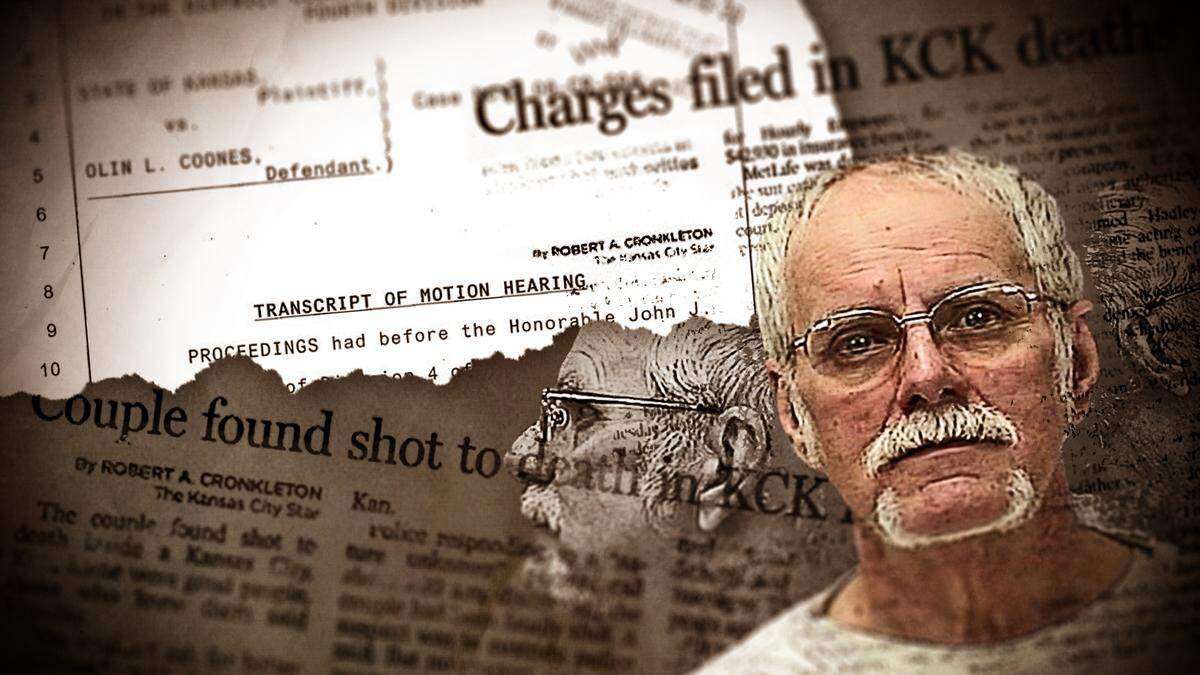
Olin “Pete” Coones, now 62, was charged in Wyandotte County with first-degree murder in the deaths of Kathleen and Carl Schroll, who were found fatally shot in their home. He’s been locked up ever since.
Now Coones is represented by Alice Craig, an attorney with the Project for Innocence and Post Conviction Remedies at the University of Kansas, along with lawyers from the Midwest Innocence Project.
During a hearing Thursday at the Wyandotte County Courthouse, they outlined their case for why Coones’ conviction should be overturned.
No physical evidence tied Coones to the crime. He was, his attorneys claim, the victim of a “Machiavellian plot” by Kathleen Schroll and the questionable testimony of a jailhouse informant put up by the prosecutor.
After two trials, Coones was convicted of killing Kathleen, but not Carl. In the first trial, prosecutors withheld exculpatory evidence related to his alibi. It was in the second trial, Coones’ lawyers say, that the prosecutor turned to a jailhouse informant he had been warned was not trustworthy.
“The impression I get is that he’s not reliable at all,” another county attorney told the prosecutor in Wyandotte County, according to Coones’ petition, filed in Wyandotte County District Court in September.
Craig said Thursday the district attorney’s office voiced concern that not all discovery in the case had been disclosed, which would amount to a constitutional violation.
Wyandotte County Assistant District Attorney J. Antwone Floyd agreed an evidentiary hearing would be the best course of action. At that hearing, Coones’ attorneys plan to present evidence they consider new.
Coones’ hearing began hours before Kansas lawmakers in Topeka heard from two men who spent years in prison for crimes they did not commit. They called for more transparency about when prosecutors use jailhouse informants.
The prosecutor in Coones’ case, Ed Brancart, did not return a call or email seeking comment. He now works as an assistant attorney general in Kansas. A spokesman for that office referred questions to the Wyandotte County District Attorney’s Office.
Alleged elder abuse
Kathleen Schroll, who went by Kathy, had been hired part-time by Coones’ sister to help take care of their father, Olin Coones Sr. A World War II veteran, the elder Coones suffered from dementia.
But Coones became concerned Schroll was taking money and assets from his father. According to Coones’ attorneys:
In the months after Coones’ sister died, leaving his father in the care of Schroll, checks for more than $28,000 were written from the father’s account to Schroll. Thousands were withdrawn from his savings.
Coones had reported claims of financial fraud and elder abuse against Schroll to the Kansas City, Kansas, Police Department and the Kansas Department for Children and Families. The state agency in 2006 sent Schroll a letter alerting her it found she financially exploited Olin Coones Sr.
Coones also called his father’s bank, which asked the elder Coones to come in. He arrived with Kathy Schroll. A bank employee had concerns about his ability to manage his accounts, so she froze them. The employee recalled it as the “worst case of elder abuse she experienced.”
As part of the police investigation, detectives sent 120 of the elder Coones’ checks to the Kansas Bureau of Investigation, which determined it was unlikely he wrote 118 of them, but he could not be ruled out as the signatory.
That case against Kathy Schroll was referred to the district attorney’s office for charges, but the prosecution was declined. Prosecutors did not provide a reason for declining the case.
The death of Coones’ sister also meant Schroll was the sole owner of Coones Sr.’s home at 7650 Parallel Parkway.
After the elder Coones died, Pete Coones learned Schroll had been listed as a beneficiary of his father’s life insurance — something that had been done online without power of attorney. Coones challenged the change in beneficiary.
The insurance company asked a federal court to determine who the proper beneficiary was. In April 2008, Coones offered to give Kathy Schroll a quarter of the money as a settlement.
Schroll was coming under increasing pressure because of her financial dealings, according to Coones’ lawyers.
The shooting
A week later, Kathleen Schroll called her mother at 2:21 a.m. April 7, 2008. She said Coones was in her home.
“He said he is going to kill Carl and he said he is going to kill me,” Schroll said. “He said he has his tracks covered where no one will know who did it.”
Schroll’s mother asked if she called the police. She had not. The mother did not hear gunshots or voices in the background before the line went dead. Schroll sounded afraid, but she was not shouting, her mother said. The mother had her son call 911.
When police arrived at the Schroll home at 47 South 78th Street in Kansas City, Kansas, they found the front door partially open. Inside, officers found Kathy’s body on the living room floor and Carl’s body in the bed, his legs hanging over the edge.
Carl Schroll, 64, was shot twice. Kathleen Schroll, 45, was shot once in the back of the head. Both were shot with a revolver Kathy often carried in her purse, according to testimony. It was found near her left foot, Coones’ lawyers said.
At 2:52 a.m., a sergeant reported a possible murder-suicide at the home, according to the petition filed by Coones’ lawyers. The home was neat and clean, showing no sign of a struggle, police said.
But because of the phone call, Coones became the focus of the investigation, his attorneys argued.
The state’s case against Coones largely centered on that call, the informant’s testimony and Coones’ legal dispute with Schroll.
At trial, the prosecutor argued Coones was not getting the results he wanted from police. As the civil court date approached, Brancart told jurors, he “took matters into his own hands.”
But Coones’ attorneys now claim Kathy Schroll shot her husband and then herself because financial abuse and fraud investigations were catching up to her. Schroll had been embezzling money from the credit union where she worked, Coones’ attorneys claimed.
“She had no way out,” Coones’ attorneys wrote. “By framing Pete, she stopped the investigation into her action and ended all challenges Pete was making to the proceeds of the insurance, the house and money taken from Olin Sr.’s account.”
Schroll’s daughter, Blair Hadley, called that claim “nonsense” and said her mother had no reason to end her life. She believes Coones carried out the shooting and noted that he was convicted twice.
“People are trying to make her out to be a monster and she’s not,” Hadley said Thursday. “(Coones) is just trying to get out of this.”
At trial, a doctor was not asked about the possibility of suicide, Coones’ lawyers said. The attorneys plan to have a doctor testify that, while uncommon, it is possible for someone to shoot themselves in the back of the head.
Among Coones’ new evidence is the testing of gunshot residue swabs collected during the investigation, which his attorneys said confirms their theory of murder-suicide. The testing showed residue on Kathy Schroll’s left hand; testing on the steering wheel of Coones’ van came back negative.
No DNA or blood evidence related to the shooting was found on Coones’ clothes or in his house or car, according to his petition.
Schroll’s DNA was found inside the gun’s barrel and on the trigger, according to the state’s response to Coones’ petition.
Coones’ alibi
In the hours around the shooting, Coones was at home, his daughter testified at trial. She said Coones went to his bedroom about midnight while she and her boyfriend watched a movie in the living room.
She later heard him coughing badly and typing at his computer, she said.
She testified Coones came out and went to the bathroom about 2:30 a.m. — minutes after Schroll called police. Her boyfriend testified he believed Coones went to the bathroom around 2 a.m.
By 6 a.m., she heard Coones calling to wake up his other children because walking up stairs made him sick. He had previously suffered two strokes and a heart attack, his attorneys said.
Coones was arrested that morning as he drove his younger children to their school bus stop. His teenage daughter was handcuffed and his son said a shotgun was held to his head, according to testimony.
Information on Coones’ computer showed someone was on the device from 1 a.m. to 2:28 a.m., according to Coones’ lawyers.
If Coones had left the home, he would have had to walk by his daughter and her boyfriend, the boyfriend testified.
But jurors have a tendency to not take alibi testimony from friends and family members seriously, Craig told The Star.
The informant
Before trial, Coones was moved from Wyandotte County to the Butler County jail and placed in a cell with a man named Robert Rupert, who was in for a parole violation. Coones found Rupert reading his legal documents, his attorneys say.
An officer testified Wyandotte County only sends detainees to Butler County, near to Wichita, if a defendant’s court date is a month or more away. But Coones was transferred there three days before a status conference, his lawyers said.
Brancart has said he did not order Coones to be housed with Rupert, Craig said Thursday.
At trial in December 2009, Rupert appeared as a witness in orange clothing and shackles.
Before he began questioning the informant, the prosecutor told him: “Let’s put you up for the jury’s inspection, bark and all, okay.”
Brancart walked through Rupert’s criminal history, which included convictions for mostly theft from the 1980s to 2002.
Coones’ attorneys claim Brancart used the informant because he had “little evidence” aside from the phone call connecting Coones to the shooting. Brancart was in contact with four informants, but Rupert was the only to testify, the petition said.
Another informant had tried to obtain information from Coones but was not successful, his attorneys said. That informant worked with a police officer to wear a wire into the Wyandotte County jail to talk with Coones. The man also wore a wire when he was released from custody to try and get information from Coones’ wife, the petition said.
Rupert told the jury Coones would talk with him when Rupert was working on a legal claim. As they spoke, Coones talked about his pending charges and confessed to the shooting, Rupert testified.
“Did the things that Mr. Coones tell you, did they, were they couched in this way, ‘This is what the prosecution has on me?’” Brancart asked. “Or were they couched in terms of, ‘This is what I did?’”
“Both ways,” Rupert responded.
“Both ways, so some of each?” Brancart asked.
“A little each, yeah,” Rupert said, according to a transcript. “Depending on what mood he was in, how mad he was.”
In their recent petition, Coones’ attorneys said Rupert’s testimony included serious inconsistencies.
Rupert testified Coones told him he was not worried about the fact that police confiscated his van, because he used his Jeep during the crime.
But Coones couldn’t have driven the Jeep on the day of the shooting because he sold it a year prior, his attorneys say.
Rupert testified Coones climbed through a window after the shooting. Yet the windows of the home were closed, and it was unlikely Coones — who was in poor health at 5-foot-9 and more than 250 pounds — could have done so, his lawyers argue.
Coones’ lawyer at the time asked if Rupert went to the district attorney “just out of the goodness” of his heart.
“You know, I’m sorry, I don’t know how you perceive it or you accept it or take it,” he responded, “but when two people wind up murdered, it is a pretty horrific situation and something needs to be done about it.”
Before the trial, a Butler County attorney told the Wyandotte County prosecutor he offered Rupert a 20-month break in his sentence for his cooperation. But a judge ordered Rupert to serve his original sentence.
“Hey, I didn’t get my deal,” Rupert told prosecutors after, according to Craig, one of Coones’ attorneys. “What’s up?”
Part of Coones’ new evidence was the prosecutor’s pre-trial to-do list. The handwritten note included the words “give discovery” next to the names of two jailhouse informants he had been in contact with, according to Coones’ lawyers.
It was unclear what exactly the note meant. Asked if it’s common for prosecutors to give jailed witnesses evidence, Craig responded: “It shouldn’t be.”
Informant bill
Claims made by Coones’ attorneys echoed stories from exonerated men heard Thursday at the Kansas Statehouse.
“People will say anything to avoid incarceration,” said Floyd Bledsoe, who spent 16 years in prison for a murder that was carried out by his brother.
Bledsoe spoke as a House committee considers a bill that would require prosecutors to disclose more information about jailed witnesses. He was also represented by Craig, one of Coones’ attorneys.
Nearly 20% of people who have been exonerated because of DNA watched jailed witnesses testify against them, the Innocence Project says. Informant testimony is the leading cause of wrongful convictions in capital cases, according to a 2004 survey conducted by the Northwestern University’s Center on Wrongful Convictions.
Coones’ conviction was upheld in 2014 by the Kansas Supreme Court. But the justices said a U.S. Supreme Court case required vacating Coones’ life sentence with no chance of parole for 50 years.
He was then sentenced to 25 year to life in prison.
Since he was charged, Coones has maintained his innocence.
“I believed in the system for 50, almost 54 years,” he said at his sentencing. “I still believe at some point that the system will work.”
Coones remains at the Norton Correctional Facility in northern Kansas, a more than five-hour drive from Kansas City, Kansas.
To prove actual innocence, Coones’ attorneys will have to establish it is more likely than not that no reasonable juror would have convicted him in light of his allegedly new evidence.
At the Wyandotte County Courthouse on Thursday, Judge Jenny Orth Myers found Coones demonstrated manifest injustice. She set an evidentiary hearing to begin March 23.
This story was originally published February 9, 2020 at 5:00 AM.