Hate crime or stray bullet? Kansas City man’s death stirs fears in LGBTQ communities
Ta’Ron Carson knew how to apply makeup, so his expertly contoured jawline and highlighted cheekbones stood out as he twirled along the sidewalk on Main Street in Midtown Kansas City on a Saturday night. As usual, he was surrounded by friends.
They had spent the night dancing to electronic music at Aura, a nightclub near East 39th and Main, and left when it closed about 3 a.m. on March 4, 2018.
Outside the club, Carson hugged his friend Brittany Bronson. They had known each other for at least six years, but she was always meeting more of his friends.
They said goodbye.
Then Carson was shot and killed. He was 24.
The crime baffled family and friends — there seemed no reason why someone would murder him on the street like that and drive away. Bronson and others who knew Carson feared he was shot because he was gay, and hoped police would investigate it as a hate crime.
Carson was active in LGBTQ community activities and was never afraid to be himself. He often performed at Missie B’s, one of Kansas City’s best known LGBTQ bars, a few blocks away from Aura, under the stage name Vanity Star.
“I feel like my friend was targeted,” Bronson said.
But within days of the shooting police said the gunfire came from a vehicle involved in a rolling gun battle that started several blocks away and involved two or three cars. Investigators had come to the conclusion that Carson was never the intended target, but rather was killed as an innocent bystander.
“It was one of the vehicles was firing shots at another vehicle,” Kansas City Police Department Sgt. Jake Becchina said recently. “And it was one of those shots that was unintended, completely stray bullet, that struck the victim and killed him.”
Detectives have identified a vehicle involved in the shooting, Becchina said. But they do not know who was inside the vehicle or who fired the shots. The investigation has identified no suspects.
D. Rashaan Gilmore, a friend of Carson’s and a leader in local LGBTQ activism, immediately suspected a hate crime and still does. He has followed the case for two years and said he has not heard reports of multiple cars involved in the shooting. Another friend, Shakea Parks, who was there the night Carson was killed, said she didn’t hear another car go by and only heard shots from one gun.
With the killing still unsolved, it’s impossible to know the shooter’s motive. And that leaves members of LGBTQ communities in Kansas City fearing they could be next.
‘Rio’
At a candlelight vigil two days after Carson’s death, more than 100 people gathered to honor him. They spilled out of the front doors at the Center for Spiritual Living at 1014 W. 39th St.
Friends spoke of Carson’s warmth and humor. His parents, Monique Carson and Tarik Hopkins, said they always encouraged Carson to be himself.
“Who you love is nobody’s damn business, as long as they love you,” Hopkins remembered telling his son. All that mattered, he said at the vigil, was to treat people right. “And he did that.”
Carson, who was nicknamed Rio, grew up in Kansas City and attended Northeast High School, where he was junior and senior class president. He was also voted prom king.
He attended the University of Kansas and Penn Valley Community College. He worked at the Chipotle Mexican Grill in the Power & Light District and as a makeup artist at Sephora.
Shortly after his death, his parents learned Carson interviewed for a job at KU as a nutrition specialist. He had the job, they were told.
Bronson met Carson when she was newly coming out and searching for a group of friends to lean on.
“Most of these kids, they’re put out their houses by their parents,” Bronson said. “We just automatically become a little family and have each other’s back.”
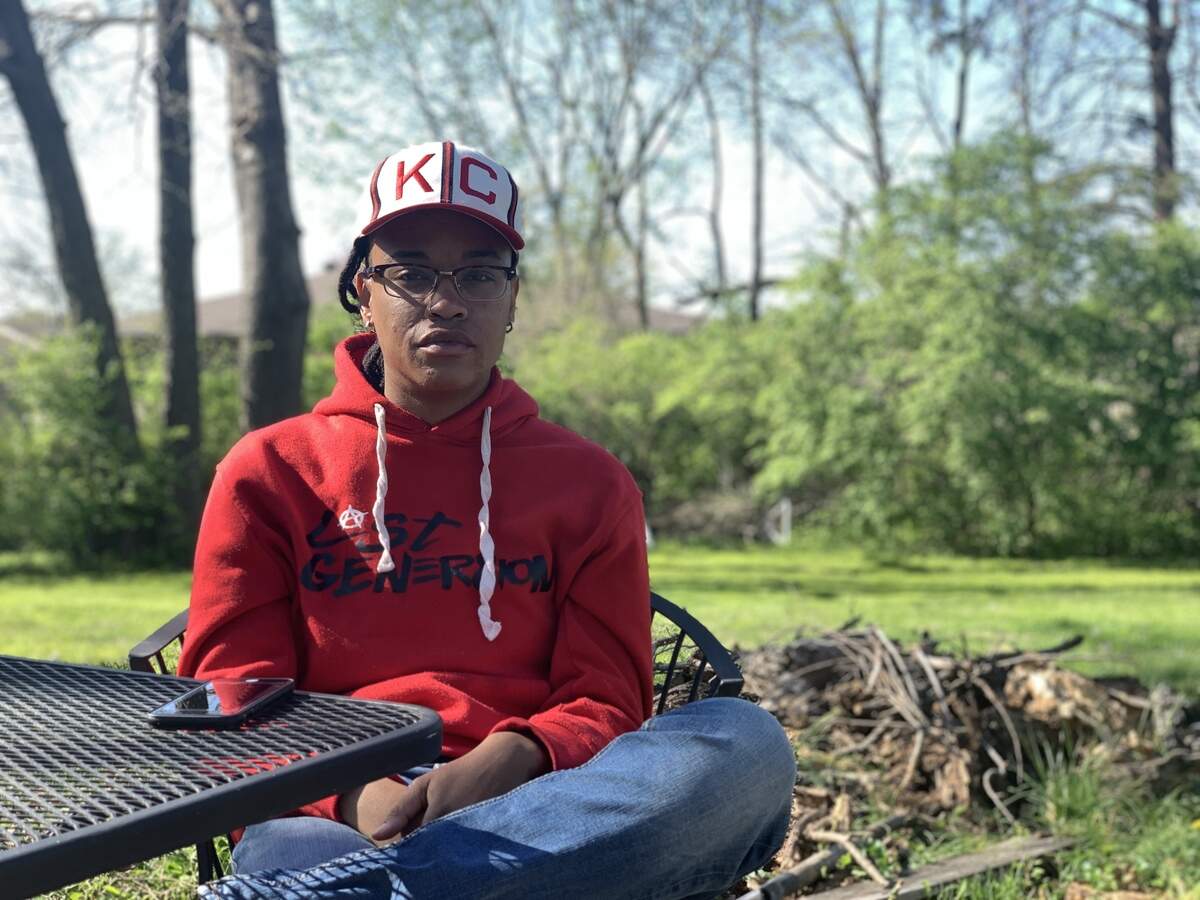
Carson was always fearless, Bronson said. He could talk to anybody.
“He was just a star,” Bronson said.
Carson’s parents were always supportive of him. His friends would gather at his family’s home, where Monique Carson would cook dinner. They played dancing games — Carson loved Beyoncé — and beer pong.
At night, Carson’s mother would check in on the group and find them asleep downstairs. As long as they were there, she said, they were safe.
Monique Carson still keeps in touch with his friends. Until Kansas City’s stay-at-home order, the friends often came over for dinner.
Carson is buried at Forest Hills Cemetery beside two cousins, who were also violently killed.
This March, on the two-year anniversary of Carson’s death, his friends invited Monique Carson and Carson’s sisters to visit the grave with them. The friends visit often, but it was the first time Monique Carson had been able to face going there in some time.
They arrived about 6 p.m. and did not leave until well past midnight.
“We hugged, we cried a little bit,” Monique Carson said.
She learned it was her son who had kept the group together.
The investigation
On the night of the shooting, there were no conflicts at the club, Carson’s friends said. The club owner reported it was a peaceful night.
Outside, Carson was just being himself, twirling around and being silly while walking to the car with his friends. He stopped and lay down on a bus stop bench.
Around that time, a vehicle drove down the street and stopped. People hopped out of the car and someone fired a gun.
When Bronson heard the gunshots, she was down the street in a car, buckling her seat belt.
The next 60 seconds were quiet.
Then, she undid the belt and went to see what happened.
She found people crying. Someone was lying on the ground. Jackson County sheriff’s deputies were performing CPR.
“And I’m like who is this? Was he in the club?” Bronson said. “All these thoughts are in my head. And then I see him. And I’m like, that’s my home boy.”
Carson died at a hospital.
“It just happened out of nowhere,” Bronson said on a recent Thursday, sitting on in a chair in her backyard. She took off her glasses and wiped both damp cheeks. “And after everybody’s feeling good and of course we’re having fun and nobody’s thinking about dying.”
Two days after the shooting, police said Carson was not the intended target. That is still the conclusion of investigators, said Becchina, the police spokesman.
“Whoever was sitting where he was sitting on that bus stop was the one who was going to get struck by the bullet, no matter what race, sex, LGBTQ or not,” Becchina said.
To solve the killing, Becchina said, police need the community’s help.
“The vast majority of homicides that we solve, we solve because somebody told us who did it,” Becchina said. “Not because of some crazy forensic TV show stuff. So that’s always our best weapon in an investigation.”
Kim Shaw-Ellis, the police department’s LGBTQ Liaison and Diversity Coordinator, said she understood why members of marginalized groups would fear the possibility of a hate crime.
“That’s where my brain goes also,” Shaw-Ellis said. “It’s a horrible, horrible tragedy.”
But as far as she knows, there’s been no evidence Carson was targeted because of his identity.
Shaw-Ellis has been working to build real relationships within the community, she said. That includes helping to recruit officers in LGBTQ communities and educating officers.
If someone wants to reach out to the police department with information on Carson’s murder and doesn’t trust the anonymous tip hotline, they can contact her directly, she said.
Monique Carson said she calls the police department once a month to check in.
The last thing she heard from detectives was that someone wanted to talk, but changed his mind. She worried that whoever shot Carson forced the person to not talk.
“Somebody knows something,” Monique Carson said. “I just want to know who did it.”
‘Let people know’
After organizing the vigil and seeing the outpouring of love and support, Gilmore has stayed involved in Carson’s case.
For months, he has served as a go-between for Carson’s family and Shaw-Ellis. He’s continued to ask questions about the investigation and draw public attention to it.
And he has been trying to hold police accountable.
“The family has reached a point where they believe, as do I, that the police department isn’t doing anything,” Gilmore said.
“Anybody who saw anything gave a statement to the police,” Gilmore said. “So if you’re saying that you’re waiting for one of the co-accused or co-conspirators or culprits who was in the vehicle too, well that may never happen.”
He said police have given him repeated assurances that the department would stay on top of the case and keep the community informed. But he’s frustrated that communication has not been consistent, clear or forthcoming.
The latest information he has received from police is about a year old, he said.
Gilmore said detectives at one point told the family that a rolling gun battle was ruled out early on in the investigation because it didn’t make sense. In a rolling gun battle, he said, it wouldn’t make sense to stop and get out of the vehicle to shoot someone.
Gilmore said he has heard police think they know who did it but couldn’t make an arrest. He said they were stuck with the hope that the individual would commit another crime and then police would be able link them to Carson’s shooting.
It sounds like something from TV, Gilmore said.
“That’s not what we want to hear in real life. In real life, what we want is justice. And we want to see that police are taking an active interest.”
In the absence of an arrest, fear that Carson was targeted has only grown. It’s rooted in the fact that he was at higher risk than most.
Hate crimes against those who are LGBTQ increased by almost 6% in 2018, according to the Human Rights Campaign. FBI statistics show race remains the most common motivation for hate crimes.
“We gotta let people know if people are being targeted,” Bronson said. “Period. If we’re not speaking up ... then it’ll happen again. It’ll keep happening.”
Carson’s friends, his mother said, always talk about how they wish he was with them. She’s happy she stays in contact with them.
At times, she scrolls through the pictures and videos on her son’s phone. She’s only made it about 1/4 of the way through, but she’s even seen videos he took in high school. His friends continue to send her more.
“There’s not a day that goes by that I don’t think about my son,” Monique Carson said. “When he passed away, it’s like everything just got dark.”
Carson would have turned 27 on Tuesday, May 12.
Monique Carson will have his friends over for dinner.
Anyone with information can call the TIPS Hotline at 816-474-TIPS (8477).
Gun violence will be the subject of a new, statewide journalism project The Star is undertaking in Missouri this year in partnership with the national service program Report for America. As part of this project, The Star will seek the community’s help. To contribute, visit Report for America online at reportforamerica.org.