
An easy fix for kid safety: Olathe-based group aims to keep children safe in cars
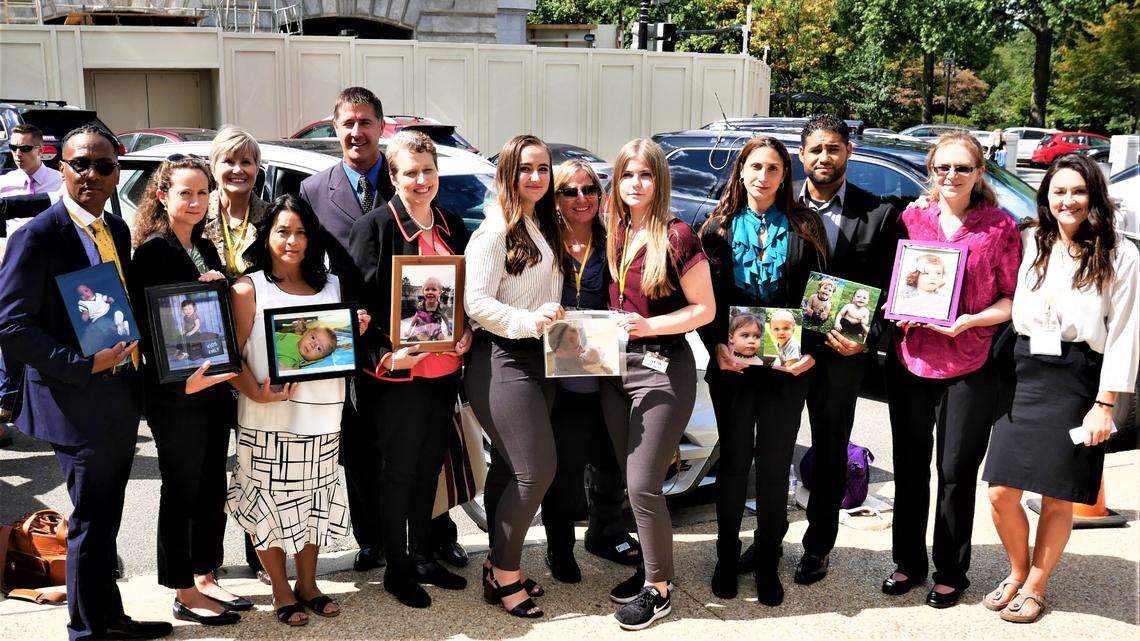
Tucked within the 2,700-plus pages of the federal infrastructure act is legislation an Olathe nonprofit has been trying to get passed for 17 years.
It’s Sec. 24222 Child Safety of the Infrastructure Investment and Jobs Act, recently signed into law.
The section contains only a few but important paragraphs designed to save countless lives by keeping children and pets safe in cars.
“The Act requires the U.S. Department of Transportation to issue a safety standard within two years aimed at preventing hot car deaths,” said Amber Rollins.
Rollins is director of Kids and Car Safety, a national nonprofit based in Olathe dedicated to keeping children safe inside and around vehicles.
The best safety standard, Rollins explained, would require auto manufacturers to equip vehicles with technology to detect a child or animal that was left in the backseat and then to sound an alarm calling for help.
Such technology is estimated to cost about $20 a vehicle, Rollins said.
It’s a small price to pay to save a child’s life.
“Since 1990, 8,000 children were either left alone or got into hot cars by themselves,” Rollins said. “Of these, more than 1,000 died of heat stroke.”
But these tragedies are preventable.
“Detection-and-alert systems exist to remind drivers of a child in the back seat,” Rollins said.
If such a system had been installed on the family truck, it could have saved the life of her 3-year-old daughter in September of 2019, said Angela Jones of Gilbert, Arizona.
“It’s sad and painful to know this technology has been available for many years,” Jones said.
Jones’ daughter died in the truck while it was parked in the driveway of her home. Jones now works with Kids And Car Safety to advocate for legislation and to educate parents about keeping children safe in cars.
In almost every hot-car death, “there was some kind of change in the routine — a detour, a phone call, running late for work,” Rollins said.
People don’t think of these as risk factors but when harried parents are distracted or their routine is disrupted, they are most vulnerable to leaving a child in a car inadvertently.
The system Kids and Car Safety is advocating would detect movement or breathing and trip an alarm such as flashing the headlights. If the driver doesn’t return to the car, another alarm would sound, such as a horn honking, a ping on a cell phone or a voice announcing “There’s a child in the car.”
At the third level of alarm, law enforcement could be notified about the location by GPS coordinates.
Currently on some cars, a beeping or a dashboard message reminds drivers that there’s something in the backseat when they get out of their car.
To make the system work, the driver opens the back door of the car and places a child in a car seat — or maybe the driver lays a sack of potato chips down. When the driver parks the car and gets out, a beeping sounds because there’s something in the back seat.
“But this system can’t tell the difference between a child and a bag of chips,” Rollins said. “And after so many false alarms, people tend to ignore the beeping.”
The system won’t help children who find their way into cars on their own and become trapped inside: “26% of hot car deaths occur after a child gets into a car on their own,” Robbins said.
What must be mandated, said Janette Fennell, who founded the organization as KidsAndCars.org, is occupant detection and alert technology.
“Without detection and alert systems, children will continue to die in hot cars,” she said.
Fennel founded the organization in 2003 after she was instrumental in making glow-in-the-dark internal trunk releases the law in 2001.
Through her work for the trunk releases, she learned that vehicles are the number one killer of children in the United States — in hot cars, power window strangulation and other incidents involving a moving or parked car.
As urgent as a need may be, change takes time, Rollins acknowledged.
Previously, hot car bills were considered in three sessions of Congress but failed to pass.
In 2019, Rollins took about a dozen family members from across the country to Washington, D.C. to advocate for legislation. All families were those whose children had died in hot cars.
“We had more than 60 meetings on Capitol Hill in a couple of days,” Rollins recalled. The act passed the House of Representatives but failed to pass in the Senate that year.
“Seeing the bill to fruition this year, we are almost to the point where we could save lives and end hot-car tragedies,” Jones said. “Our advocacy will continue for a safety standard that is more than a driver reminder — one that will detect and alert.”
For more information, visit www.KidsAndCars.org; 913-205-6973; amber@KidsandCars.org
This story was originally published December 30, 2021 at 5:00 AM with the headline "An easy fix for kid safety: Olathe-based group aims to keep children safe in cars."