
Mahaffie Stagecoach Stop and Farm partner with the Smithsonian to dig into rural roots
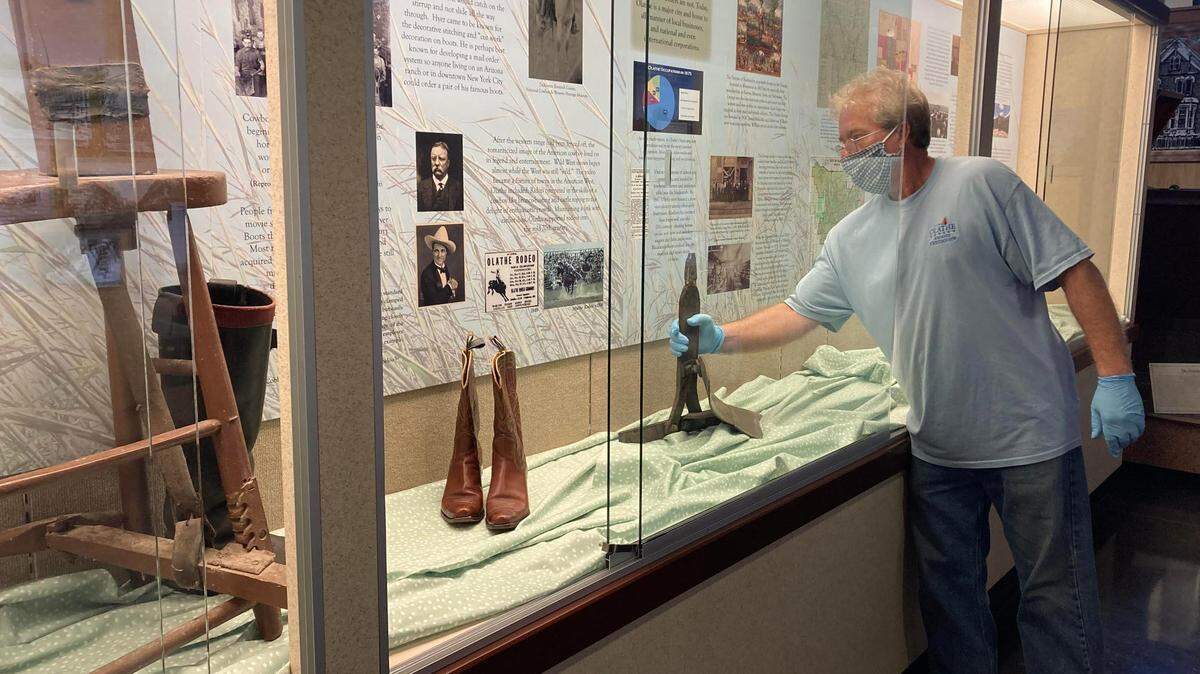
Olathe may be a bustling suburb now, but like all of Johnson County, it has deep rural roots. A partnership between the Mahaffie Stagecoach Stop and Farm and the Smithsonian has produced a new exhibit delving into the city’s past.
“From Rodeos to Roundabouts: Exploring Olathe’s Roots” is part of a larger project from the Smithsonian called “Crossroads: Change in Rural America.” In the past, it has worked with Humanities Kansas to share other exhibits as part of its Museum on Main Street program.
“We hope these local stories will really spark conversations about how their communities have experienced these changes over time and how they’ve adapted and how that will impact their future,” said Abigail Kaup, program officer for Humanities Kansas and statewide coordinator for Museum on Main Street.
The Smithsonian has a broader touring exhibit going to six sites in Kansas over the next nine months. That exhibit, designed for smaller communities, will be in Iola until Oct. 11. Mahaffie’s Olathe-specific partner exhibit will stay on display until Jan. 30.
“There is a dearth of really good local stories that explore this theme. About eight years ago, we had another exhibit called ‘The Way We Worked.’ We had so many applications and so many great stories that it felt like a real tragedy to not to explore those more,” said Tracy Quillin, associate director of Humanities Kansas. “So, we offered the opportunities for the sites that don’t have the Smithsonian exhibition to tell their stories through local exhibitions and programming that are then tied to this larger initiative.”
Mahaffie received a $1,500 grant from Humanities Kansas to put together the show and teamed up with the Olathe Historical Society to make its content.
“What we wanted to showcase is how the business of agriculture developed, and especially how the Mahaffie family helped tie it into how that attracted other businesses to open here as well,” said Alexis Radil, events coordinator at Mahaffie.
Some of the things the exhibit spotlights are the hatchery and dairy businesses that started in Olathe in the late 1800s and early 1900s.
Another local highlight in the show is the story of the Hyer Boot Company.
“Legend has it that a cowboy went into Charles Hyer’s shoe shop and needed a different shoe designed. And Charles Hyer helped design what we think of as modern cowboy boots with the pointy toe, the raised-up heel and the more scalloped top on the leather,” Radil said.
Another element of the story is how students from the Kansas School for the Deaf learned to work with leather and became employees at the company.
Artifacts on display include an original pair of Hyer with a more typical pair of 1860s boots, a case of milk bottles from the Olathe View Dairy and lard buckets from the Olathe Meat Processing Company.
Those distinctive tales are part of the point of this show.
“Kansas stories are not monolithic. Rural stories are not monolithic. It’s really been important for us to allow communities to tell their grassroots story: What makes them unique, what struggles they’ve had, what innovations they’ve had,” Quillin said.
It’s not just about long-ago history. The exhibit looks at the current impact of agriculture in Johnson County.
“We also talk about how businesses in Olathe, like Tractor Supply Company, have their businesses here because they’re on the edge of Olathe. … We even mention how you can raise chickens in your backyard in Olathe to tie into how agriculture still impacts you today,” Radil said.
Olathe is unique among the partner sites for this exhibit.
“We were really excited to work with Mahaffie. It’s the only site that’s over the 20,000 population mark. It adds a really different perspective on this change in rural America,” Kaup said. “Their project represents the rural roots of Olathe and Johnson County and how they transitioned from rural into this suburban-urban area.”
This story was originally published September 24, 2020 at 12:00 AM with the headline "Mahaffie Stagecoach Stop and Farm partner with the Smithsonian to dig into rural roots."