
Firefighters who can sew? Shawnee team may get teased but save department time, money
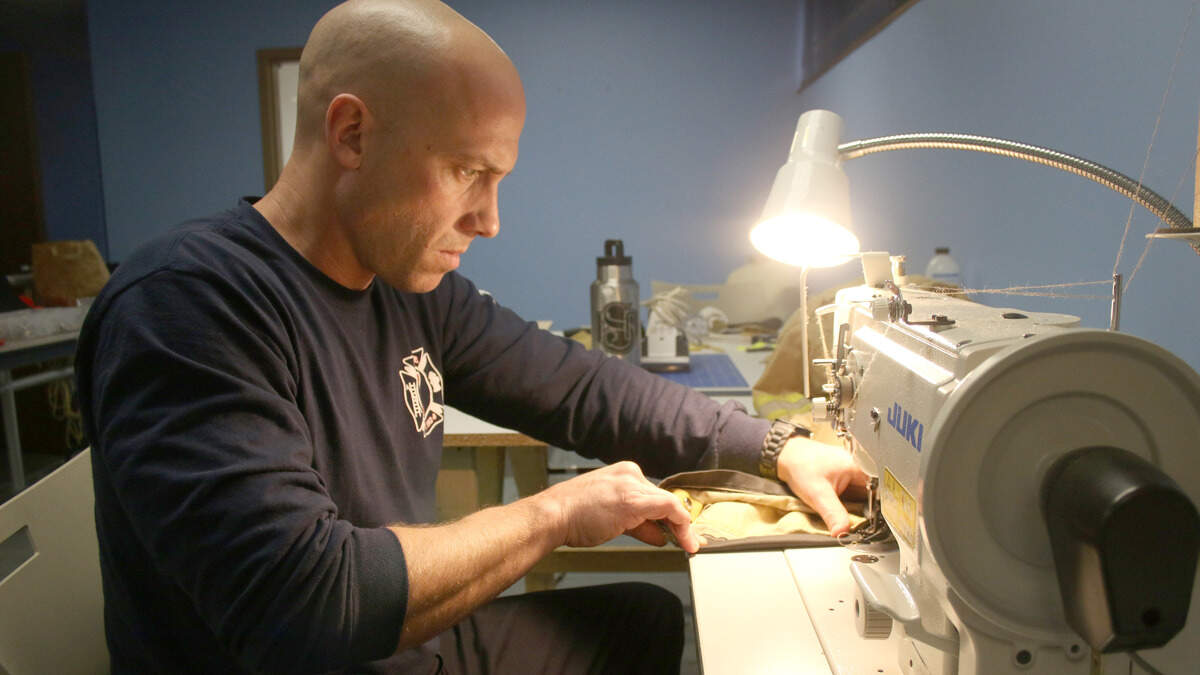
When a firefighter rips his or her uniform, repairing it isn’t quite as simple as ironing on a patch. Although it used to take weeks or months of waiting and thousands of dollars to repair their gear, the firefighters at the John B. Glaser Fire Station in Shawnee can have everything fixed in a few days.
Capt. Andy Fenstermann, who has been a firefighter for Shawnee for seven years, was the first to take on the task of learning to repair firefighting gear. And it’s not quite as simple as many might think. At the time, Fenstermann had pants that needed to be fixed.
“I actually approached the chief with, ‘Hey, can my mom just fix these?’ And he said, ‘No.’ So I did a little bit of research and found that most manufacturers for the gear will teach you how to sew and certify you in fixing your own bunker gear for your department, and they’ll do it for free,” he said.
“So at that point, we were basically airfare and a sewing machine away from putting a program in place.”
In 2015, Fenstermann and fellow firefighter Mike Owens went to Honeywell First Responder Products in Dayton, Ohio, and spent three or four days learning about how to repair turnouts properly.
Before heading out, though, “I did ask my mom to give us a crash course. She taught me and Mike just a little bit. She showed us how to thread the machine and how to run a piece of fabric through it.”
In Dayton, they started with the basics of sewing in a straight line, then progressed to working on the inside of a pant leg, because firefighters frequently need repairs on the knees of their pants.
All of this work is precise and has to meet the National Fire Protection Association standards. The machine itself was $2,200 investment and is a heavy-duty industrial one that uses kevlar-infused thread.
“I was a sewing machine salesman’s best friend. I walked in, and I was like, ‘I want the biggest, baddest machine you have,’” Fenstermann said.
One of the requirements is that the uniforms must hold one pound of pressure per square inch to keep out heated vapor in a fire situation. Two other firefighters in Shawnee worked together and rigged up a device to test the repairs to make sure they met that standard.
“Once we put water on that fire, and it could be 800 to 1,000 degrees, it quickly turns to steam, and that can go through our gear and burns pretty well. So this is a thermal layer,” said Corey Sands, fire marshal for Shawnee.
By Fenstermann’s estimate, every firefighter needs a repair on something at least once a year. Before he started doing the repairs himself, each repair cost at least $200, plus shipping, and had the inconvenience of leaving firefighters to use their backup gear for weeks or even months. It really adds up when you have 70 firefighters.
Now, he asks his colleagues to wash the garment, notify him that it needs a repair, and usually, it gets repaired by the next day. Along with Fenstermann, three of his colleagues are certified to make the repairs.
Being part of the sewing squad of the fire department has gotten Fenstermann some ribbing from his fellow firefighters, but he knows they appreciate the work he does.
“Everybody likes not having to have their gear gone for long,” he said.
Because of the quick turnaround time, the firefighters are much more likely to get a garment repaired immediately, rather than waiting for it to get bad enough to warrant the inconvenience of sending out for repairs. Catching the repairs when they’re small lets the gear actually last longer, and that means a lot when a complete set of gear costs $2,500 to replace.
He’s got it down to a science now — Fenstermann can patch a knee in five minutes. When he’s off-duty, though, he leaves the sewing to his mom.
“I don’t even have a sewing machine at home. My mom is still the family go-to for clothing repairs,” he said.
This story was originally published February 18, 2020 at 7:00 AM with the headline "Firefighters who can sew? Shawnee team may get teased but save department time, money."