
Access Services helps hundreds of disabled students at JCCC navigate campus, classes
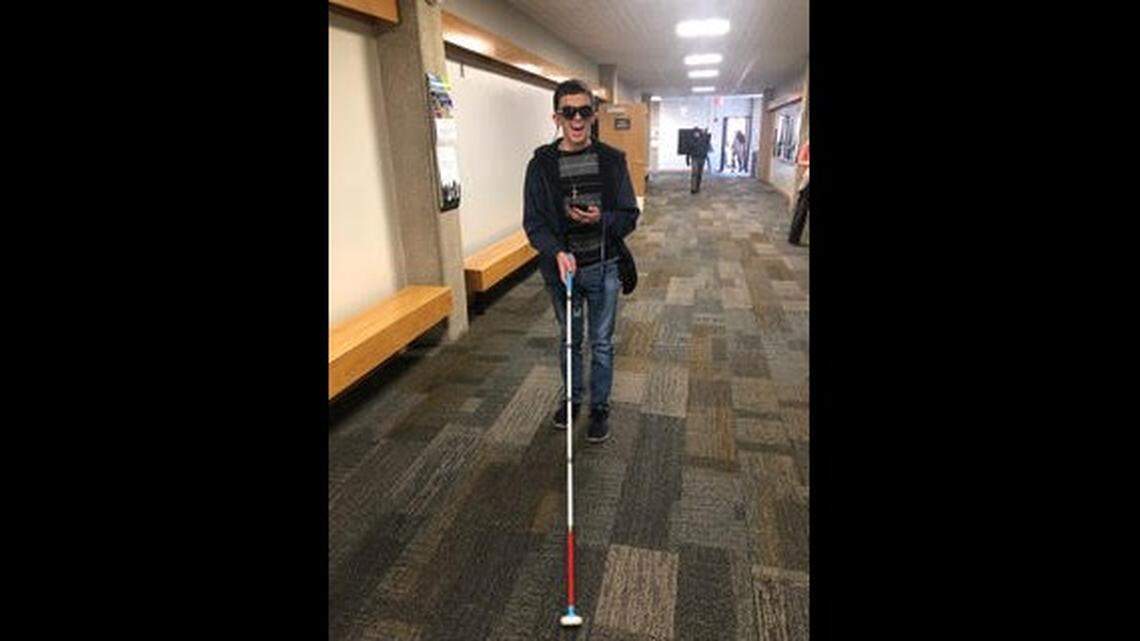
Typical of many college students, Fabien Siffrin wanted a snack midway through his day at Johnson County Community College. Atypical of most college students was the way Siffrin nabbed that snack.
Siffrin, who is blind, stood at the vending machine on the second floor of the JCCC’s General Education building.
With the help of the most recent resource available through the college’s Access Services, Siffrin was able to push the buttons 151, grab his peanut M&Ms and head to his tutoring session.
“Many college kids like me, who have a disability, have accessibility issues,” Siffrin said. “With the help of Access Services, faculty and other staff at JCCC, I can get things done and accomplish my goals.”
JCCC first began providing services for students with disabilities in 1972 as students from the Kansas School for the Deaf starting attending classes.
“This was a full year before federal legislation, Section 504 of the Rehabilitation Act, mandated access for students with disabilities,” says Holly Dressler, access adviser and chairwoman of Access Services.
“Since that time, JCCC has maintained a strong commitment to serving the needs of students with disabilities and providing access to all of our various student and community offerings.“
Dressler says the program grew as more students with disabilities began attending JCCC and requesting accommodations.
Federal legislation, as well as the Americans with Disabilities Act, required colleges to provide reasonable accommodations to students with disabilities so that students who were being served in high schools would receive appropriate accommodations and services when they transitioned into higher education.
In addition, JCCC housed the Gallaudet Regional Center and a National Interpreter Training Grant in the 1980s and 1990s.
“Deaf students from surrounding states came to JCCC as we had a strong reputation for serving deaf students,” Dressler says.
Currently, between 500 to 600 students with disabilities request accommodations each semester at JCCC.
“We serve a wide array of students with varying disabilities,” Dressler says, adding that among those served, the colleges works with veterans, international students and newly diagnosed students.
“Individual students bring their own unique set of past experiences, current challenges and hope for the future. We meet each student where they’re presently at and develop a support plan to help them meet their goals, whether this means successfully participating in a class, earning a certificate or associate degree, or transferring to another four-year college or university.”
It was Siffrin who brought the technology he used at the vending machine to the attention of JCCC.
It’s called Aira. Users like Siffrin have a mobile phone device and special glasses with a high-definition camera. A livestream video of everything happening in front of the user is transmitted to a remotely located agent. That agent then relays the description back to the user. All of this happens in real time.
Siffrin owns his own glasses and pays for minutes on Aira. The Access Services program allows Siffrin to use his Aira glasses without having to use his minutes.
Siffrin says he is able to navigate JCCC pretty well by memorization of landmarks and paths with the help of his father. But, Siffrin says, you can’t memorize things such as shifting inventory in a vending machine or an unplanned wet floor sign.
Siffrin says people are more than willing to guide him, but often his requests often go unheard in a world of growing users of earbuds and headphones.
Siffrin, 22, graduated from the Kansas School for the Blind. He has been blind since age 1 ½ as a result of a tumor on his optic nerve.
He says that technology has always played an important role in his learning. He hopes to someday work with the visually impaired and technology.
He receives tutoring through Access Services in Networking Fundamentals, a recommended course for the AAS degree in computer support specialist he is working toward.
JCCC Access Services offerings include testing accommodations, note-taking assistance, sign language interpreting services, audiobooks/alternative text and assistive technology. For information on Access Services, visit accessservices@jccc.edu or call 913-469-3521.
This story was originally published December 3, 2019 at 12:00 AM with the headline "Access Services helps hundreds of disabled students at JCCC navigate campus, classes."