How did police conclude suspected highway shooter had escaped? Experts weigh in
AI-generated summary reviewed by our newsroom.
- Investigators said they had searched all survivable places before concluding he escaped.
- A cadaver dog gave a soft alert and the battalion chief searched accessible areas.
- Experts say reviews should assess containment, evidence and search decisions.
The discovery of the suspected Interstate 70 shooter inside the same fire-damaged Independence home to where authorities believed he had escaped has raised questions about how investigators assessed the scene before concluding he was no longer inside, policing experts say
Those questions are likely to become the focus of any after-action review examining the search of the home and the decision to shift investigators’ attention to a regional manhunt.
Law enforcement experts said the review should examine not only the physical search of the fire-damaged house, but also the information investigators relied on in concluding that suspected I-70 shooter Oscar Sanchez-Munoz was no longer inside.
The central question investigators should answer is not simply why Sanchez-Munoz was ultimately found inside the home, but what led officers to believe he had escaped, said Spencer Fomby, a former Berkeley, California, SWAT commander.
“My question would be, how confident were they with their containment, and what led them to believe that suspect escaped?” Fomby said.
Searching a structure damaged by fire, flooding and debris can be extraordinarily difficult and dangerous, Fomby said.
“When you have a basement area that’s flooded, with burning debris and potentially structural issues with the building, there may have been a limited search of that basement area,” he said.
Fomby said homes filled with furniture and personal belongings become even more difficult to search after a fire.
“There’s all the stuff that people collect, and that stuff catches on fire,” Fomby said. “Then the water comes in. It can be extremely challenging to search.”
In his experience, officers should first determine whether they maintained containment around the home and whether there was any indication the suspect had breached the perimeter before shifting resources to a broader manhunt.
Those questions took on added significance after Kansas City Fire Department officials said a cadaver dog gave an alert to human remains in the flooded basement during the initial response.
The Fire Department later expanded on those comments, saying that a battalion chief searched every area of the basement and first floor that was physically accessible but did not locate human remains.
The department said the battalion chief told investigators he did not believe human remains were present in the areas that could be physically searched at that time.
KCFD said the canine’s “soft alert” and the battalion chief’s assessment were both relayed to investigating agencies before firefighters left the scene.
Police explain search efforts
Police Department spokesperson Capt. Jake Becchina said Friday that there was heavy congestion in the basement, with furniture and building materials, all of which had been under several feet of water, reiterating what he said during a Wednesday news conference.
Becchina said investigators believed they had exhausted all “survivable places” inside the home before shifting their focus to a public search for Sanchez-Munoz.
“At that point in time, we were confident that all of the survivable places in this house had been searched and that he was not located,” Becchina said Wednesday. “Some of that is what led us to kind of pivot to notifying the public, asking the public’s help.”
Becchina previously said investigators faced significant challenges searching the home after the fire. The basement contained several feet of standing water, part of it had collapsed, and it was “one of the most congested basements I’ve seen in my 23-plus-year police career,” he said.
Investigators “very thoroughly searched” the residence but did not locate Sanchez-Munoz, Becchina said Wednesday. His body was ultimately found beneath debris in the flooded basement after family members returned to clean the home.
Multiple agencies, including federal partners, the fire department and the Missouri State Fire Marshal’s Office, repeatedly searched the property using a variety of resources, including cadaver dogs and search-and-rescue dogs.
“We have things we’re going to learn from,” Becchina said Wednesday. “We have things that we’ll iron out with our partners in Independence. We’re going to have conversations after this as well.”
Sanchez-Munoz became the focus of a regional manhunt after investigators accused him of opening fire on motorists June 16 along Interstate 70, Interstate 670 and other Kansas City-area roadways, killing one person and wounding four others as fans traveled to Kansas City’s first FIFA World Cup match.
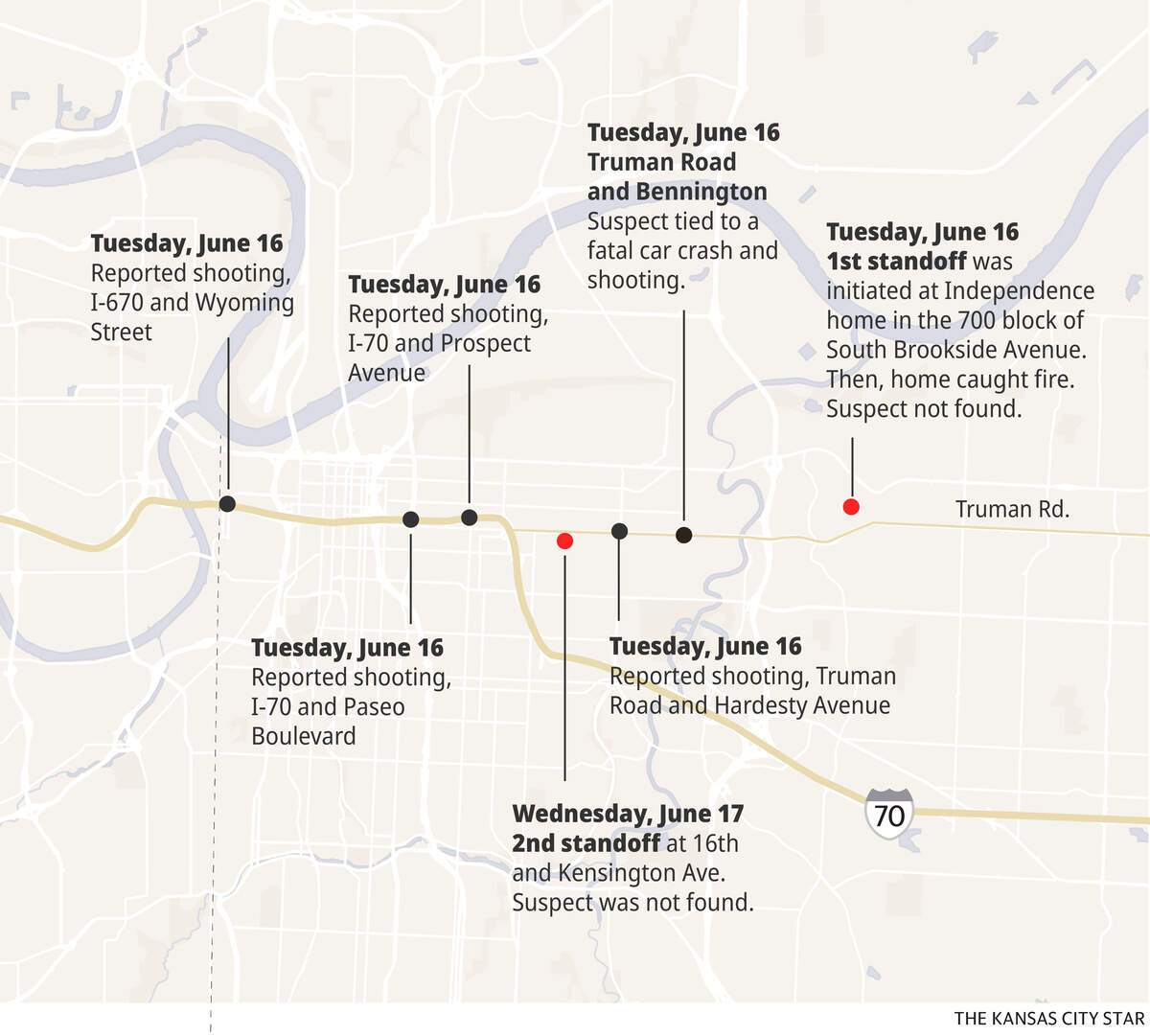
Investigators tracked him to an Independence home later that evening, where they believe he started a fire before authorities concluded he had escaped. The weeklong manhunt ended Wednesday after family members cleaning the fire-damaged home discovered his body in the flooded basement.
Review should examine key decisions
Former police lieutenant Glen Haas, who now teaches at Utah State University, said the circumstances described by investigators suggest what he called “a cascading series of issues.”
Haas said a fire-damaged home with standing water, collapsed debris and a body concealed beneath both water and rubble presents unique challenges for investigators.
“That actually sounds pretty plausible,” Haas said after hearing the investigators’ description of the basement. “It certainly doesn’t sound like negligence.”
Haas said the conditions described by investigators make it difficult to immediately identify human remains after a structure fire, particularly when debris and standing water are involved.
Haas said a cadaver dog’s “soft alert” also should be viewed in the context of the conditions inside the home. He said water can spread scent across a larger area, making it more difficult for a dog to pinpoint a location.
“If the dog hit on it at all … the dog did pretty well,” Haas said. “The scent literally is everywhere on top of that water.”
Haas said investigators should closely examine the decisions made after the initial search, including what supported the conclusion that Sanchez-Munoz had escaped.
“The questions are valid,” Haas said.