This group helped build 18th & Vine and KC’s urban core. Now it’s being honored
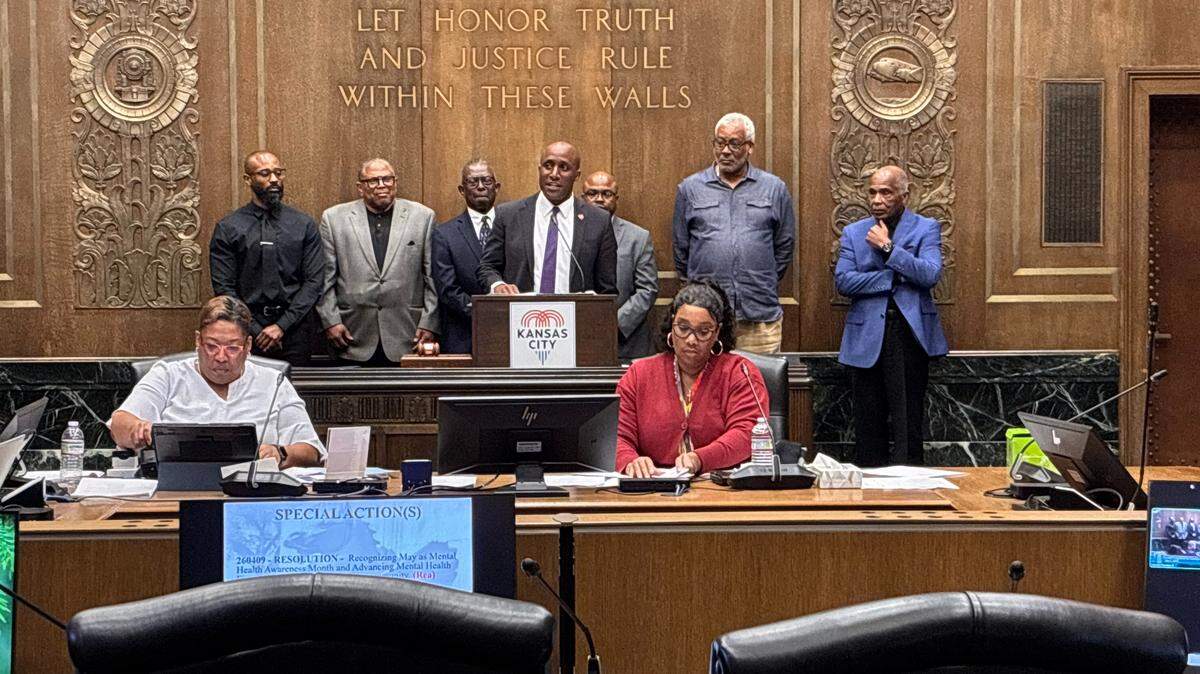
The Black Economic Union of Greater Kansas City was formally recognized Thursday at Kansas City Council chambers for nearly six decades of economic development, housing advocacy and community investment work in Kansas City’s urban core.
City leaders honored the organization with a proclamation recognizing its long-standing impact on economic empowerment and community development efforts across Kansas City, particularly within historically Black neighborhoods and the 18th & Vine Historic Jazz District.
During the proclamation presentation, Mayor Pro Tem Ryana Parks-Shaw described the organization as a continuing force in Kansas City’s economic landscape.
“For nearly six decades, the BEU has helped shape the path of our city through affordable housing development, support for Black-owned businesses, workforce and financial literacy programs, and investments that strengthen the historic 18th and Vine District and surrounding neighborhoods,” Parks-Shaw said.
Founded in 1968 by Jim Brown and Curtis McClinton, the organization has become one of the city’s oldest community development corporations. Brown was a retired player with the Cleveland Browns, and McClinton a former Chiefs halfback. Through housing projects, business development initiatives and workforce programming, the BEU has played a central role in redevelopment efforts throughout Kansas City’s urban core.
Over the decades, the organization helped lead development projects that included affordable housing units, elderly housing, commercial office space and retail centers. The BEU also helped shape redevelopment conversations surrounding 18th and Vine through advocacy, partnerships and economic planning efforts.
Parks-Shaw also noted that Kansas City’s BEU remains the only Black Economic Union still operating in the country.
“The organization stands as a powerful testament to visionary leadership, community partnership, and the belief that economic opportunity strengthens entire communities,” she said.
Mayor Quinton Lucas thanked current and former BEU leaders during the council session and reflected on the organization’s long history of community advocacy.
“It’s good to see everybody still doing the work to lift our community,” Lucas said. “I thank you all for all that you keep doing.”
Eric Hawthorne Sr., director of economic development, joined the organization in 2024, said he became involved because of the opportunity to create visible and lasting community change.
“Creating tangible change that people can see, feel, understand, and basically have hope for the future,” Hawthorne said.
Hawthorne said the organization remains focused on affordable housing and ownership opportunities at a time when many residents are struggling to remain financially stable.
“In today’s economy, we’re looking to build affordable housing,” he said. “People are being priced out of homeownership, and we want to create homeownership within the community and create investment strategies that will lead us to generational wealth.”
The organization’s modern programming continues to center on workforce development, financial literacy, entrepreneurship and youth engagement. In recent years, the BEU has operated financial literacy initiatives, youth ambassador programs and business development efforts designed to connect residents with long-term economic opportunities.
Hawthorne said the organization’s work remains necessary because many of the structural inequities that existed during the BEU’s founding still exist today.
“Kansas City is one of the most segregated cities in the country,” he said. “If you look at the Troost divide, it is the remnants of segregation carved into the city’s infrastructure.”
Thursday’s recognition also carried personal significance for the family of Curtis McClinton, who is now 86 and suffering from memory loss. His daughter, Margo McClinton Stoglin, traveled from Dallas to attend the proclamation ceremony and celebrate both the organization’s history and its current leadership.
McClinton Stoglin said she grew up hearing about her father’s work in redevelopment efforts connected to 18th and Vine, housing projects and broader urban core investment.
“He was able to secure grants,” McClinton Stoglin said. “He was able to advocate and be one of the key people in the conversations and a catalyst for 18th and Vine and all that beautiful development with the museum, the restaurants, and the Swope Parkway developments with apartments.”
She described her father as someone deeply committed to civic engagement, education and economic opportunity.
“He cared about people. He cared about his community,” she said. “He always taught me about giving back and civic engagement.”