
Crown Center has historic status. What that could mean for Royals development
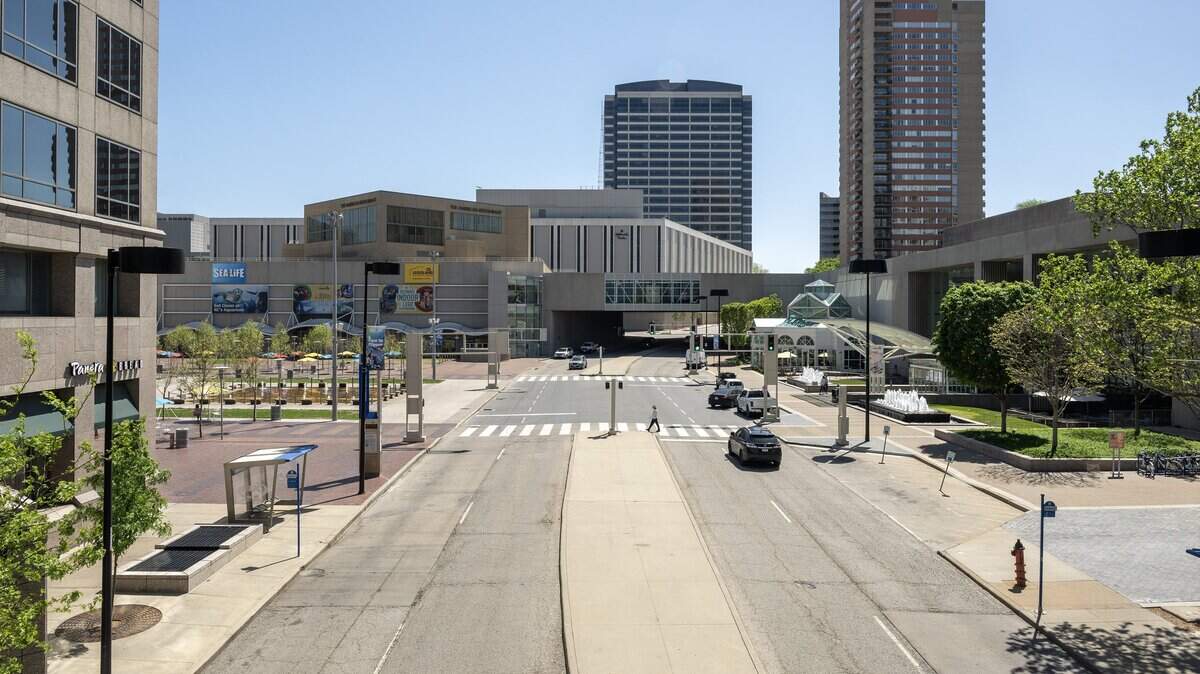
Update: The Royals and Hallmark Cards, alongside Kansas City Mayor Quinton Lucas and Missouri Gov. Mike Kehoe, announced Wednesday morning announced plans Wednesday morning to bring a new Royals stadium to Crown Center. Conceptual renderings show that the stadium would go where Hallmark currently has its headquarters.
Crown Center will see massive investment and redevelopment with a planned new Royals stadium in an area that was itself built to renew a distressed neighborhood.
Crown Center’s architecture, layout and very existence are so distinctive — as a planned, mixed-use district with modern buildings surrounding a public plaza — that the area is listed on the National Register of Historic Places.
Officials announced Wednesday that the Royals plan to build a new stadium in Crown Center, and early renderings appear to show that the stadium will replace Hallmark’s current corporate headquarters. The renderings, which are conceptual and are not a final, formal plan, show most of Crown Center retained, including the ice skating pavilion, the fountain plaza, the zigzag building and the shops across Grand Boulevard.
Full details about how Crown Center could be redeveloped have not been announced.
Combining hotels, shopping, entertainment, dining, offices and more, Crown Center has newer buildings, but its core historic structures were built from the mid-1950s into the early 1970s. Hallmark led its development and maintains its headquarters there.
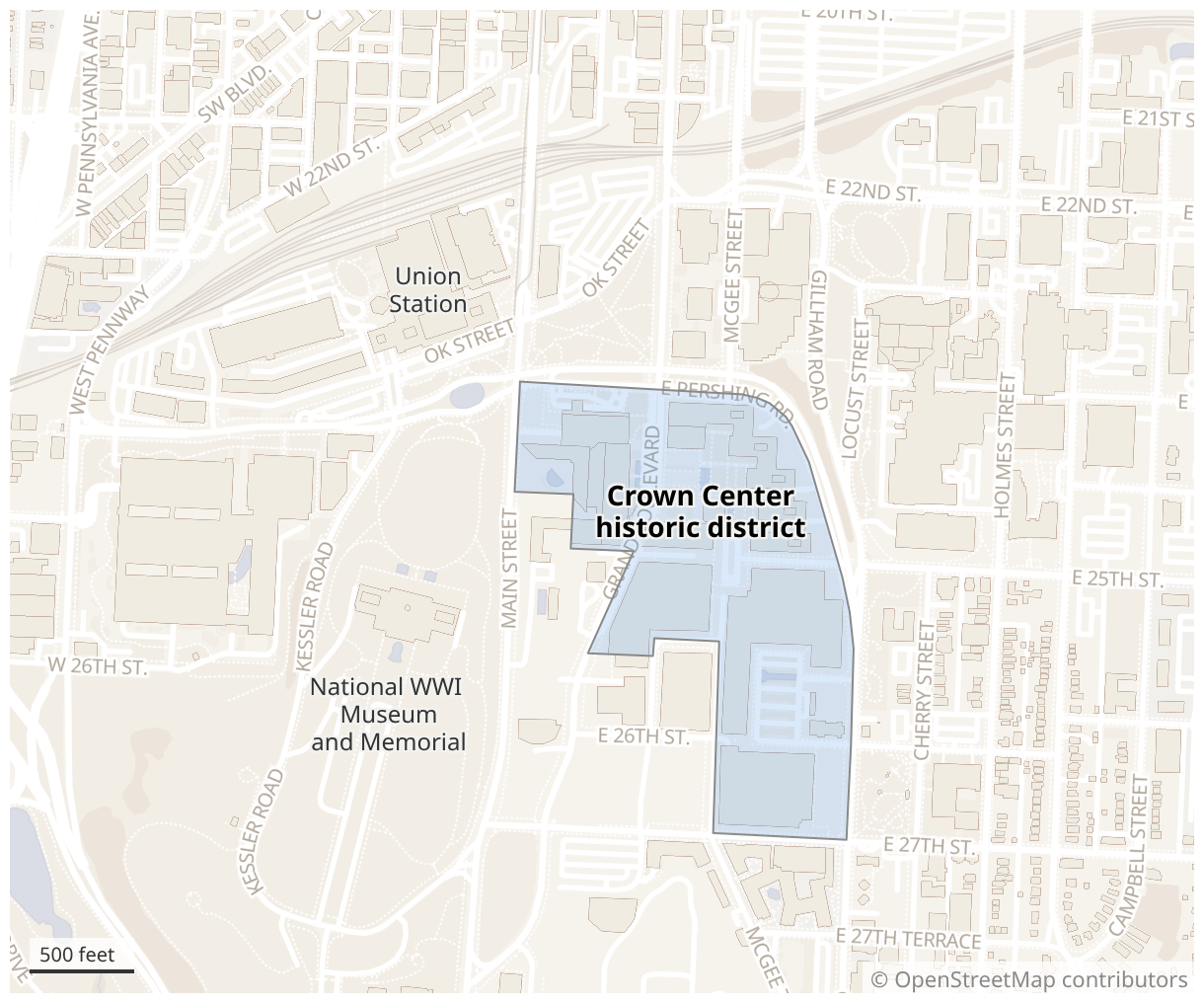
With an application prepared by Rosin Preservation and approved by the National Park Service in 2019, Crown Center’s listing is in many ways honorary and serves to ensure its history is documented and considered worthy of preservation.
“It’s significant for its architecture, for Brutalism, for modern architecture, and a cohesive shopping and mixed-use center and for community planning and development, and essentially commerce for the business orientation and significance and the role of the history of one of Kansas City’s largest corporations,” said Ethan Starr, executive director of historic preservation group Historic KC, on Monday.
But national historic status also unlocks potential state and federal tax credits that developers can use to help rehab and repurpose historic buildings.
Developers in Kansas City regularly use historic tax credits to help save and reuse buildings for housing and other uses, such as the future Aladdin apartments in a former hotel downtown or the future lofts in the vacant ABC warehouse building on Main Street.
Without the tax credit support, such historic buildings could instead go vacant and blighted.
“That is a key feature of the National Register that ensures historic buildings essentially maintain competitiveness as a means of future investment in the urban core in particular,” Starr said.
Details remain minimal about Royals development
More remains to be announced about the full scope of reinvestment and redevelopment in Crown Center alongside the new stadium.
But, given Crown Center’s listing on the national register, those tax credits could theoretically be available to rehab or give new life to some of its buildings as part of a broader development.
Among them: the zig-zag office building off Pershing Road and the Brutalist-style Westin Hotel north of the shopping mall. Those buildings are considered “contributing” to Crown Center’s historic nature.
Proposals and projects receiving tax credits would be subject to review by state or federal officials to make sure that they maintain a historic character.
Some other buildings are within the Crown Center district, but they are not considered “contributing” because they are of different style and are not as tied to its particular history. That means they would not be eligible for the tax credits, Starr said.
Among the “non-contributing” buildings are, ironically, the 1923 Our Lady of Sorrows Catholic Church and the 1987 office building at 2405 Grand Blvd., where The Star’s offices are located.
Local listing would mean local protections
But while Crown Center is listed on the National Register of Historic Places, it’s not listed on Kansas City’s local historic register.
That’s a separate list and maintained at the local level. If Crown Center did have local historic status, the development would have another layer of protections under city code.
The city’s Historic Preservation Commission, an appointed board, would need to sign off on major changes to a building’s exterior, for example.
That includes an owner proposing to demolish a building with local historic status. Demolitions for buildings on the local list cannot be blocked forever, but an owner could have to wait up to three years if a demolition permit is denied.
In order for Crown Center to be on the local historic list, someone would have to file an application and then move the nomination through multiple public hearings from multiple boards ahead of final City Council approval — far from a certainty, as recent nominations in the Valentine and Pendleton Heights neighborhoods have shown.
But an application for historic status can delay construction or demolition permits until officials have time to weigh in on the nomination.
And the city has further rules around demolishing older buildings, passed in late 2024. It appears that those rules could apply to at least some structures in Crown Center, including the headquarters area that renderings show the stadium replacing, even though they’re not on the local list.
Those rules allow the Historic Preservation Commission to consider delaying demolitions for up to 45 days, which gives the public some time to consider alternatives to demolition.
This story was originally published April 21, 2026 at 8:11 PM.