What’s with new artwork in KC’s 18th and Vine? Banner goes up after controversy
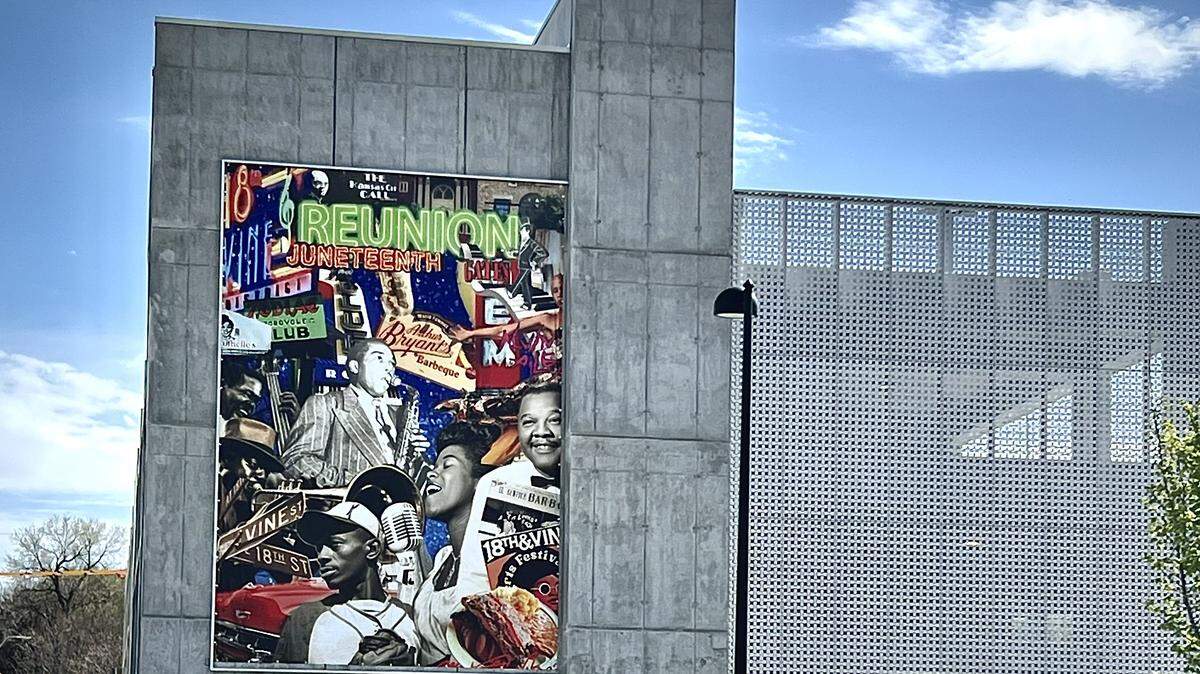
A temporary banner now fills the north face of the new parking garage at 18th Street and Lydia Avenue, occupying a space that has become a focal point in Kansas City’s ongoing debate over public art and representation.
The installation comes after the Kansas City Municipal Art Commission reset its process to select a permanent mural for the site. Commissioners voted to end the initial finalist round and reopen the call with a stronger emphasis on local artists, following concerns that the first round did not adequately reflect Kansas City’s creative community.
“Artists, in my opinion, are the bridge to the soul of our community,” said Michael Toombs. “They help translate what we feel about certain things that are going on.”
Until that process is completed, Toombs has created a large-scale banner to decorate the wall and reflect the cultural identity of the historic 18th and Vine Jazz District. The piece serves as a placeholder while the city determines how it will move forward with a new, locally focused selection process.
Toombs, a Kansas City native who has worked as a community-based arts educator since the early 1990s, designed the banner as a collage of imagery tied to the district and the broader Black experience in Kansas City. The work, titled the “Reunion Project,” draws on music, food and community institutions to present a visual narrative of contributions that have shaped the area.
The design includes references to the Mutual Musicians Foundation, The Blue Room and The Call. It also highlights community presences like the Zodiac Motorcycle Club and Kansas City’s barbecue legacy through Arthur Bryant’s and Gates Bar-B-Q. The self-funded piece was developed over about a week, combining research and visual assembly before being scaled to approximately 20 feet by 30 feet for installation.
“The idea for the banner was born out of the fact that I’ve done a number of projects on 18th and Vine, or in the Black community, over the years,” Toombs said. “When this project came along, it was an opportunity to do something that celebrated the accomplishments of our community as it pertains to music and food and other areas of focus that we’ve contributed to in the city that we hardly ever are reminded of. I just thought it was a great opportunity and I wanted to be a part of it.”
The banner builds on Toombs’ history of community-centered public art, including past projects focused on violence prevention and public remembrance. His work has consistently emphasized participation and reflection, using visual storytelling to engage residents and acknowledge shared experiences.
With the Lydia garage installation, Toombs sees the banner not only as a temporary solution, but as a potential foundation for the permanent mural. He has applied to propose expanding the design into a painted work created by a team of local artists, bringing together multiple groups with ties to the district.
“I want to see this piece as the permanent installation for that place, but I’d like to see it painted,” he said. “I’d like to hire some artists from the 18th and Vine Arts Festival and some artists from the African American Artists Association. I have a team of artists that I’ve worked with to do murals, and I’d like to take that team of about 12 to 15 artists and reproduce every segment of the mural.”
The city’s decision to restart the selection process has amplified broader questions about how local artists access large-scale public commissions and how cultural spaces are represented through publicly funded work. The Lydia garage wall, positioned at a key entry point into the district, has become a symbol of those concerns.
For Toombs, the conversation extends beyond a single project and speaks to the role artists play in shaping how communities see themselves and their history.
“The purpose of this process is about changing minds and affecting perspectives and broadening people’s insights,” Toombs said. “And artists are going to be one way of accomplishing that.”