How artist tells stories of chronic illness with ‘a Kansas City passion’
Two decades ago, Keisha Jordan was diagnosed with lupus while she was still in college, at a time when information about the disease was scarce and answers were limited.
The diagnosis forced her to confront uncertainty at a young age, reshaping how she moved through the world and how she understood her own body. Over time, that silence gave way to purpose, as Jordan began using her voice and talents to educate others about a disease that disproportionately affects Black women and is often misunderstood or overlooked.
That same sense of purpose now runs through her creative work.
A Chicago native who relocated to Kansas City during the pandemic, Jordan has more than 20 years of experience in marketing and advertising, but has always identified as an artist at her core.
As a painter and textile designer she blends personal narrative with cultural history, using color and symbolism as tools for storytelling and healing. Through projects such as Kansas City’s Parade of Hearts and her ongoing community programming, Jordan has built a practice where art and advocacy intersect, transforming her lived experience with lupus into work that centers visibility, reflection and connection.
Recently she sat down with The Star’s culture and identity reporter J.M. Banks to talk about her journey as an artist, her struggles with lupus and using her craft to advocate for change.
Can you begin by telling me about your early life and what brought you here to Kansas City?
I moved here during the pandemic. I have been working in marketing and advertising for like 20-something years. So one of the reasons I came to Kansas City is because I moved during the pandemic, and I lost my job, and I got an offer working at Barkley (an advertising agency).
I got the offer, and it was like the universe opened up and I came here to Kansas City. And I’ve been in love with it ever since.
Can you tell me about your work as a visual artist and interior decorator?
I’ve always been an artist at my core. That’s just who I am.
With that being said, I’ve always been into the visual arts space. So I did a lot of art contests and exhibits in Chicago. I ended up going to school for arts and communications, which is where I got my degree in advertising. Then I became more on the commercial side of things, which is how I ended up in advertising.
From there, I just continued down this path of evolving, just letting it lead where it leads. So from there, I was experimenting, doing a lot of brand stuff and then exploring into the interior space: designing wallpaper and textiles and stuff like that, and doing other things, helping other brands and then even using art as a catalyst for storytelling.
So I started getting into art when I was very young. I remember growing up, in class, a kid was drawing Bart Simpson. That was the cool thing, and Ninja Turtles at the time.
So I remember him doing that, and I was trying to pick up what he was doing. He was like, “No.” And I was like, “Dude, you can’t tell me what to do, so I’m going to figure this out.”
So I remember getting into art then. I practiced, and I was very determined. From there, I became more and more involved in art, and my parents picked up on it. My art teachers were very instrumental in my development.
So from there, I started doing more colored pencil, more pastels, then some charcoal work. Then I started getting into acrylics and watercolor. So I was doing a lot of experimenting in the beginning, traditional stuff, just trying different things out, trying the medium that I felt comfortable working with.
From there, I ended up landing more in colored pencil and then more watercolor and ink work. Before I left Chicago, I ended up getting more into glitter work, which is very messy, but I entered a lot of different competitions throughout Chicago.
And then I stopped when I moved to Kansas City because it became time-consuming and just a little too messy.
How do you think you have used your art as a tool for telling your story?
Within the wallpaper and textile business, but also as a way of educating and enlightening people through lupus, creating different events around that, focusing on art events, raising money and awareness for lupus.
Because working with lupus or if you know anything about lupus, it’s such a complex disease. A lot of people call it the mystery disease because there’s not enough information about lupus. And how people get diagnosed is also a mystery.
No two diagnoses are alike. There’s a lot around lupus that people are still learning about. So I try to find ways within the arts to educate and make people feel more included, more informed, in a way where people can understand it a little bit more.
So my very first project when I moved here, despite the fact that it was the pandemic, and it was more of a passion project, I decided to do a documentary around lupus. I reached out to the LFA. I was already a volunteer with the Lupus Foundation of America and I had volunteered with them for like seven years, doing the annual lupus walk, raising money, all of those things.
So when I came to Kansas City, that was the first thing I reached out to, in regards to helping me put together this documentary, which is called the “Wolves and Butterflies Lupus Diary.” I used my own money for this.
I reached out to them, and they gave me some names. And from those names, three amazing women from Kansas City decided to be a part of this project. I was very honored that they took a chance on me because I was brand-new coming to Kansas City. Nobody knew who I was. I barely knew the city. I moved to a city I didn’t know anything about. I had no friends, no family, so I was starting completely over.
And the fact that these women trusted me with their stories is really touching to me. So I met up with them. I used a production team here in Kansas City, they’ve done a lot of different documentaries with PBS here in Kansas City. They were phenomenal. So I wanted to keep this kind of like a Kansas City passion.
I worked with some music producers to do the score for the documentary. So it was kind of like a big deal here. Again, I’m brand-new to Kansas City, I didn’t know anybody and so many people just felt compelled to help me and help bring the awareness and bring this project to life. It really touched me in a way where I just fell in love with the city even more.
The city has such a heart for supporting the arts. They didn’t care about the money. They were like, “Look, whatever you need to do, we got you.” So I loved how the community poured into this project as much as I did. And then it became this magnificent piece.
So again, I won some awards for it, which I’m very proud of, and it’s a very interesting conversational piece. People keep asking me, “OK, what’s next? What’s next?” And as you know, it does cost money. I do want to do more production on it, but I kind of put a pin in it right now because I’m not sure how I want to evolve it.
But I do get a lot of people reaching out to me, especially within the LFA or smaller support groups. They’ll be like, “Can I show your documentary?” Because it’s on YouTube. I opened it up to the public, and people find it and watch it and have discussions about it. They even invite me to come out and talk about it.
I think it’s definitely a good conversation starter and a good way to educate people about lupus in a way that’s very simplistic, where people can understand what it is.
At what point did you realize art wasn’t just something you created, but something you could tell stories with and heal and advocate with?
I think when people started responding to my work. Sometimes artists, we have this thing where we have a message we want to share with the world, or an emotion but sometimes we don’t realize how other people perceive our work is different than how we want the world to perceive it.
It’s interesting how people would stop and stare. They noticed the vibrancy of the colors that I use and how it emotionally made them feel. They were mesmerized by that. And that’s always been a strong foundation of a lot of my work, even in my wallpaper designs.
I always have a strong sense of color and how I use color to tell stories, or how I use color in a way that heals and relaxes people, calms them down, gets them excited. I learned that color is a valuable tool. And I feel like that’s something everybody can relate to, color is universal.
From there, I built off of that and started building storytelling around my own experiences, being a Black woman, and especially living with lupus. That started getting added into my art afterwards.
What year were you diagnosed with lupus, and can you walk me through your mindset receiving that news and what that meant for you?
I was diagnosed with lupus about 24 years ago. I was in college at the time, this was like 2001, I hope my math is correct.
That was difficult because the internet wasn’t what it is now. It wasn’t like I could just look it up. Wikipedia didn’t exist like that. When I first got diagnosed, my doctor handed me a brochure and was kind of like, “Just read up on it.” That’s all I got.
At that time, it was difficult because I didn’t know what was going on with me. I just knew I was very young and commuting back and forth between the suburbs of Chicago, where I lived with my parents, and the city, where I was going to college. And I was getting sicker every day and didn’t know what it was.
It got to a point where I just couldn’t keep going. I grew up in a family where if you’re not dying, you keep rolling, you keep going. But it got to a point where I just couldn’t.
When I got diagnosed, that was devastating. At first, I couldn’t wrap my head around it because I’d been healthy all my life. So what do you mean I have lupus? What is that?
My doctor was like, “You’re going to be on medication for the rest of your life. You’re going to live a normal life.” And I was like, “But what is that? And when you say normal, can you give me more information around that? Because normal is subjective.”
And he was like, “Well, I don’t know, because lupus affects people in different ways, so I can’t really answer that question.”
And it was weird, because I’d been sick all that time, and when he finally named it, I think it was like a week later I was in the hospital. Everything was starting to shut down. I have the most common lupus, which is called SLE. I was in the hospital for a week.
Luckily, my diagnosis journey has been pretty stabilized. I’ve been in the hospital a couple times since then, but it hasn’t been anything as tragic as some of the people I’ve heard through the LFA or people I’ve met at lupus events. I feel like I’m definitely blessed.
But it was traumatic at a young age because I thought my life was going to be over. I didn’t know what kind of quality of life I would have, if I would live to be 40, or even 30. I didn’t know. It was very devastating.
Can you break down what lupus is and how it affects the body?
Lupus is an autoimmune disorder. Basically, your white blood cells turn against you and start attacking some of your vital organs. Your white blood cells are supposed to protect you from diseases and viruses, but it flips and starts attacking itself, other parts of your body.
There are four different types of lupus. The most common is SLE. You have discoid lupus, which you’ve probably seen, people with the big sores on their face. There are a few celebrities that have that. And then you have one that affects the nervous system. Nick Cannon and Toni Braxton have the one that affects the heart.
So there are different types that affect different parts of your body. And it’s tricky because lupus has symptoms that can seem common, fatigue, dizziness, so you might think you just need water, vitamins, rest. And then it builds up.
In my documentary, I interviewed a young lady who talked about going back and forth to doctors because she had all these symptoms. She said it took her 11 years to be properly diagnosed. On average, it takes about six to seven years to be properly diagnosed for lupus and that’s a fact.
Sometimes people get diagnosed with fibromyalgia or other autoimmune disorders, and that’s not what it is. It’s also hard to test for lupus. There are certain markers, but even that isn’t 100%. So it’s tricky to diagnose.
Lupus affects Black women at a higher rate, why has it gone so widely unknown in our community for so long?
I think there’s a systemic issue with us, number one. Number two, lupus is hard to detect. No two diagnoses are alike. My lupus journey is completely different than someone else’s.
Another fact about autoimmune disorders, especially lupus, is autoimmune disorders come in pairs. So I have lupus and this, and someone else might have lupus and this and that. That’s another reason why it’s hard to diagnose.
There aren’t a lot of doctors who are educated or trained when it comes to lupus. You get a referral to a rheumatologist, and my biggest thing was I didn’t feel like mine was knowledgeable enough. She even told me, “Look, I’m doing the best I can.” And I’m like, I get it, it’s a learning thing, but this is my life.
So a lot of them don’t have all the information. They have to study it and understand it. But everybody’s diagnosis journey is different.
It’s hard to say why it affects the African-American community the most. It’s starting to spread more now. Even people with implants are getting affected and having autoimmune disorders, especially lupus. So it’s spreading outside the African-American community too, but I’m not sure why it affects us the most.
When did you first feel called to speak publicly about lupus?
That’s a tough one. Full transparency, I was always ashamed. I didn’t want people to know. That was hard because I was dealing with something I couldn’t articulate, how I was feeling and what it was. It’s called the invisible disease for a reason.
I was very young, in the prime of my life. I wanted to hang out and go to the club and be the cool girl. I couldn’t. I couldn’t explain to my friends that I’m sick, I don’t feel good, I’m tired. Everybody else is dating, and I’m like, I can’t be out there. I can’t wear heels. My feet, my knees will cramp up. I have lupus arthritis.
I was ashamed, and I hid it for a long time. Then it got to a point where I was talking to someone and they were like, “This is who you are. This is part of your life now. You can’t hide from it.”
I finally met somebody who had lupus, and we started talking. I didn’t feel alone. You don’t meet too many people who have lupus. When I met that person, I felt more compelled and more comfortable talking about it.
Nobody in my family has lupus, so it was hard to talk about what I was going through. Meeting somebody who could relate gave me confidence.
A friend of mine shared a post on Facebook, years ago, that his mom died from lupus at 33, very young. I reached out to him and said I didn’t know. He told me they were opening a lupus chapter in Chicago and invited me to a meeting. And the rest is history.
Me and him have been part of the Chicago chapter since it started. And being around other people who have lupus or family members with lupus made me more comfortable sharing my story and being a supporter.
What role do you think art can play in educating people about chronic illness beyond statistics and medical terminology?
Art connects people in a universal way. Art and music are universal tools, they spiritually connect people without judgment. Reflection and storytelling within that has a way of healing, honoring the past or present, and building awareness and visibility.
When people saw my lupus documentary, they were intrigued. They said they didn’t know what lupus was until they watched it. They thanked me for breaking it down in a way that was simplistic so they understood it.
Reading it in textbooks is intimidating. Seeing medical jargon online is intimidating. I tried to make it more human, human to human, where people feel like, “Okay, I get it.” This is someone who lived it, who understands it, and can talk through it. That’s the power of art.
What themes do you see recurring in your art, and why?
I think now it’s interesting, because I feel like in the beginning I was kind of all over the place, respectfully, because I was exploring. I was like, “Let me try this. Let me do this. Let me do that.”
But I think it always comes down to storytelling, history and reflection. That’s the biggest thing. Even if you look at some of my lupus work, I’m always showing symbolism. I have this one called The Warrior, it’s this woman, she looks very empowered, she has a bald head. People are like, “Oh my God.”
And if you look closer, her scars on her face are warrior marks. But with lupus, you can deal with different skin disorders, discoid lupus, stuff like that, so it’s all symbolism. A lot of my art reflects the spirit of the person or the subject matter I’m trying to share with the audience.
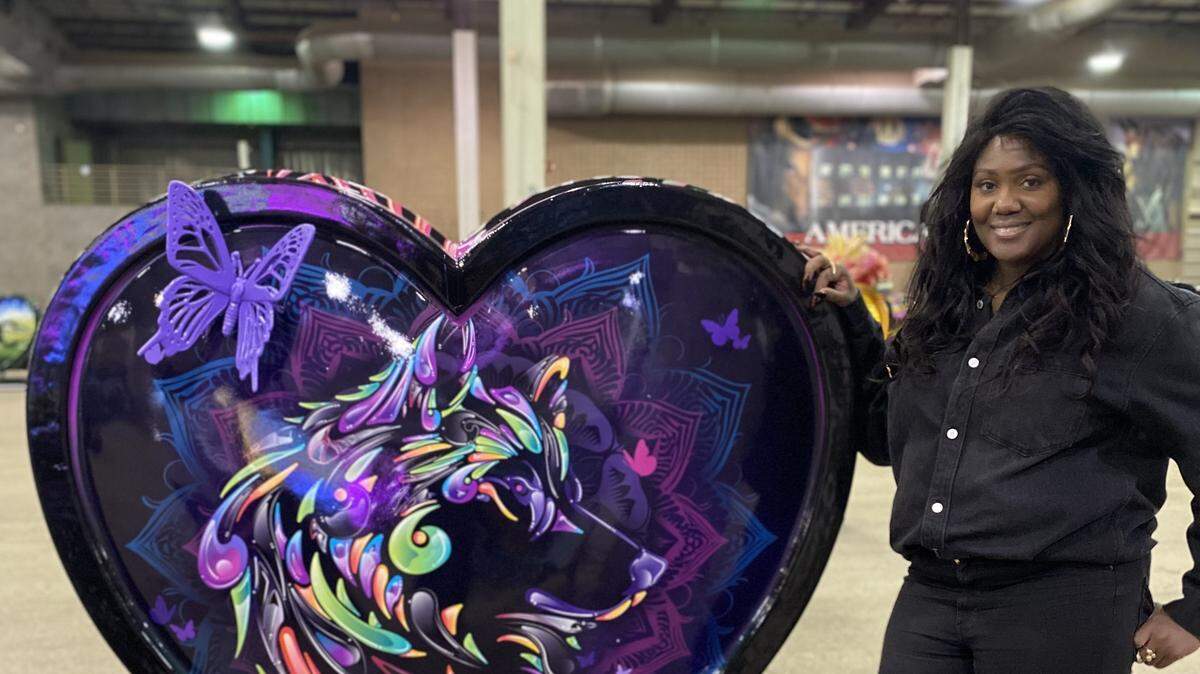
I did the Parade of Hearts twice, in 2023 and 2024. The first one I did was for the Wheatley Providence Hospital here in Kansas City. I wanted to pay homage to Kansas City and its history, but I also wanted to highlight people who are often invisible, just like lupus and share a piece of history. A lot of people didn’t even know that hospital existed.
So again, it’s reflection, honoring, and celebrating people who are often not seen in the public.
Can you walk me through what you do, and how your artistic background influences your approach to interior decorating?
I’m not officially an interior designer. Most people put me in that category, but I’m mostly more of the decorator. In the sense that I create home goods products. I do wallpaper, textiles, plates, cups all that kind of thing. All the stuff that you need.
However, people may disagree. Like, when I’ve seen your apartment, it looked fly. So maybe I do have some aesthetic value that people appreciate.
But I would say when you’re designing a home, I’m always thinking about how people live, what kind of story they want to tell, what people feel when they come to your home, what kind of color, what kind of vibe. All the things that make up you.
When people walk in your house, they should feel, “That’s Keisha,” or “That’s Jan,” or whoever. It’s important to honor that person, their history and where they’re trying to go.
I’ve been in business officially for a year and a half, but I’ve been doing the work for almost 10 years. It was a slow start. I was experimenting with it. I did smaller projects with other interior designers and friends who let me play with their spaces a little bit.
So in Chicago and even here, smaller projects but I didn’t officially launch my business until like a year and a half ago.
Can you walk me through the creative process of creating your own wall paper and what goes into that production?
That story is interesting because my background is marketing and advertising, and I knew that industry has a shelf life. I was in my thirties trying to figure out, what’s the next thing for me? What do I want to do with my life?
I took a small business course when I was still in Chicago. When I graduated, a friend of mine looked at me and was like, “Keisha, one thing I have not seen and I’m being very transparent with you, I have not seen Black people in the home decor space.” And I was like, “What do you mean?”
And he was like, “I’ve seen your artwork. You can translate that into collections. You can design textiles. You understand color and shape and stories.” He said, “Yes, there’s African design, but when it comes to African-American stories, you don’t see that in the market.”
So I started thinking about what stories we don’t share with ourselves, or what isn’t in the mainstream, who we are and how we want to be represented. At the time, I had moved into a bigger apartment in Chicago, and I wanted that apartment to reflect everything that I am, so when you walked in, you felt Keisha, you understood her story.
So I started thinking: what am I into? Number one, I’m a home girl to the max. I’m laid back, but I’m bougie. I’m smart. I’m a little bit of a church girl. I’m all these random things rolled into one.
I like jewelry, and I’ve always been in love with the bamboo earring. I always thought it was iconic. Growing up, my mother would never let me wear it because she thought it was too fast. So now I’m an adult woman, and I’m like, “Okay, I want that.”
To me, that was always the symbol of the home girl, the real fly girl and I always felt like that’s who I was at my core. So I took that shape, started sketching it out, and I was like, “What if I made that a repeating pattern?”
I did that, vectorized it on Illustrator, played around with it, put it on Instagram and people kept asking me about it. I was like, “Oh, that was just something I was doing.”
I started with textiles first, submitted the print to a company that does digital textiles. But I didn’t like the quality, I knew it would fade over time and I wanted something more high-end, coming from the commercial side. Like, if I’m going to do this, I want to do it really high-end.
From there I realized they also do wallpaper, and I was like, “Huh how does this work?” So I studied, watched YouTube, figured out how to set up the file correctly, submitted it, and it came out as a wallpaper roll.
A friend of mine tapped me on the shoulder she was starting her interior design company in New York. She saw it online and said, “I have a client that saw that and they want it.” This was like 10 years ago, before my business officially started.
We printed it, it worked out, and she was like, “What else you have?” And I was like, “What do you mean?” So from there I started concepting other things, what I felt was relevant or cool — and what’s important to us as African Americans, what story we want to leave, what legacy we want to express in our spaces that feel like home, that feel like us. And also sprinkling in those moments of Keisha.
Some of my wallpaper has things around Chicago because I’m that urban girl, but I live in the Midwest, so it’s that balance. I call it urban opulence. It’s urban, it’s Midwest, it’s not all the way New York urban, but it’s Chicago urban and it has a sophistication.
Kansas City is starting to tap into that more now, especially with all the growth. So my wallpaper and textiles have started taking on that storytelling too.
Earlier you mentioned getting to paint a heart for the Parade of Hearts, and I imagine that heart was later auctioned off. What did that opportunity represent for you personally and professionally as an artist?
I think it opened up a lot of doors, because to be honest, I didn’t know anything about the Parade of Hearts. I was still brand new to Kansas City. A neighbor of mine knew I was into the arts and sent me a flyer. I applied, and I didn’t know if I was going to get picked.
I got selected, and I did the heart. And when it was time for the public display, I realized it was just me and another girl, we were two of the only Black artists out of, I think at that time, was it 100? And I was like, “This is a problem.”
I was proud I was there. I think The Community Voice interviewed me, which was an honor, it was my first interview and they highlighted the two or three Black artists who were there. But it was a problem for me.
Also, I felt like the work I did, honoring a part of Kansas City that was forgotten, the history of the Wheatley Providence Hospital, was very important to highlight and share with the rest of Kansas City. Because not only Black people, but even white people, didn’t know that history.
So I want Kansas City to do a better job of supporting minority artists. And even with programs like this, I was more excited this time because there were some Black men. The first time, it was mostly Black women. This time there were Black men too, and I was excited about that.
I think it’s starting to be a wave, slow but the more exposure a few of us get, the more others feel permission or confidence to be pushed out there more. And I just want Kansas City to really promote and highlight minority artists more.
What have been the biggest challenges you’ve faced getting your art and message out to the masses?
I really haven’t had any resistance. Everybody has been receptive and supportive. Even me moving to Kansas City, where I didn’t know anybody, people were like, “You’re doing what? OK, cool. Let me help you.”
It took me by surprise because I’m from Chicago, it’s different. You gotta know somebody. But here, people were like, “I like what you’re doing. I see your heart. Let me help you.” So it wasn’t a struggle, which surprised me.
What are your plans and goals for the future in regards to your art and interior decorating work?
I’m planning on doing a lot with it, and I definitely want to step into my business full time. That’s the goal.
I still use art as the foundation because I look at my business as art. My tagline is “transforming spaces through innovative art.” I think of it as solution-based art, art that creates wellness, belonging, safety, comfort, and welcoming, all the things that make you feel good.
Me dealing with lupus and some other disorders, has also affected my mental health and all of that. I think my work has been helpful with that. So I see my business as this vehicle of wellness, using those core items as tools to help people through that.
Right now, I’m preparing a three-part series here in Kansas City. Next month is the first part. I want to talk about what it means to be at home, what is home, what is your space like and invite tastemakers, interior designers, and architects into the conversation.
I’m creating a documentary around that. It’s going to be at Triune, which is a restaurant here in Kansas City, and it’s about building a culture and community around that.
That’s my biggest thing too, even with lupus, building community, because that foundation and community can be the catalyst that pushes a lot of this forward.
So yes, building community around home and wellness and supporting local artists, artisans, and makers who relate to the home, that’s part of my mission of wellness and design.
For artists navigating illness and burnout and life disruptions, what advice would you offer them about continuing to create?
Number one, allow yourself to breathe and take a break. Sometimes artists get into that mindset of “we gotta produce, we gotta push stuff out.” No, give yourself a break.
I take breaks and look at other artists, go to museums, or don’t even think about it. Sometimes I have conversations, invite a friend to lunch. I break and unplug for a little bit. Then I find inspiration through everything around me, even small conversations.
Another thing I got into a couple years ago is sound bath meditation. I have a friend here in Kansas City. That’s helped me feel more grounded and clear my mind. Resting, working through anxiety, doing meditation, focusing inward, breath work, that’s been something I’ve been into the past couple years, and it’s been really helpful.
Another thing I forgot is that I’m currently doing a monthly radio series, these talks, where I’m inviting people to share their lupus stories.
Lupus is this whole thing about people being unheard and not being seen. So I’m working with a local Hispanic radio station called La Mega Radio. We post it online, and it’s been really good. It’s been well received. So that’s one thing.
For more stories about culture and identity, sign up for our free On The Vine newsletter at http://KansasCity.com/newsletters.
This story was originally published January 25, 2026 at 5:00 AM.