For wealth, local nonprofit documents the lives of Black KC creatives on video
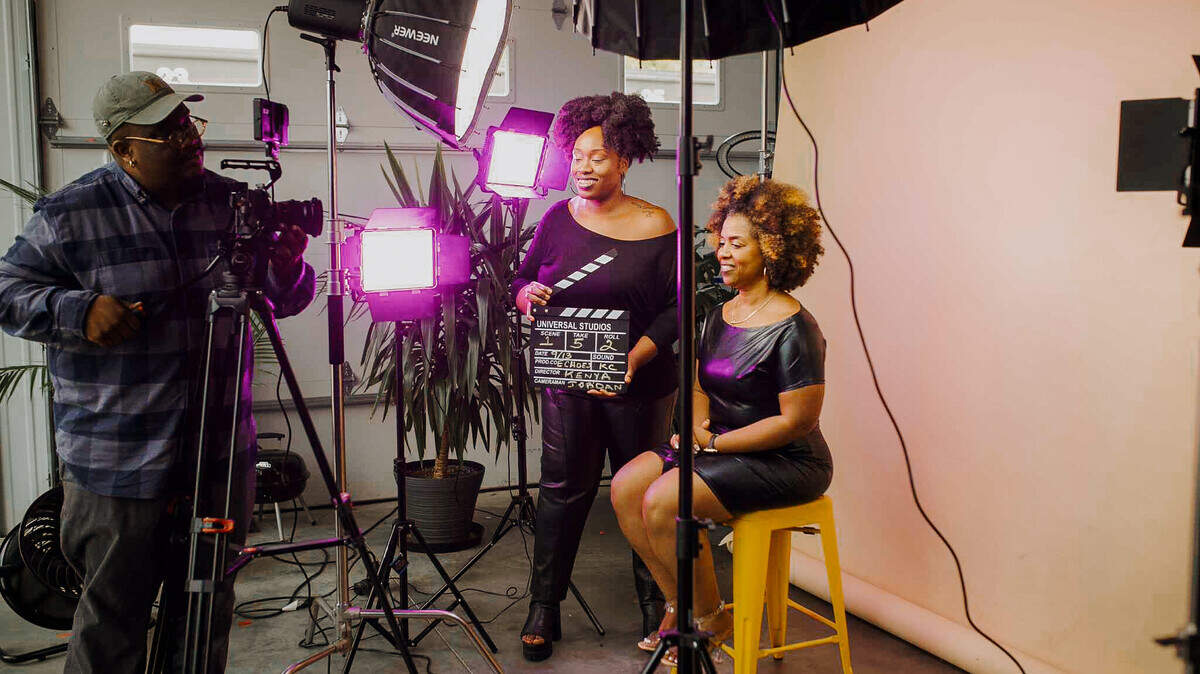
Since June of 2025, Geaneen Anderson and her team formed a new Kansas City nonprofit that blends documentary storytelling with a push for economic stability in the urban core.
After years working as a financial broker, she also works as the executive director of Echoes of the City KC, an organization built around creating and documenting creative greatness in the metro.
Through the organization’s documentary series, “Echoes of the City KC: The Roots and Rise of Kansas City Black Regals,” the nonprofit is profiling Kansas City poets, musicians, content creators and community leaders and tracing how they built their platforms.
Anderson said the films are designed to show the full story, including hardship, racism, social injustice and financial setbacks and to challenge the idea that local success came easy or by chance.
This winter, the group is extending that mission into what it describes as Kansas City’s first Black Wealth Week, set for Feb. 23–28. The week will include discussions on the state of Black wealth, networking for creatives, a vendor-focused festival, a gala honoring documentary subjects and community award recipients, all aimed at connecting culture, community and practical steps toward financial stability.
Recently Anderson sat down with the Star’s culture and identity reporter J.M. Banks to talk about creating her organization, documenting the stories of Black creatives and promoting Black businesses.
Banks: can you tell me a little about your background and upbringing?
Anderson: Well, I did not grow up here, but I’ve been here for 23 years. I’m from Arkansas. It’s a little bitty town called Eudora in the southeastern part, six miles before you cross over into Louisiana. So I’m from way down there.
I am a financial broker. I’ve been in my profession for 14 years but I taught science in the Kansas City District for 10 years prior to that.
Can you tell me about your organization Echoes of the City KC and its mission?
I would say our mission is twofold. Our mission is to uplift Kansas City by helping the community understand factors as far as what it takes to become wealthy, and how to have a healthy community. We base it on the five pillars of wealth: mental wealth, physical wealth, time wealth, social wealth, and financial wealth.
Part of our initiative is documentaries. We have done documentaries. The whole goal is documentaries of leaders who have made an impact in our community and we tell their stories. It’s called Echoes of the City KC: The Roots and Rise of Kansas City Black Regals.
We tell stories of their life from the beginning to where they are right now. That actually brings in those five pillars of wealth, but also shining a light on anything that they encountered, whether it was hardship, financial, social injustice, racism, just everything that they encountered in their lives, to tell their story.
The purpose of telling their story is to inspire others, to show people that your current circumstance doesn’t necessarily mean that’s your fate and how to push through things and how to still do more for people and provide for people. Because all of these people are pillars in our community, that are doing something community-based.
What led to you and your co-founder creating this organization?
So I actually used to be my co-founder Kenya Williams’ teacher. When she finished school, I taught her in middle school — but when she finished school, she went off to Grambling and studied videography.
When we connected later in life, I saw her at the Mary Kelly Center because she was a program director over there. I was telling her that I no longer taught, I do financial services now, financial literacy, teaching people how to do the right things with their money. And she was like, “Oh, that’s something I’m interested in.” So she became one of my agents.
One day, 10 years ago, she was like, “have you ever seen Oprah’s Masterclass? I want to do something like that for community leaders in Kansas City.” She said, “But you know, I like to be behind the screen. I don’t want a face. I don’t want to do the face part.” I said, well, I looked at it and I said, “Yeah I think that would be great. I would love to come together with you and do something like that.”
So, to fast forward, another one of my agents was on Facebook, and she had asked me had I ever seen this stuff that was coming out of North Carolina, Charlotte, where they were doing a Black Wealth Week. And I said, “No, I haven’t seen that.” She showed it to me, I’ll never forget it was January the 5th. I told her this looks good. You want to go? Let’s go check it out,” because I think that would be something amazing to bring back to Kansas City.
So I reached out to Kenya, which is the co-founder, and I was like, “Hey, we want to go check this out. You want to go?” So me, Kenya (Williams), and Adrian went to Charlotte and we checked it out. We thought it was amazing and we had plans to put it on together, but I had an idea. I said, “Hey, let’s merge the two.” I said, “Can you remember how you wanted to do the Oprah Masterclass? Let’s do the Oprah Masterclass, but let’s merge it with the Black Wealth Week.” Meaning, that when we do the Black Wealth Week, at the end of the Black Wealth Week, let’s culminate it with a gala. At that gala, those documentary-feature people could actually be the honorees at the gala.
The conversation started in June of 2025 and we just got to work.
So it was two different ideas, but just kind of merged together to represent what Echoes of the City KC really stands for. We will be putting on an event called Black Wealth Week, which is Feb. 23-28 and the 28th will be the day that the gala is.
How many interviews have you done so far and who are you featuring?
We have already done three documentaries and we’re editing the other three because we have six documentary features. One is on Christina Williams and Tamela Ross the founders of The Blakk Company. Then Glenn Robinson, Hood Dude Food Reviews. Terell Ray, creator of the Kansas City People’s Choice Awards. The next is on Glenn North, the poet, Terri Barnes who is the chair of the Kansas City Mayor’s Commission on Reparations and then the last person is Stanley Taylor, who is the founder of Greek Picnic, and then he does a lot of other community things in the school system with children.
What values guide the work your organization does documenting these stories?
I like to say what we wrap it around is true, genuine lived experiences of people and their stories. Because stories allow us to heal. It allows people to hear our stories and heal.
With that being said, we were inspired to bring people’s stories to life. I’ll say, put it out there so people could know it. Because we see these people every day, and some people think, “Oh, they’re just born with a silver spoon in their mouth,” and that’s absolutely not true. Most people who do something outside themselves actually went through something and want to prevent others from going through the thing.
What are the responsibilities that come along with being the executive director for an organization like this?
So it’s a lot of sacrifice, a lot of sacrifice. Meaning it’s things you have to give up personally. It takes a lot of focus on others. One of the biggest things is carrying the weight of the empathy, of feeling people’s issues or how people feel.
Whether it’s turmoil, whether it’s grief, whatever emotions they have when they’re telling those stories, you feel it. Being able to feel it, have empathy, and then be able to replenish within your own self is a huge sacrifice. It’s a lot of weight.
Just making sure that everything is on time because the documentaries are very, very, very tedious. It’s only like a two-man job right now, me and the co-founder. We’ve been doing all of it, as far as reaching out to people, the community engagement, the editing, and all of it is basically on us because it was just an idea.
So it’s not really, at this point with it being brand new, any financial support and different things like that. As a matter of fact, we don’t even own a camera. We didn’t have a computer; it broke on us. So it was just all of those things that come with having this grand idea, but not necessarily having the provision. So just trusting God through it all, that when you move your feet, and it was a calling on you to do, that you have the faith that the provision will come along with it.
Have you guys released all the documentaries you’ve shot so far?
Three of them are released. So the one for Christina (Williams) and Tamela (Ross) is released, the one for Hood Do Food Reviewed is released, which is Glenn Robinson and the one for Terrell Ray is released.
They can be found on our YouTube channel, which is Echoes of the City KC, along with other shorts and snippets of the other documentaries. So we have recorded them all, but we haven’t put all of them together as far as to edit it, but three are all the way complete. They’re all on our social media handles, which is Facebook, Instagram and TikTok.
What was the selection process like for choosing the people you wanted to document?
When we did it, which we’ll have a different process the next year, but when we began with the idea, our goal was to be diverse in the selection, to pull from different industries and different avenues that these people were focused on working in. To make sure that it was balanced as far as age, gender and the effect of what we discovered by looking at people on Facebook and the impact that they were actually having with their presence.
What do you see the long-term vision of the organization being in the work it does in the community?
We want it to be sustainable. But we actually see and visualize having some form of center that we could open up to the community where they’ve got resources on mental health, physical health, time wealth, social wealth and financial wealth, that they can come to one place and we help people on hand, or people to refer them to when they need help, where they didn’t have to pay for those services.
That’s one of the long-term things we want to have, a center people can come in and work out, or come in and have a counseling session, or come in and have a free consulting with a financial advisor or professional.
How do you measure or recognize impact beyond views for your project?
The views are just a second part that we look at. But impact to me is measured because all of these people, these are events and different things that we have personally went to or went around to, just kind of see, okay, what is this person doing in the community? What are they doing? What is the impact?
So just basically being present, asking individuals who attend, watching them for a while, because yeah, we just kind of started this, but this has been something that we have had our eyes on, as far as the documentary part, for over 10 years. So just measuring through what we see people attending, people commenting about, how people feel from these events, or just having interaction with the individuals with the things that they’re doing in the community.
What’s been some of the feedback you’ve received since you’ve launched the series?
The feedback has been real interesting because a lot of people are just like, “Oh my gosh, we’ve never seen anything like this.” We’ve seen several podcasts, but not actual documentaries of people that we see every day.
We have this other section that’s called History Moments with Professor Wilmore and he does a quick little snippet on Wednesdays where he talks about some kind of history of Kansas City and we put visuals of that on there. Someone commented that this is their favorite history channel or history piece that they see on Kansas City. So they love watching that.
I’ve heard people talk about how excited they are and that they’ve never heard of a Black Wealth Week and that’s just so exciting to see. The city has written a proclamation to declare that to be Black Wealth Week, a theme for Kansas City. So we did get a city proclamation on that. They thought it was an amazing idea.
So it’s just been so much positive feedback on the excitement to see people’s stories, to know that those are the five things that we’re talking about and then the fact of it being a collaborative type of situation where we’re wanting to connect with other nonprofits and businesses and organizations.
Can you give me the breakdown of Black Wealth Week and what people can expect in February.
So first night will be the State of Black Wealth KC, and that will be like a discussion, hearing from experts in those areas, where they are talking about those issues and what we can do collectively to make it better. So that’s what the State of Black Wealth would be about. Also, kind of make it fun, where we have people talk about what wealth means to them. Just interactive.
On Wednesday night, we want to have a mixer, a network mixer, where entrepreneurs and creatives and community people come in and network with one another. We want to have a short panel, maybe about 20 or 30 minutes, where we’re hearing from different entrepreneur support organizations, giving tips on how entrepreneurs can better their lives in those five areas of wealth.
Friday night, we want to have a Black Wealth Week Fest where it focuses on the economics of our community, where we have vendors. People can come out and sell their products, display their products. But at the same time, we want to have a series of events, so maybe a small fashion show, a small art display.
We’re even looking into having a cook-off, even an area where we can get restaurants to come out and give people tastes of what they’re cooking. So just a whole lot of things that bring in a lot of what Kansas City is all about in one place as a fest.
Saturday is the gala, which is called the Roots and Rise Gala, where we will be honoring the six features of the documentary, but we also have three award recipients.
The first award will be called Echoes of Legacy, which will go to Derek Wilmore Jr., which is the same person that does our History Wednesdays with Professor Wilmore. He will receive that for sharing his history and keeping the legacy of Kansas City alive.
The second one will go to Joseph Macklin and it will be the Echoes of Visionary Impact Award for his innovative mission that he has with opening up The District and providing an opportunity for young people, or anybody, to come in and build their skills in that area of the arts.
Then we will have the Echoes of the Lens Award, which will go to Stinson McLendon, who has done so many documentaries on the history of Kansas City. He actually used to be a school teacher as well. He used to work for PBS, and that’s actually who taught Kenya, that’s where she got her peek at wanting to be in videography, through his class at Paseo (Paseo Academy of Fine and Performing Arts).
So that will be a festive, production-style night, where it would still be live storytelling on the history of Kansas City, like two stepping and spoken word and jazz.
How would you like to see the organization grow and evolve over the years?
I would like to see it get on a huge level, where we’re able to have our documentaries on some type of network, where Kansas City is not known just for certain things like the Chiefs, or the history of jazz and all of that stuff is amazing, but the people of Kansas City as well.
For more stories about culture and identity, sign up for our free On The Vine newsletter at http://KansasCity.com/newsletters.