
Heidi Gardner’s cats love their weekly sound baths. Now they’re offered to KC pets
AI-generated summary reviewed by our newsroom.
- Sound baths use resonant instruments to calm and energize human listeners.
- Cats unexpectedly responded to sound baths, showing calm and attentiveness.
- Heidi Gardner shared the feline reaction online, boosting interest in pet sound therapy.
A few weeks ago while house-sitting for a friend, Joann Schermerhorn decided to use the time to practice her new sound bath skills.
So she spread out her musical instruments — singing bowls, chimes, a steel tongue drum — on the living room floor and began to play. The soothing, deeply resonant humming of the bowls and sparkling tinkling of chimes filled the room.
A sound bath is an aural experience that washes over the listener, helping them feel calm, less stressed, more energized for some people. Schermerhorn, newly certified in the practice, was prepping for an appointment with a human client.
But what happened next took her by surprise.
Two older cats in the home, one ill, the other blind, followed the sounds into the room. A feisty 2-year-old cat, busy chasing birds in the backyard, came into the house and sat down at her feet.
“And I was like, ‘Oh this is really cute.’ So I sent Heidi all these videos and she was obsessed with it,” said Schermerhorn.
Heidi is “Saturday Night Live” star Heidi Gardner, who spends her summer break from the New York-based show at her Kansas City area home.
Gardner is a passionate cat lover and when she saw how her pets responded, she shared photos with her 370,000 Instagram followers, many of whom had probably never seen cats enjoying a sound bath.
“I have the best petsitter in KC,” Gardner boasted in one post. “She does kitty sound baths and they love it.”
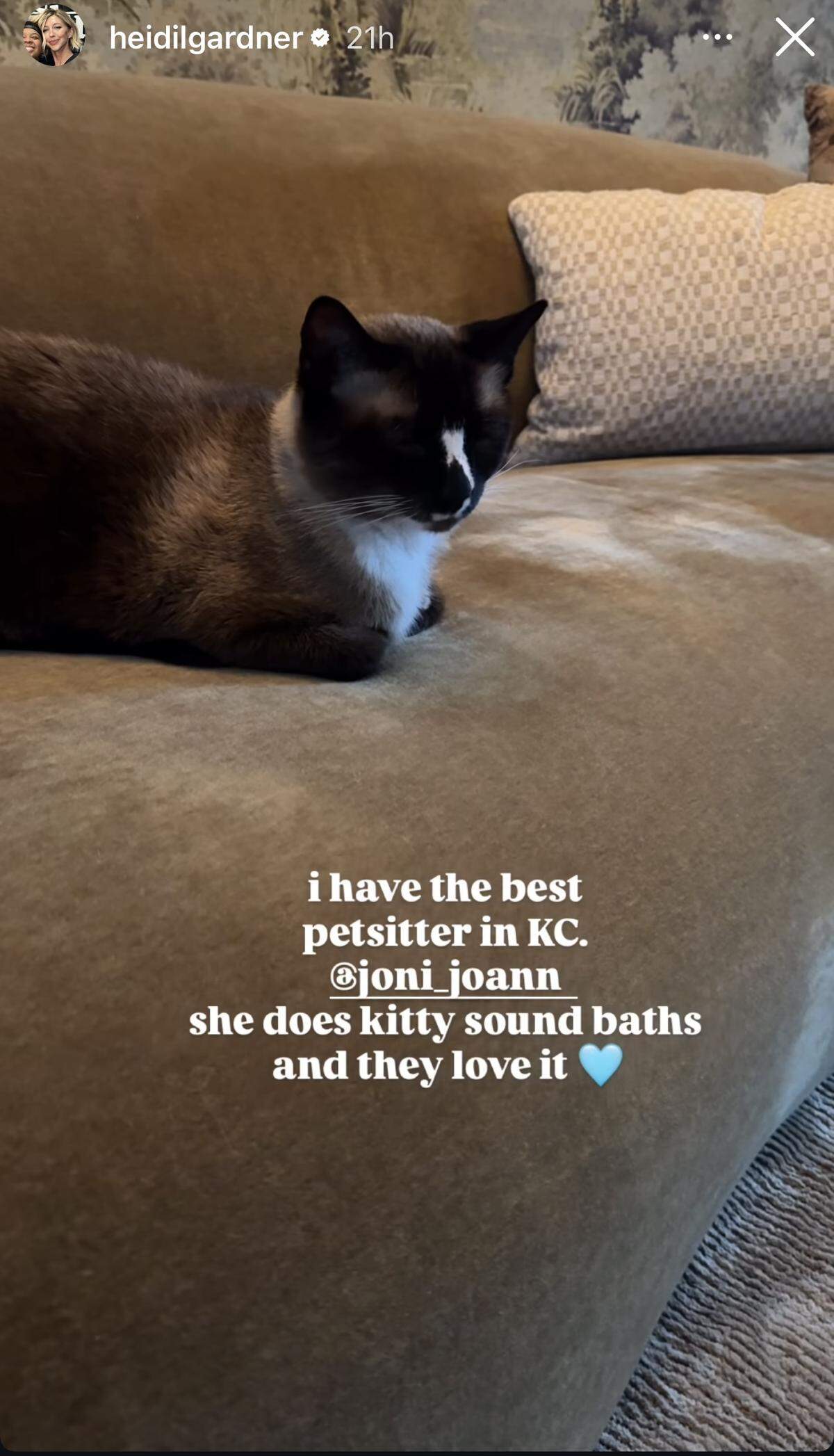
Until that day in late June, Schermerhorn had never considered providing the experience for pets. But Gardner asked her to begin doing them weekly for her cats and the women continued to watch the cats respond.
Nearly two months later she’s still doing them regularly for Gardner’s feline menagerie and plans to until Gardner takes the cats back to New York with her.
And Schermerhorn is now offering the service to other Kansas City pet owners. It’s the same technique she uses for humans, just quieter.
“It was a really nice bonding moment for them because Heidi’s four cats, they don’t snuggle, they’re not all best friends,” Schermerhorn said.
“But when I do sound baths, the three older ones get on the couch and all spoon. Heidi and I, we always try not to talk to each other because we don’t want to disrupt the sound, but we’re looking at each other and whispering, ‘oh my God.’”
Schermerhorn had seen her own cats respond similarly as she practiced in her Overland Park home. She’s been in the wellness industry for 20 years, currently working at Very Well KC in downtown Overland Park. When the wellness center began hosting sound bath sessions. Schermerhorn became certified through the Sound Healing Academy in the Bronx, New York.
But she had never considered doing it for pets until Gardner suggested it. So she started a business, Tending Pets KC, and is busy signing up clients.
“We both were just fascinated by how much it’s really helped her cats. And then she said, ‘you need to do this. You need to start offering this. No one does it,’” said Schermerhorn.
The idea intrigued her because she enjoys animals; she spent two years as the onsite dog walker and pet sitter at an Overland park apartment complex. But she found a lot more information about sound baths for humans when she began researching. She knows what she has seen, though.
A few weeks ago during a bad storm she was with her brother’s three dogs: two older dogs and a super-anxious, nearly-2-year-old Goldendoodle. She held one of the older dogs in her lap as he shook, freaked out by the thunder.
“So I took him into the bedroom and started playing that steel drum, and the puppy immediately kinda laid down and was just watching me and the older dog who was shaking and was frightened completely stopped shaking, got off my lap and curled up next to me and was totally fine,” she said.
Eager to see how other animals might Schermerhorn said she reached out to nearly every shelter in the Kansas City area offering to provide free sound baths for the animals but no one responded.
But she has partnered with Whiskers Cat Cafe and Coffeehouse in Kansas City to provide sound baths for cats, and humans, on every other Monday over the coming months. August and September are already booked.
Two KC kittens enjoy their bath
One night last week, Schermerhorn set up her instruments in front of the living room fireplace in Melanie Meyers’ Brookside home to create a sound bath for the two tiniest cats in the house — Corn and Buckwheat, neither weighing more than a sneeze, each less than 2 pounds.
Meyers has volunteered more than five years with KC Pet Project, devoted to fostering kittens who need bottle feeding, a job requiring 24/7 attention. She also trains volunteers to work with these tiniest, neediest of cats.
It’s a cause close to her heart since she learned the harsh truth about kittens. Cats that are not weaned, bottle age under four weeks old, have the highest euthanasia rate in shelters because “if they come in and the shelter doesn’t have a foster or anyone to take care of them they just have to euthanize. I was devastated by that,” she said.
The American Humane Society says 71% of cats who enter shelters are euthanized compared to 56% of dogs because cats are more likely to come to the shelters without owner ID.
Meyers was curious to see how foster kitties would respond to a sound bath. “I’m hopeful that we can kind of get them to relax,” she said before the session began. “They still have a little unrest, for those first three weeks especially ... I’m just really hopeful that it can kind of provide a calming peace for them.
“Foster kittens have been through the ringer a little bit. A lot of them, even at a couple of weeks old, have had very difficult lives. Some of the stories and the ways we’re receiving them at the shelter can be just heartbreaking. So something that can be calming, peaceful for them so they can relax and feel comfort in their day-to-day life, that’s what I’m hoping for.”
Corn and Buckwheat had very different reactions. Corn, initially interested in Schermerhorn’s instruments, eventually began running around, checking out corners of the room, the couch and a feather play toy before ultimately crawling inside a TV cabinet where she took a nap.
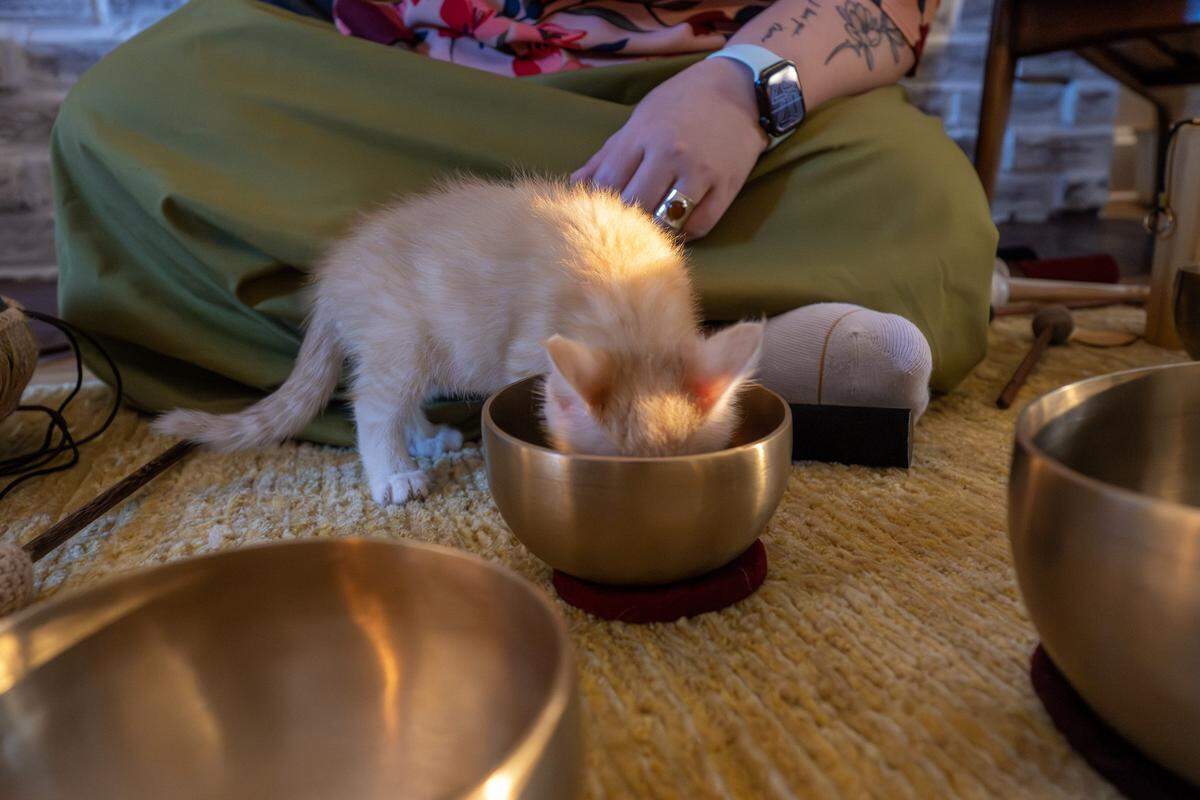
Buckwheat, though, was fascinated, at one point pushing his tiny nose close to Schermerhorn’s chimes.
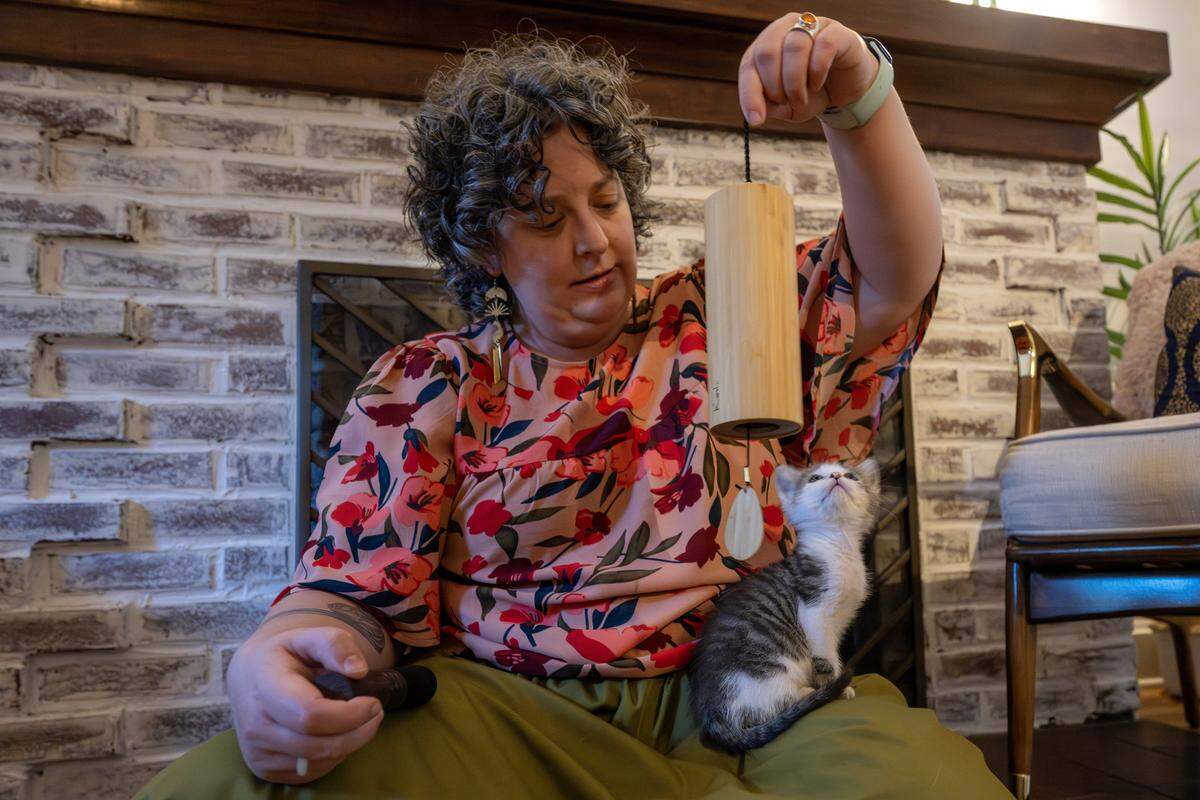
And toward the end of the session, he was curled up in a ball in Meyers’ hands. She could feel his tiny body vibrating as he softly purred.
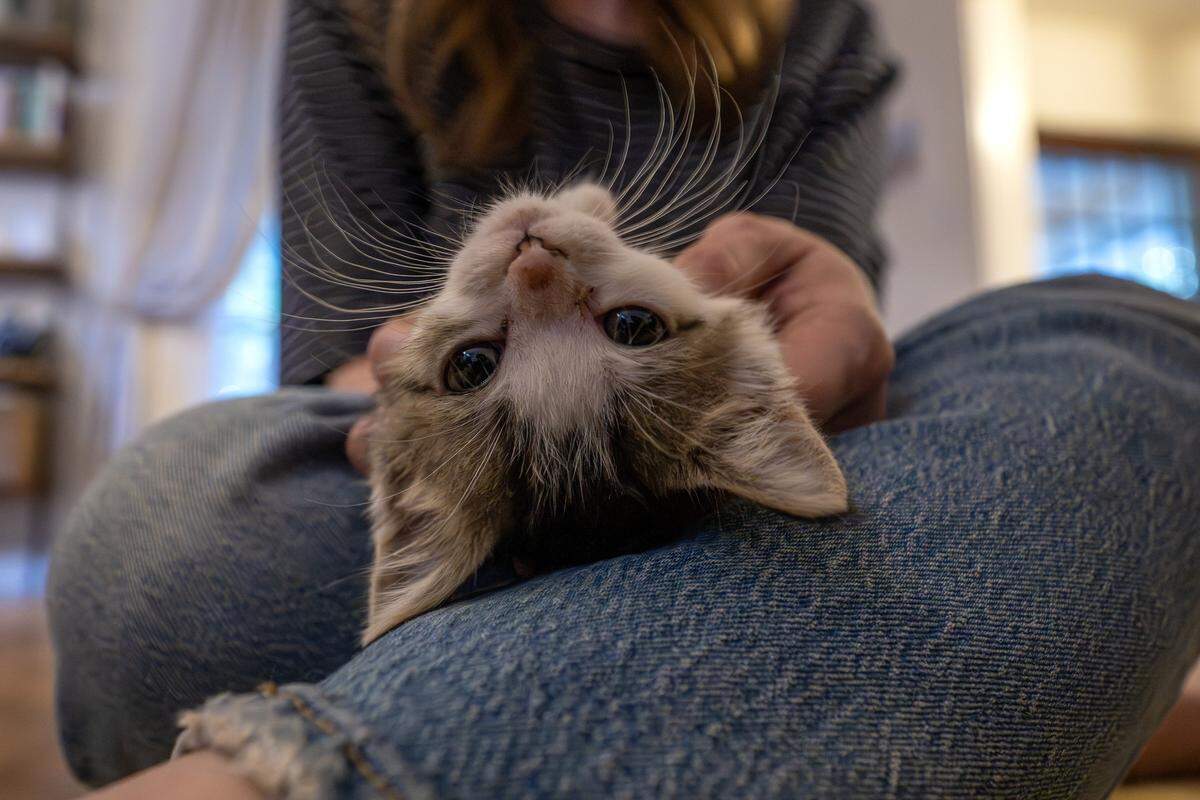
Meyers already saw how one of her other foster kittens had responded to a sound bath because Gardner is trying to adopt him.
Four-month-old Lil Romeo, named after the rapper, has rare congenital hypothyroidism. He’s tiny for his age, like a mini cat, and is taking thyroid medication to help him grow.
“But the interesting thing with him is that developmentally he is very delayed, both physically and also mentally. And when I had him, I was concerned he was having hearing issues as well. I wasn’t really sure,” Meyers said.
“So then Heidi had him for a long weekend and brought Joann over to do a sound bath and that was the first time I ever saw Lil Romeo respond to sound. Isn’t that incredible?
“He not only responded to it, he meowed for the first time. He had never made a sound before. It’s so sweet.”
Cats are not dogs, and vice versa
Schermerhorn sets aside an hour for each sound bath session. Each begins informally as she interacts with the cats, letting them check out the instruments and even climb into her tote bag or the bowls.
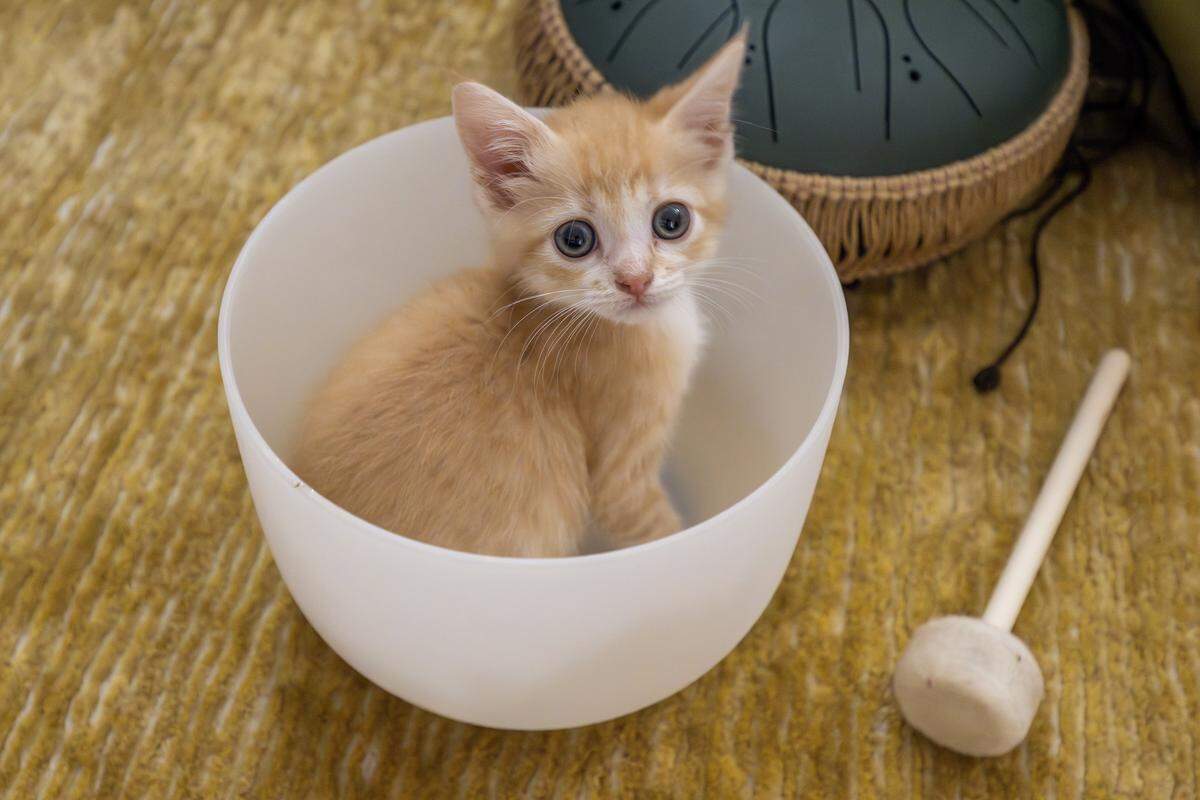
A sound bath isn’t just about “playing music,” she said. “I would say the best way to explain it is it’s using vibrations, it’s about the frequency. It’s about playing at a certain hertz.”
A hertz is how frequency, which determines the pitch of a sound, is measured.
Humans and animals hear at different hertz levels. “I think humans, they don’t really hear past 20 hertz,” she said. “Cats can hear up to 48 to 85 hertz so they hear higher notes. So for them I notice that they’re really resonating with the steel tongue drum and my chimes.”
But responses depend on the animal from what she has seen so far. Where some cats might hear the sounds and bat their paws at the air, others simply plop down and sleep.
Schermerhorn watches reactions closely. “I’m looking at their whiskers, how their ears are placed, do I see the whites of their eyes,” she said. “I’m really paying attention to their tails, I’m reading their body language.”
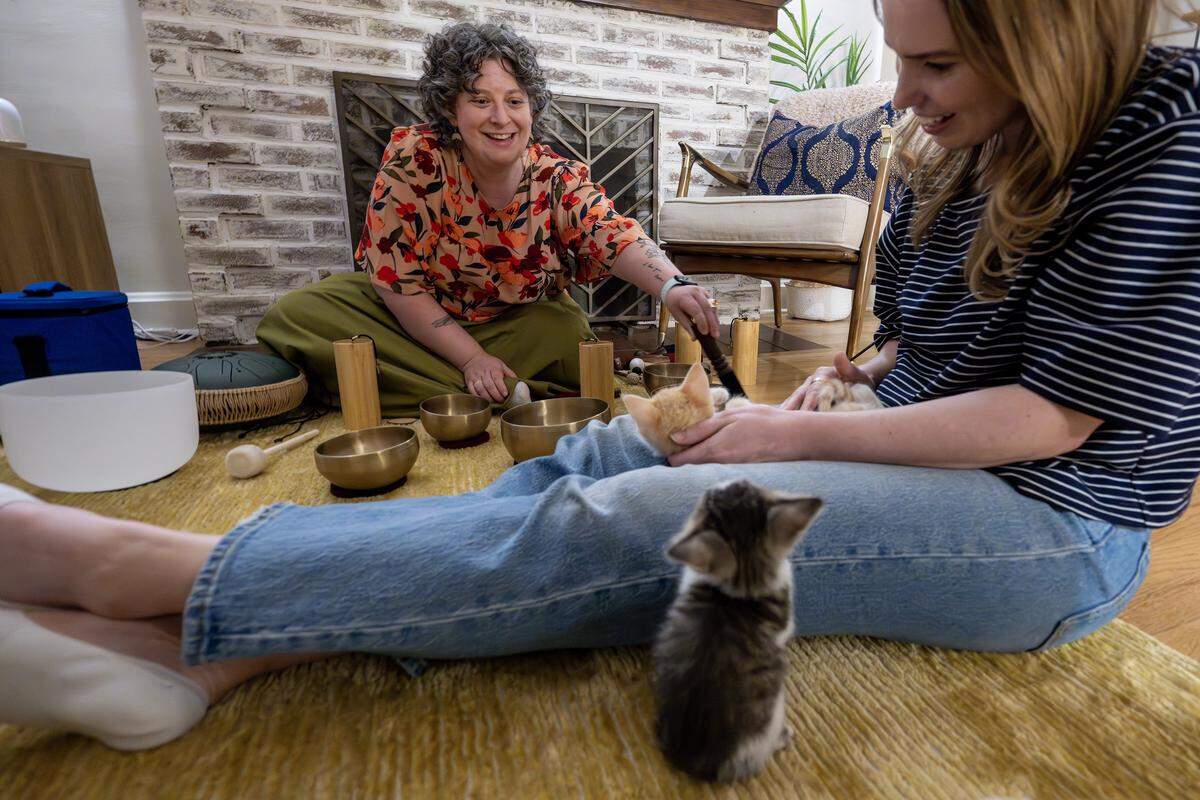
With Gardner’s four cats, “two of them really like the chimes and they like listening to the higher pitch of the music,” she said.
“But with her little one, the little kitten who is 10 weeks old, he loves the singing bowls because it creates that little wah wah wah reverberation and I think he feels that frequency.
“They can feel the vibration in their paws, their whiskers, their fur. They can feel all of that. And whenever I start playing the Himalayan singing bowls, he is all about it.
“With dogs, I wouldn’t play the chimes for them because they hear lower so they’re going to resonate more with drums and the lower-frequency instruments.”
She’s never had a cat have an adverse reaction, but not all of them like the sounds. One of Gardner’s four cats, for instance, wanted out of the room while she was playing.
“I told Heidi to just let her out,” Schermerhorn said. “We’re not forcing her into this. If she doesn’t want the wellness, it’s OK. It’s just about reading the animal and making sure you’re not forcing them into something they’re not into.”
So far, most of the people who have sought out Schermerhorn’s services have pets with problems.
“I do think, and maybe its just us as pet owners, we just think that when there’s an issue or a problem that’s when we’re going to seek help for our cats or animals. Typically, we’re not going to look into these modalities,” she said.
One client had a 16-year-old cat who was lonely after the other cat in the home died. “She just wanted him to have that experience,” Schermerhorn said.
“Usually it’s people who have cats that have stress, anxiety, something that they’re wanting to help calm. I think it’s going to be similar to kind of like when a human being comes to me and gets a treatment from me.”
Schermerhorn would eventually like to transition full-time into working with animals. “I was even thinking about becoming a veterinary assistant at one point, but I just never did,” she said. “I just stayed in the wellness industry. But yeah, it’d be great.”
Actually, the cat sound baths have proven to be beneficial to both pet and owner, especially for Gardner who “sometimes will lay down and be zoned out listening. So a lot of the time it’s been nice for Heidi,” Schermerhorn said.
“Or Heidi will get up on the couch and they’ll all come and sit near her or sit next to each other. And then Heidi being Heidi, because she’s so cute, she has her cat that passed away recently. She has his ashes in a little box and she even brings him into the room and sits with him.
“So yeah, if anything I feel like it’s a real good bonding time for the owner and their cats.”
This story was originally published August 12, 2025 at 5:30 AM.