Johnson County city weighs legal risk of limiting home demolitions and rebuilds
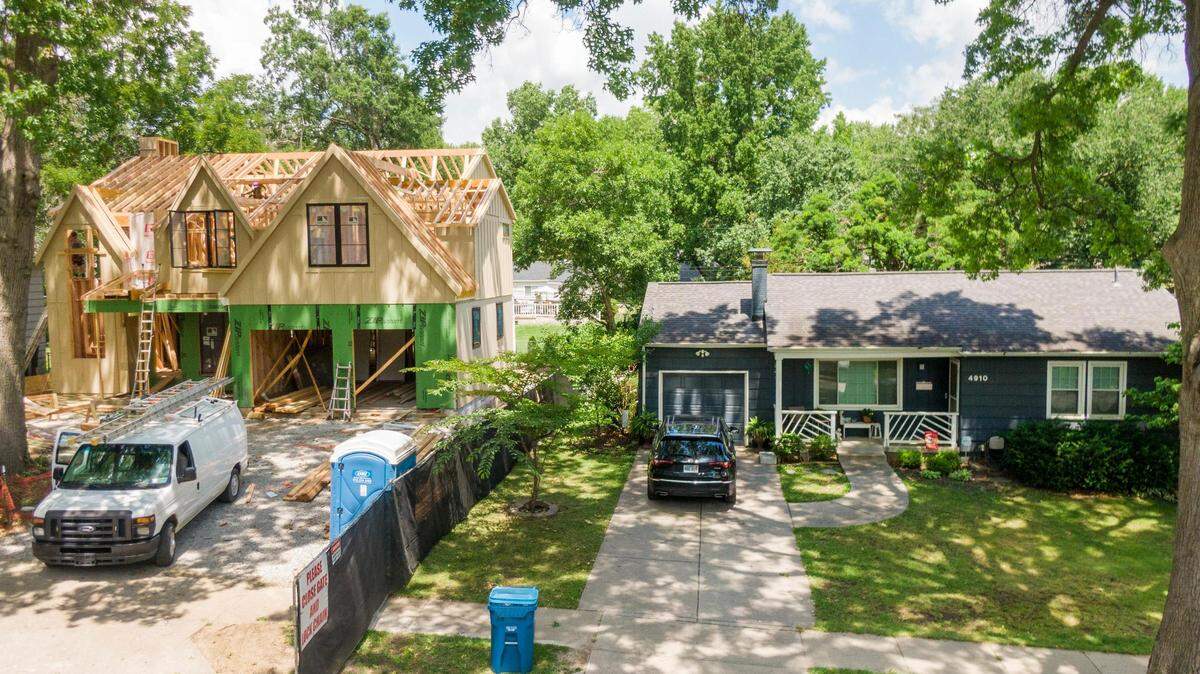
After residents raised alarms over the ways development and redevelopment can compromise a neighborhood’s character and drive up property taxes, the Prairie Village City Council will discuss if they want to explore potential residential development restrictions.
The concern is around teardown-rebuilds in particular, which occur when someone buys a property, demolishes the existing structure and builds a new house in its place. The trend has been a source of tension among Prairie Village residents for years as more modest homes are replaced and almost double in value.
In 2023, 50 homes were built in the city and 45 homes were built in 2024. Numbers for 2025 appear to be on a similar scale, according to the city report.
Regarding restrictions, staff considered moratoriums or caps on the total number of permits the city could issue for redevelopment projects both citywide and for certain blocks. They found that a cap or quota could bring forward legal challenges. A moratorium, which would just be a temporary restriction on development, might work, but details need to be ironed out before going any further.
In particular, Prairie Village staff want to know if the City Council wants to change the code, if the changes would be exclusive to demolition projects or if they would also include heavy renovation projects – which would also need to be further defined in order to add it to the code.
Discussions to amend the city’s neighborhood guidelines – particularly around teardown-rebuild projects – have caused high tensions in the northeast Johnson County city and played a role in recent election cycles. This discussion comes at a time when the City Council recently approved a new municipal complex project, which has also sparked debate among residents and caused one to file a lawsuit against the city.
Initial reactions to restrictions
Such a change to city code to limit rebuilding would be likely to spark some controversy, especially among owners who want to do with their property as they wish.
City staff cautioned that a direct change to what can be done with property that is currently zoned to allow for a new house could lead to lawsuits down the road against the city from owners who want to rebuild.
“On first impression, any quota or cap brings with it substantial risk of a legal challenge,” the staff report read.
Residents could raise constitutional issues related to property rights and enjoyment.
“The broad risk with any restriction on property rights is that they could be challenged as a ‘taking’ of property,” the staff report read. “These claims are centered on constitutional principles not to deprive someone of property without due process, and not to take property for a public use (without compensation).”
If a quota or cap is implemented, staff said in the city report that they worry if securing permits would then become a race and result in “disparate treatment of otherwise alike property owners.”
Staff also cited potential challenges in determining when one project is “sufficiently wrapped up enough” to allow the next one to begin and project delays holding up the rest of the line.
“The reality is that, even where the council may have good-faith motivations and may seek to carefully outline a restriction that is as reasonable as possible, if a restriction prevents building or demolishing without providing compensation for that restriction, it is fairly likely to draw a legal challenge,” the staff report said.
Staff will seek further direction from the City Council on this matter during Monday’s meeting at 6 p.m. at the city’s municipal building – 7700 Mission Rd.