KC music club gets hit with 1,100% property tax reassessment. ‘A death sentence’
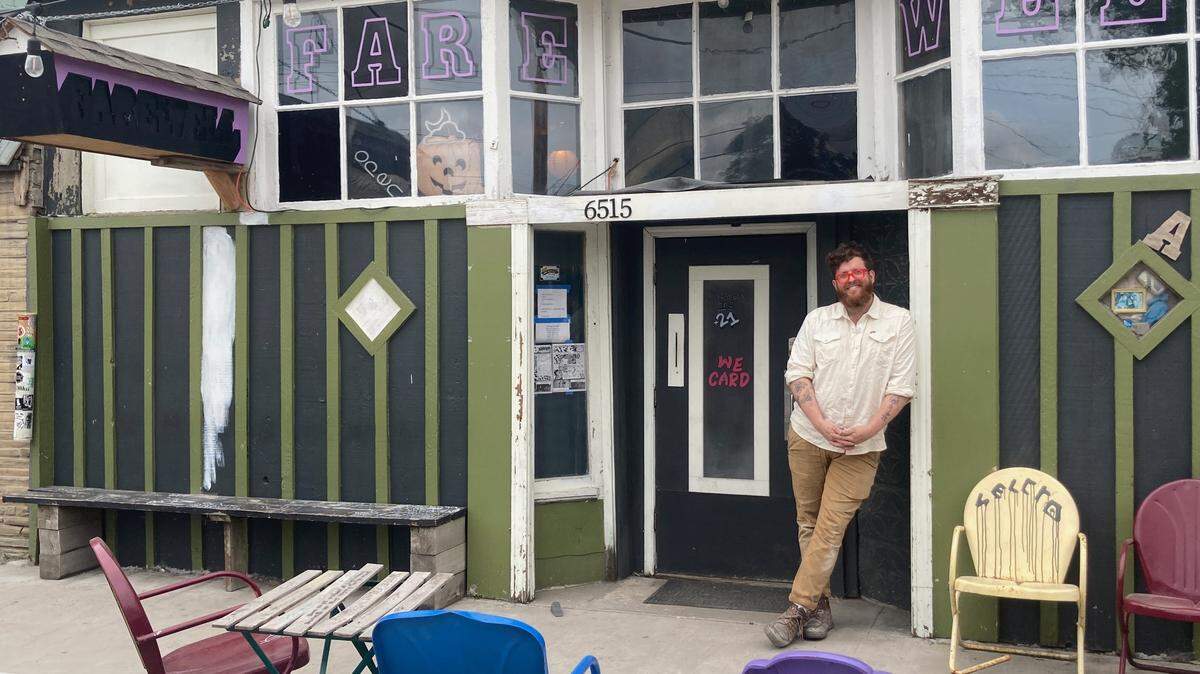
Max Popoff, a friendly and bear-sized music club owner, a punk rock zealot in orange glasses, is hardly kidding when he says that the grass-roots music scene he loves, “saved my life.”
Also no joke: How Jackson County’s latest tax assessment of two unpolished buildings that Popoff renovated in Kansas City’s industrial Leeds neighborhood — and out of which he cobbled two now-popular live music clubs, one named Howdy, the other Farewell — has all but triggered an existential crisis.
The reason is taxes.
According to the county reassessment letter that Popoff received in May, the market value of the building that houses Farewell at 6515 Stadium Drive — and which Jackson County in 2023 said was worth $56,000 — had jumped to close to $700,000, a rise of more than 1,100%.
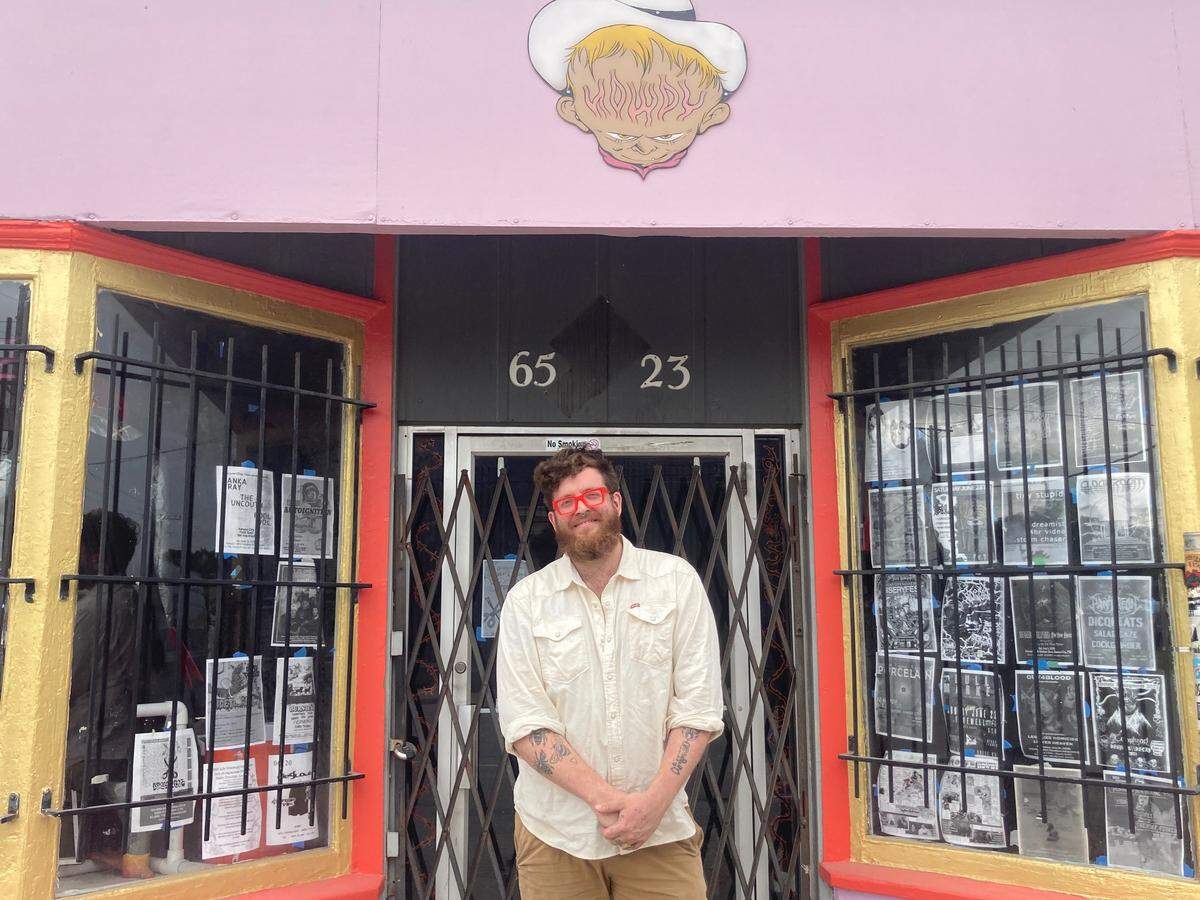
The value of the building next door that houses Howdy, the county said, had more than quadrupled from $106,000 to more than $450,000. As a result, Popoff said, his combined yearly taxes would jump from less than $5,000 a year to $30,000, a cost that would be unsustainable.
“I would have to close,” Popoff said.
He continued, “They were insinuating that the two buildings — which are like the only two standing buildings there — are somehow worth $1.1 million. I was like, ‘Look, if you think it’s worth that much, you can buy it.’”
As is his right, Popoff chose to appeal the revaluation to the county. And the county on June 11 reached an agreement with Popoff to reduce the combined value by nearly 70%, from $1.1 million to $301,460.
The number, however, would still double his tax burden.
“I equated it to, you know, being given a death sentence, and then being told they’re just taking your legs,” Popoff said. “ Somehow I’m supposed to feel like that’s a victory.”
Small businesses, big tax increases
Except he doesn’t see it as a victory.
Nor do a growing number or small business owners who say that Jackson County’s revaluations of their commercial properties are hitting small businesses harder than many expected.
Last week Ian Davis, the owner of Blip Coffee Roasters in Kansas City’s West Bottoms, deemed the 626% increase in the property tax assessment he received in May as nothing less than “a shakedown” and “simple extortion” that was putting his business at risk.
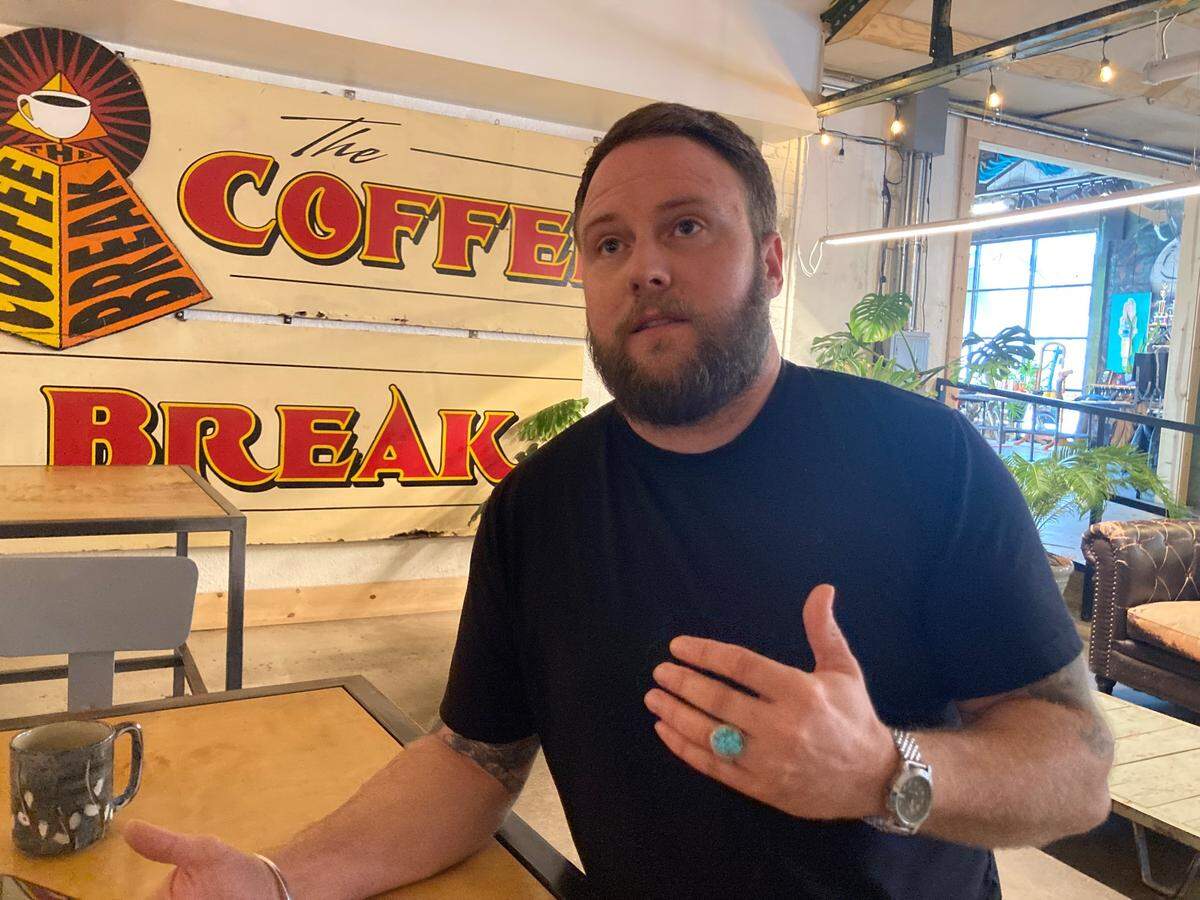
“I can’t afford a 600-whatever increase,” he told The Star.
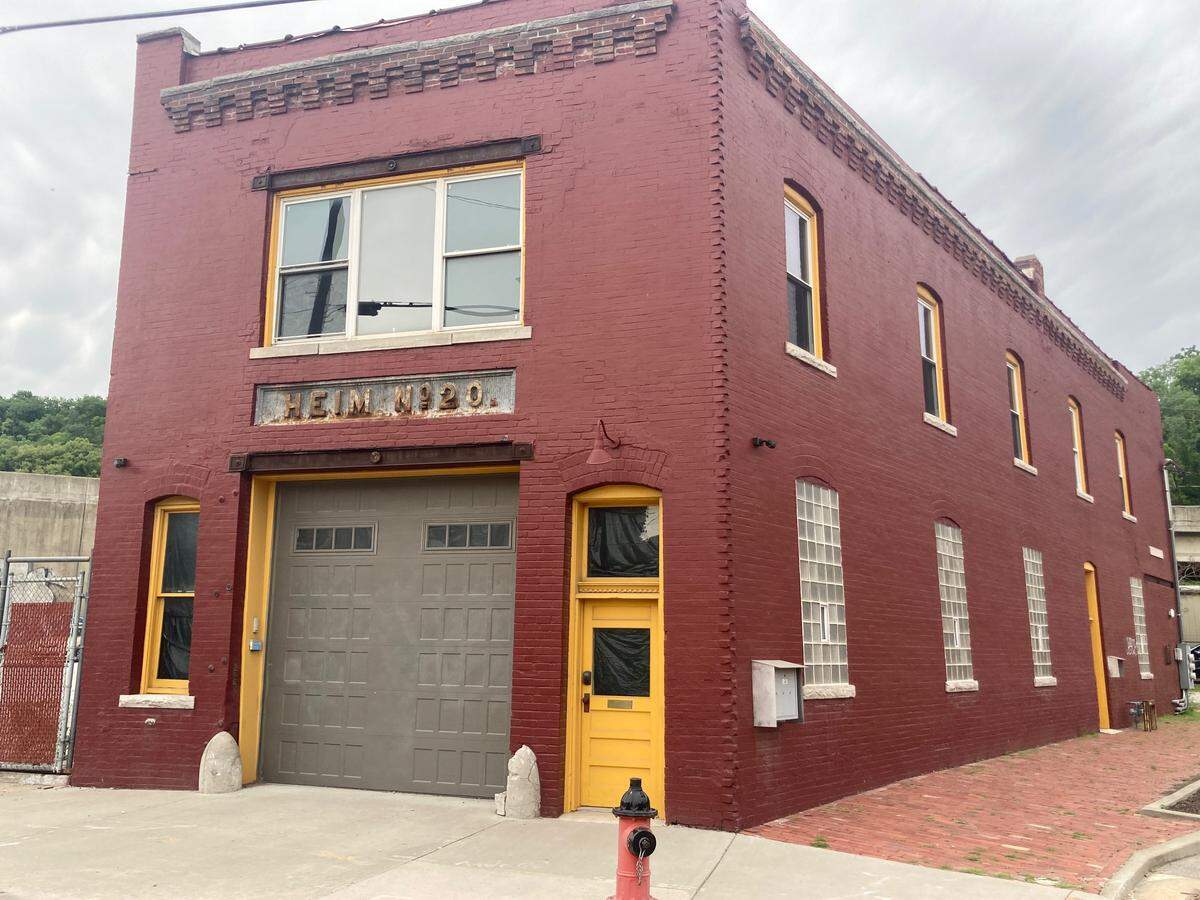
In Kansas City’s East Bottoms, Andy Rieger, the co-founder of the J. Rieger & Co. distillery, went on LinkedIn to denounce a 577% spike in the assessed market value of one of his buildings, an unoccupied, 135-year-old former firehouse at 2701 Guinotte Ave. In 2023, it was valued at $101,000. In the new assessment: $684,000.
Rieger called the revaluation “hostile.”
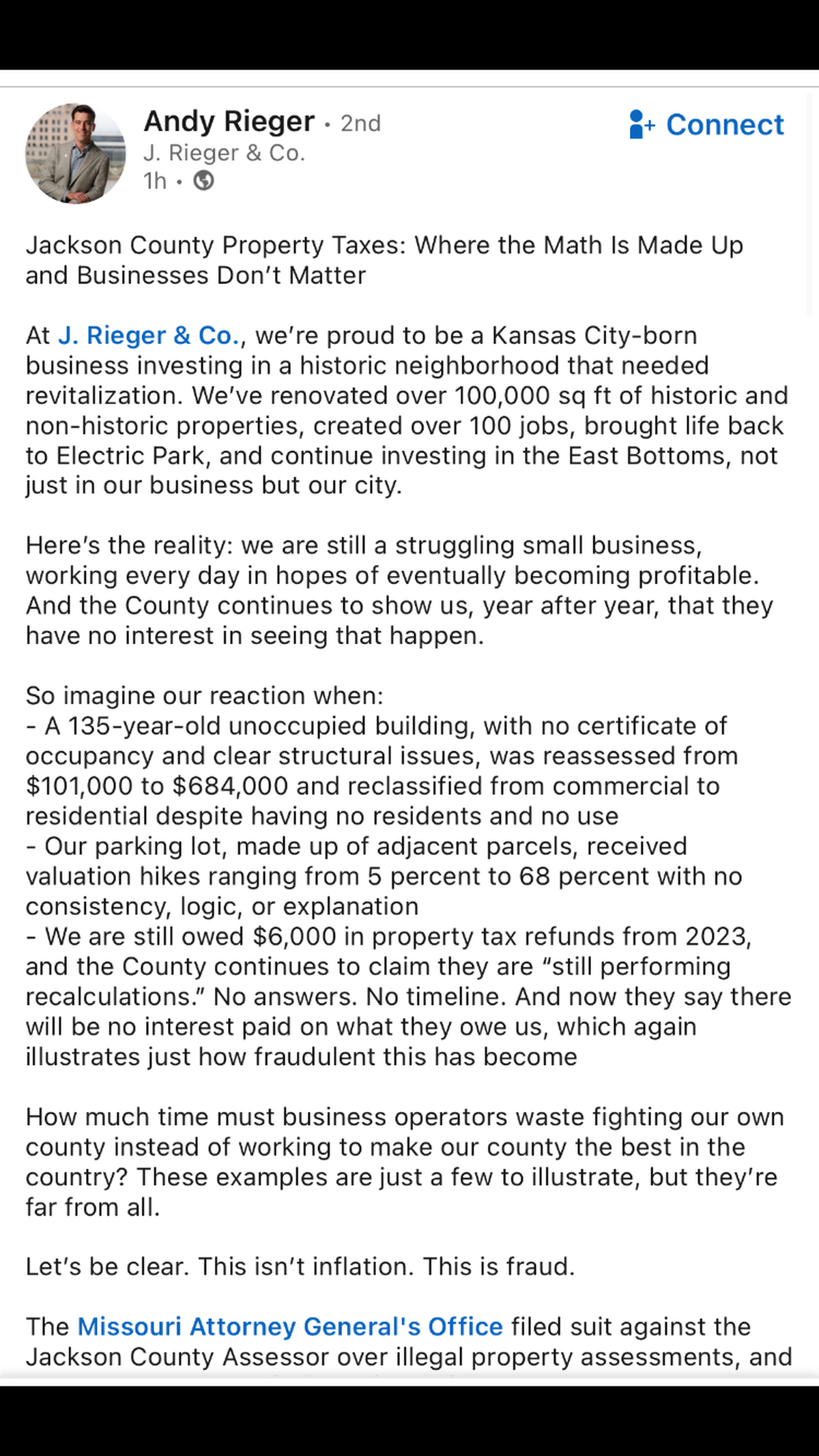
“Our county excels at chasing off potential new businesses from wanting to open shop in Jackson County,” Rieger wrote on LinkedIn. “Property taxes are being weaponized against the very businesses trying to invest in distressed communities. This isn’t how local government is supposed to work. It’s not just short-sighted, it’s hostile.”
Rieger said to The Star, “Businesses are what make places grow, or not. If we are going to suffocate the businesses in taxation, then businesses aren’t able to make income, and draw customers, and invest to make more taxes possible.”
Jackson County property taxes
To be sure, county officials have long argued that they are simply raising the value on properties that, in some cases, have been under-assessed and severely undervalued for years. The Star sought comment Wednesday from the county.
In a previous general statement to The Star, Marshanna Smith, a county spokeswoman, explained:
“Jackson County is required by Missouri law to assess every property at its fair market value,” she wrote. “Our responsibility is to ensure that all properties, residential and commercial, are valued as accurately and fairly as possible based on current market conditions.
“With more than 300,000 parcels in the county, there are times when assessed values have not kept pace with actual market trends. When that happens, state law does not allow for a phased or gradual adjustment. Instead, we are obligated to bring the property to its full market value in a single reassessment cycle.”
Smith said owners can submit an appeal if they feel a new valuation is inaccurate, and corrections do occur.
“We understand the financial pressures that some small business owners are facing,” she wrote. “Our goal is to be accurate and fair—not punitive. We encourage anyone who has questions or concerns about their property’s new value to reach out and engage in the process now, while there’s still time to make adjustments if warranted.”
Jackson County homeowners hit with increases
In 2023, Jackson County received thousands of complaints from homeowners, upset at what they considered excessive increases in their residential property revaluations. Homeowners, on average, were seeing increases of 30%, while some saw their valuations double.
Thousands of homeowners appealed and fought their revaluations with county assessors. In August 2024, the Missouri State Tax Commission ruled that Jackson County must roll back its assessment values on 75% of the county’s more than 300,000 parcels, due to errors by the county assessor’s department.
The commission ruled that property tax increases must be capped at 15%. A month later, Jackson County sued to undo the Tax Commission’s order.
But in April, Jackson County lost that suit. Following the ruling, Jackson County Executive Frank White, Jr. and County Assessor Gail McCann Beatty announced that residential property assessment increases in 2025 would be limited to no more than 15%.
Howdy and Farewell
Popoff understands the need to raise valuations. He, like others, argue that the county is raising them too much, too fast, and the figures appear to be indiscriminate.
“I mean, my big issue is — and call me an ideologue or something — we see all these big businesses down here getting tax exemptions, and we’re small businesses. And it’s just kind of ludicrous to me that we are somehow paying the same amount in taxes,” he said.
In some ways, Popoff feels almost as if he and other business owners who have invested in redoing buildings in blighted areas are being punished for their efforts.
In 2018, when Popoff — who previously ran a music venue Roller Dog on Troost Avenue — opened Farewell, the Leeds area’s gritty, industrial landscape, located about a mile and a half west of Truman Sports Complex, was part of the appeal.
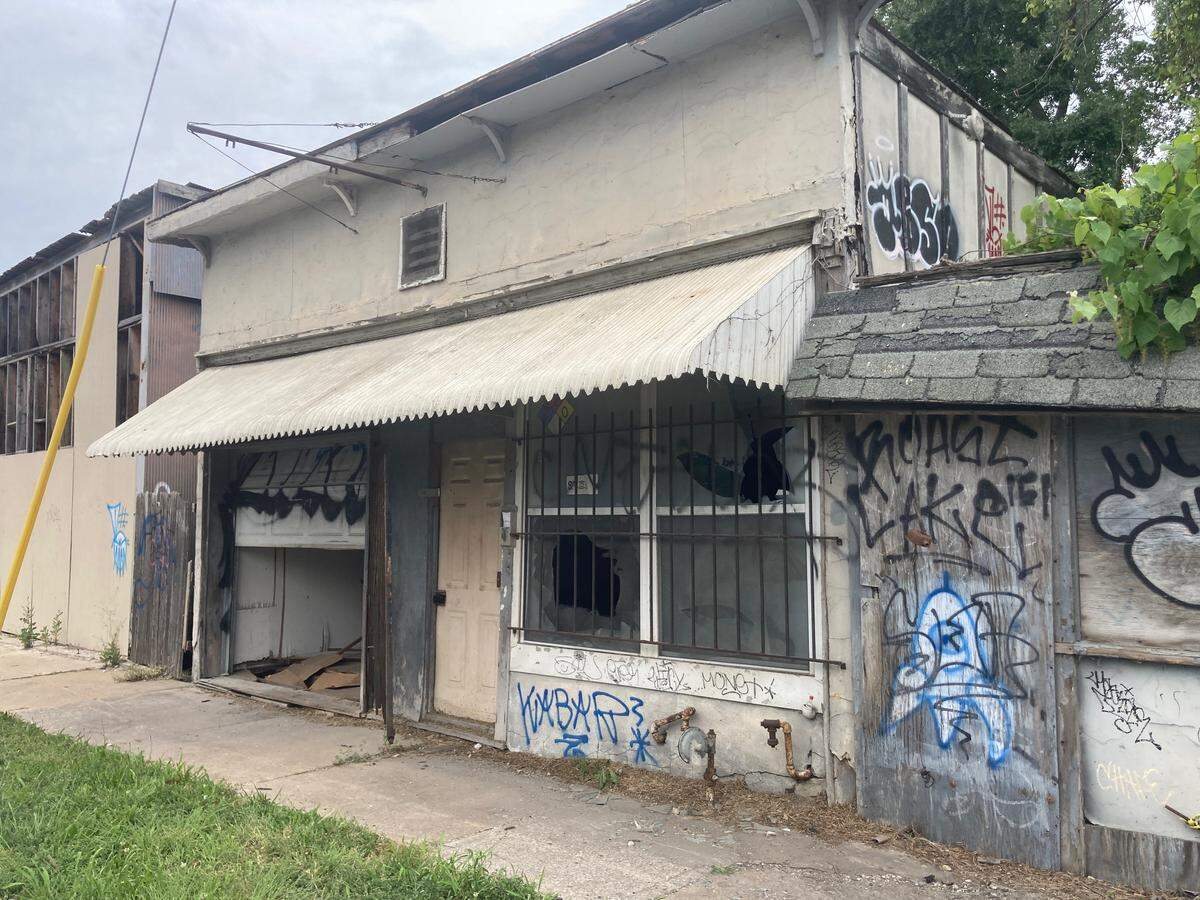
Located yards from railroad track, Farewell and Howdy sit near an auto lot surrounded by fence topped with barbed wire. The building directly across the street stands in sad disrepair, its windows smashed, swathed in graffiti, a front garage door hangs half-open. It is not a block, he argues, where any small commercial building like his should be worth $700,000.
“We chose the neighborhood that was the least sexy,” Popoff said of the area, once home to the General Motors Assembly Plant. “We weren’t gentrifying or ousting people. We weren’t taking over spaces. The only thing down here was the Leed’s Diner,” since closed.
Popoff, who also works in construction, put Farewell together himself. In late 2023, he eventually bought the building for $80,000 from his former landlord. He also purchased the building next door and opened Howdy.
Open seven nights a week, the venues draw packed crowds to hear live local and touring bands of all stripes: hip-hop, country, punk, rock, metal, funk played on a plywood stage. Located at the rear of Farewell is the club’s signature “animal room,” the sound-proof green room for band members, its walls covered in stuffed toy animals.
“Come in here and it’s like completely dead sound,” Popoff said. “The opportunity for us and other artists to come down here and do (stuff) like this. . . It’s intentional. It’s fun. We have taken this opportunity — and we don’t take it for granted — to create some artistic spaces.”

Popoff said, “I mean, like, we still are always hanging by a thread, which is like, charming in its way. . . .It’s like we’re selling Hamm’s for $3. We’re not getting rich.”
Which is why higher valuations and taxes matter.
“I’m stubborn,” Popoff said. “there’s no way I’m going to give up.”
Manny Abarca holds listening session
The cries of small businesses owners have caught at least one county legislator’s ear.
On the heels of The Star’s story on Blip Coffee Roasters, Jackson County Legislator Manuel “Manny” Abarca last week held a listening for small business owners at the West Bottoms cafe.
Abarca was recently embroiled in legal domestic matters involving a charge of domestic battery, a restraining order by his wife, and custody of their 2-year-old son. Abarca has pleaded not guilty to the battery charge.
With a cap on residential valuations as the model, Abarca on Wednesday said he planned to introduce an ordinance to the county legislature asking for a similar cap, no more than 15% a year, on commercial real estate valuations.
A second ordinance would extend the deadline on property assessment from July 14 to Aug. 1.
“I mean, there’s no doubt that rates should increase,” Abarca said. “But not so much that you can’t survive. That’s where the 100% — or even the 50% over — becomes something that businesses can’t course correct. I mean you’re eating profits. You’re doing a cost-benefit analysis as to why you even exist.
“I run a nonprofit and couldn’t imagine if one of my required fees went up 500% or 1,000%”
This story was originally published June 19, 2025 at 5:00 AM.