
This intricate underground process helps ‘future-proof’ Nelson-Atkins’ artworks
Most museum-goers stroll through halls of carefully lit paintings, meticulously cleaned sculptures and sophisticatedly written labels without ever realizing the underground operation that makes it happen.
Beneath the curated floors of the Nelson-Atkins Museum of Art, you’ll find a space full of white gloves, do-not-touch stickers and walls with specialized paint costing $150 per gallon.
In this place, ancient art meets high-tech imaging that would have once been described as wizardry.
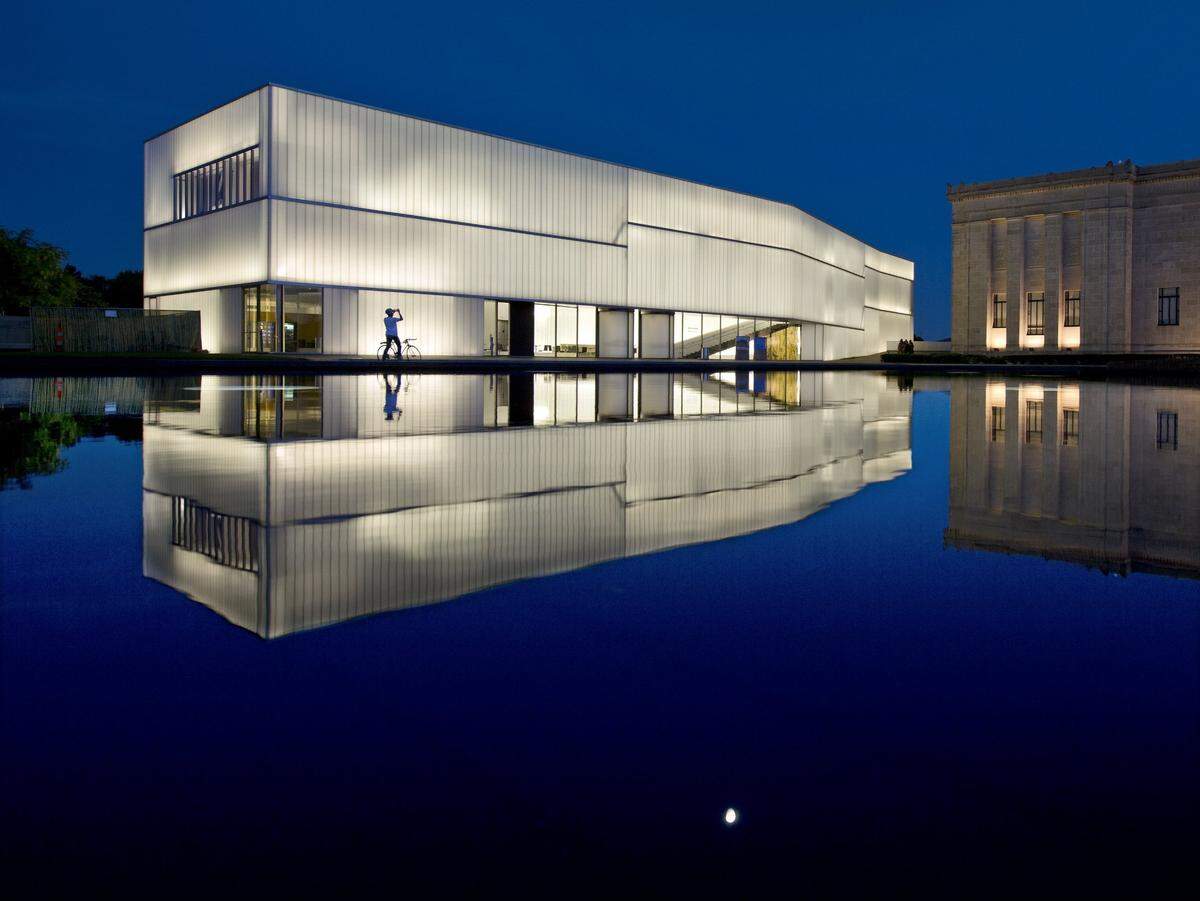
When Joshua Ferdinand gets to work in the morning at the Kansas City museum, he descends into its depths until he reaches the photo studio positioned below the Bloch building.
Behind the lens
The photo studio that Ferdinand, manager of digital production and preservation, works in is designed for precision. The neutral gray and black space, equipped with daylight-mimicking lights, ensures color accuracy for photography and video. Adjacent to these spaces, a climate-controlled space preserves the archive of film slides from the pre-digital camera era.
“The only thing with color down here is the artwork and things you can trip over,” Ferdinand said. “That’s a measure that we do for art safety as well as, you know, color accuracy.”
These film slides and the photos Ferdinand’s team creates are part of a much bigger need to make art available for public viewing while maintaining images for art conservation and historical research.
Part of Ferdinand and his team’s job is to “future-proof” their images. This means that they try to capture images in the highest resolution possible to minimize the number of times each artwork has to be photographed. This saves the museum time and reduces the art’s exposure to lighting that could damage it.
For example, one of the more famous pieces in the Nelson-Akins collection is Monet’s “Water Lilies,” a painting about 6.5 feet tall and 14 feet long. Photographing it in one frame with as much detail as needed for conservation records is nearly impossible.
Even with the best camera, the team can only produce a file of 300 pixels per inch.
“That’s good enough for most standards. But you know, when you think about conservation efforts, kind of being caretakers to that piece,” Ferdinand said. “They always want to see it at a bit higher resolution.”
To combat this challenge, the team uses computational photography, capturing the painting in sections and digitally stitching them together, to create ultra-high-resolution images that serve both conservation and research needs and, in theory, can be printed at the original 6.5 by 14 feet dimensions of the painting itself.
According to Kathleen Leighton, media relations and production manager, the museum’s collection has roughly 45,000 pieces, with about 2,700 on view. Ferdinand says that the photography department has photographed around 40,000 of those works.
Each new acquisition is quickly photographed by whomever is receiving the piece upon arrival to document its initial condition, ensuring an accurate record from the start — regardless of when it’s scheduled for high-resolution imaging. Ferdinand said his team could get the art anywhere from a month to years later.
Once they get to full capture the art, it goes into the photographic archive, a digital collection of images of the objects in the museum’s possession. In addition to the high-resolution images, it includes film negatives, contact sheets, audio and video. The primary aim is preservation: ensuring that images and the associated information remain accessible and intact for future generations.
This high-quality documentation provides resources for teaching and learning, allowing students and the public to engage directly with visual history without having to be in the physical presence of an object.
This process also allows museum researchers and scholars access to primary source material that may be too fragile to handle.
Photographic life of an artwork
The process of photographing a new object varies for every piece. Some already have high-quality images with them; some works are on loan and others simply are going straight to display.
Before an artwork joins the collection, curators assess its significance and provenance, ensuring it meets the museum’s ethical and legal standards. Once acquired, conservation staff carefully examine and photograph the piece and enter all details into the museum’s database for future reference.
“If we have a piece that’s going to go out onto display, like as soon as we collect it,” Ferdinand said. “We try to get it shot before it goes up there, so it could be anywhere from a month after it’s acquired to sometimes years later.”
It depends on how quickly the object needs to be processed for display or the archive.
When it is time for Ferdinand and his team to photograph the object, it is a very slow process and involves many people. The art preparator is in charge of moving the work from place to place, while the curator handles the work in the studio. Preparators, curators, conservators and photographers all work together to carefully document the object while making sure it is not handled or exposed more than necessary.
Some artworks, such as highly reflective ceramics or delicate scrolls, present unique challenges. The team tailors lighting and imaging techniques to each piece, ensuring the best possible results without compromising the object’s integrity.
The resulting photographic archive is a vital resource for scholars, conservators and the public. Detailed images and metadata support research, teaching and exhibitions, while digitization efforts make the museum’s collection accessible to audiences around the world.
Beyond the galleries, the team’s work appears in museum publications and educational materials, further extending the reach and impact of the collection.
“It’s an amazing tool to get the work digitally preserved and shared with the world that’s waiting to take our museum beyond our walls and share it,” Ferdinand said, “You know, just last year we had over 212 requests for our collections images to be shared in publications for like 11 different countries around the world. I truly love what we do down there.”