How did Golubski get a gun? Ex-KCK cop’s death before trial leaves lingering questions
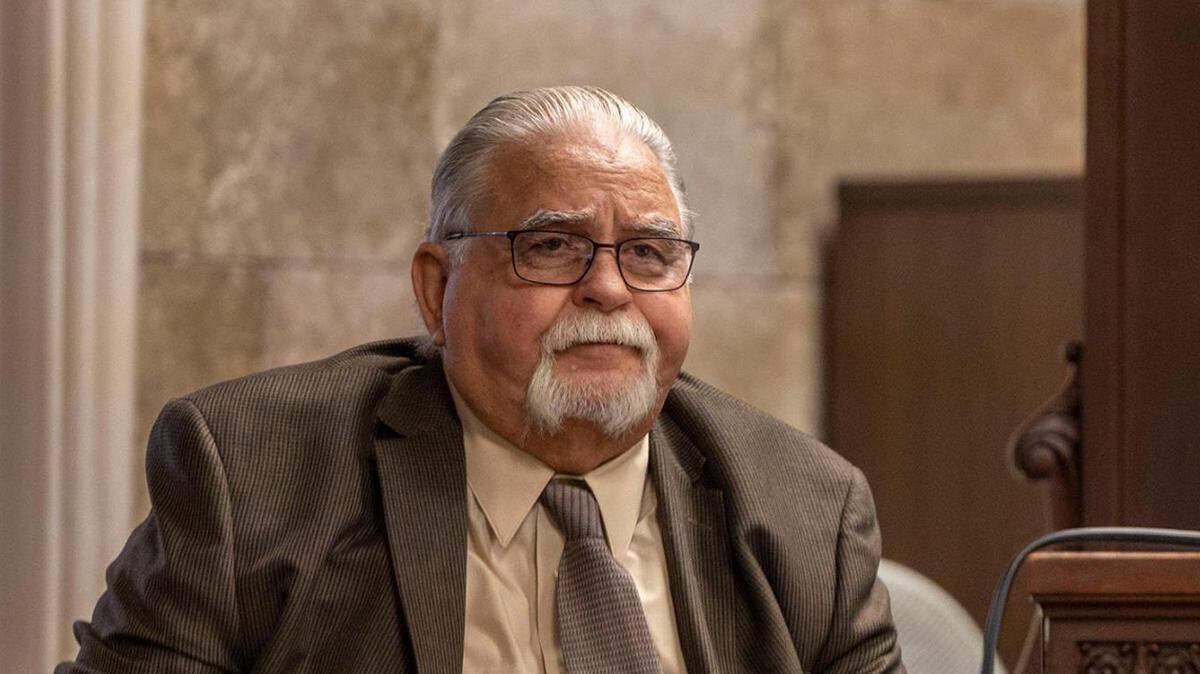
Two years of court-mandated supervision for Roger Golubski, an infamous ex-Kansas City, Kansas, cop whose alleged crimes and long-awaited criminal trial gripped national attention, was not enough to keep a gun out of his house.
The retiree mostly left his front door — always under the eye of a government tracker — for approved court and medical appointments during his term of home arrest. On Monday Golubski ended his own life from an apparent self-inflicted gunshot. Police found his body on the back porch of his Edwardsville home.
Now, the fact that Golubski had access to a firearm unbeknownst to authorities has sparked fresh calls for answers and laid bare an obvious security gap. Experts and officials told The Star this week the case demonstrates how weapons can slip under the radar even with constant court monitoring.
“It’s certainly not a foolproof security when you have a home arrest like that,” said Sean O’Brien, a criminal law professor at the University of Missouri-Kansas City.
Golubski, 71, has faced two federal indictments since 2022. Prosecutors alleged the longtime officer, who achieved the rank of homicide captain over a career that spanned more than 30 years, raped women and committed broader atrocities targeted in the Black communities of Kansas City, Kansas.
Golubski’s death paused an open forum that may have answered some longstanding questions surrounding accusations of official misconduct, a yearslong FBI investigation, and a series of heinous crimes prosecutors leveled against the retired homicide detective.
The Kansas Bureau of Investigation, or KBI, is investigating Golubski’s death. Authorities discovered no immediate signs of foul play. An agency spokeswoman said the question of how Golubski obtained a firearm would be part of the state agency’s review.
As a pretrial detainee on house arrest, Golubski was supervised by U.S. Probation and Pretrial Services. General conditions of his home detention available in the court record show a provision barring him from the possession of weapons, including firearms. He also was subject to constant electronic monitoring.
Reached by phone Wednesday, Chief U.S. Probation Officer for the District of Kansas J. Scott Jones declined to comment on the particulars of Golubski’s case or general procedures of his office, saying the court expressly prohibits the discussion of cases the office oversees.
A probation officer assigned to Golubski’s case did not respond to The Star’s phone messages seeking information. Neither did Lorene Stewart, a longtime domestic partner who lived with and was responsible for Golubski upon his release to home detention.
U.S. Marshal for Kansas Ron Miller told The Star that Golubski was not under the custody of his agency and any questions concerning inspections of the home would need to be answered by the pretrial and probation office.
Legal experts consulted by The Star said the home detention process typically involves an initial check of a home for the presence of weapons. From there, federal officers may conduct surprise visits or check-ins at a residence to ensure continued compliance with the court’s order.
But gaps do exist. Complicating factors often include the random comings and goings of visitors; interactions a detainee has while outside the home; the activities of other residents; and the potential to keep contraband well hidden from supervising officers.
Obtaining firearms under supervision does happen, O’Brien said, and those offenses typically are cause for revocation of a pretrial release order. Unannounced visits to ensure homes are free of guns or other weapons vary by jurisdiction and defendant.
“Sometimes they’re like weekly, sometimes monthly, sometimes they hardly ever happen,” he said.
Lara Gatz, an attorney representing the philanthropic social justice organization Team Roc, said people in the position of Golubski are often detained until trial because of the connections made as law enforcement officers.
“If you look at the case and what he did, he definitely should have been incarcerated. But I think he gamed the system and really manipulated the court utilizing his health concerns,” said Gatz, who previously worked as a federal prosecutor for more than 20 years.
She said the situation may offer lessons to be learned about additional terms and conditions of release for law enforcement officers or former ones, who often have access to firearms or know people who do.
“We have to learn from a situation like this, how to do better the next time, so that the victims get their day in court, and the coward doesn’t get the easy way out.”
Home detention history
Golubski was first arrested by the FBI in September 2022, accused of raping and kidnapping two women, including one as young as 13 years old at the time, between the 1990s and early 2000s.
Two months later, the former detective was named alongside three alleged co-conspirators — including long-feared drug kingpin Cecil Brooks — as part of an underaged sex trafficking ring run out of an apartment complex at 26th Street and Delavan Avenue.
Golubski was receiving extensive medical treatment for diabetes and heart conditions at the time of his arrest. He spent five days in the Shawnee County Jail, under the custody of U.S. Marshals Service, before appearing in court to discuss detention.
Prosecutors sought to keep Golubski jailed from the outset, highlighting the serious criminal allegations to include rape, kidnapping and the infliction of terror, through threats and physical force, primarily against Black women.
But the court determined that prosecutors failed to prove Golubski posed a threat to the larger community, a condition weighed heavily by judges in determining whether to impose pretrial incarceration.
The probation and pretrial services division also provided the court with a low-risk assessment for Golubski and in January 2023 supported a more relaxed court supervision.
Outside of the weapon in his home discovered Monday, one other known violation of Golubski’s home detention order came nine months ago.
In late February, prosecutors sought to revoke Golubski’s house arrest after a citizen filmed the former detective visiting a Culver’s fast food restaurant near the Legends Outlets shopping mall in Kansas City, Kansas.
Magistrate Judge Rachel Schwartz responded to that transgression with a verbal warning in court. She also noted at the time that granting a revocation order would be unusual on a first offense such as the one Golubski made.
The judge ultimately allowed Golubski to continue his home arrest, issuing a ruling that specified “discretionary leave” outside permitted exceptions “shall not be approved by the pretrial services office or supervising officer.”
No-show, arrest warrant
On the morning of trial, as the first wave of jurors waited to be called into federal court in Topeka, Golubski failed to show up by the scheduled start at 9 a.m.
U.S. District Court Judge Toby Crouse spoke to prosecutors and Golubski’s defense attorney, Chris Joseph, concerning his whereabouts. An arrest warrant was issued, tasking the U.S. Marshals Service with bringing him to court.
At that point, the FBI would have arrested Golubski before turning him over to Marshals, said Miller, of the Marshals Service.
“Had we had him in custody, we would have been able to produce him for court, get him where he’s supposed to be, transport him and all that stuff,” Miller said.
Miller said that had Golubski been in Marshals custody, he at minimum wouldn’t have had access to a firearm.
“That doesn’t eliminate the possibility that he might have not tried to do something to himself while he was incarcerated,” Miller said.
“In the end, he just decided he wasn’t going to court.”
Anger, shock, skepticism
Many of the allegations against Golubski first came to light in court as Lamonte McIntyre, imprisoned as a teenager for a Kansas City, Kansas double murder, won freedom after 23 years behind bars.
McIntyre and his mother Rose McIntyre alleged Golubski framed him because Rose McIntyre rejected Golubski’s sexual advances, an accusation that fit the character of many others to follow. The Unified Government of Wyandotte County later settled a civil claim for $12.5 million.
Cheryl Pilate, a Kansas City attorney, represented Lamonte McIntyre to have his conviction overturned. Though she has spent years investigating Golubski, she believed the trial would perhaps offer a chance to learn things she did not know before.
She said the preparation for the trial took “an enormous effort” by many, including the witnesses preparing to testify.
“It’s terribly difficult. Everybody’s kind of suffering a case of whiplash right now,” she said.
Over the years, Pilate learned Golubski was notorious in the northern end of Kansas City, Kansas, where he “was very well known and he was feared.” She believes the investigation led by the KBI of his death will offer a greater level of trust among many in Wyandotte County, where a local agency’s review would likely be met with “a healthy dose of skepticism.”
“I’m very interested, as I think many people are, where the gun came from, what forensic material or fingerprints may be on it,” she said, adding: “Investigation means investigating, getting facts. And it’s necessary to answer the community’s questions.”
Meanwhile, Goluski’s victims feel cheated out of a chance to tell their story after Golubski’s death, attorney Bill Skepnek said. Skepnek represents several victims who were prepared to testify in the trial and long feared Golubski would try to harm them.
“From the perspective of my clients, they’re afraid that he has a gun and he might come [to] kill them,” Skepnek said. “What are they doing to make sure that these rules are actually being enforced?”
Skepnek also questions why Golubski was released under the custody of Stewart, the domestic partner who resided with him in Edwardsville. An answer to that qualification would likely exist in reports prepared by the government that are not a matter of public record.
“Why are we going to count on her?” Skepnek asked. “What basis did the government or the court have for relying upon her?”
The end of Golubski’s criminal trial marks a “setback for the community,” said Gatz, the lawyer for Team Roc. But she said Golubski is emblematic of a larger problem that “hopefully, in the next trial, will see the light of day.”
“We’re not leaving,” she said. “We’re not leaving Kansas City until the victims in this case have had their due process.”
This story was originally published December 4, 2024 at 5:11 PM.