KC takes pride in its jazz history. So why is a rare film collection sitting in caves?
They had to act fast, Kansas City Mayor Richard Berkley told the city council. Otherwise another city would beat out KC for the chance to buy what experts called the greatest, largest collection of jazz films in the world.
New Orleans and Paris – the one in France – were interested.
“The importance of doing this quickly cannot be overemphasized,” the late mayor said that Friday afternoon in April 1984, as he convinced the council to spend $200,000 – more than $600,000 in today’s inflated dollars – for 700 hours of rare jazz films that a Columbus, Ohio, lawyer had spent a lifetime accumulating.
Kansas City’s American Jazz Museum was little more than a dream at the time. It had neither a name nor a location. But Berkley and others felt it wise to start acquiring artifacts like those flicks for when the city did get around to building a jazz museum or hall of fame to showcase the city’s role in the development of that uniquely American art form.
“I’m sorry to get so carried away,” University of Kansas jazz professor Dick Wright said when a reporter called to relay the news. “Who knows what they’ll find in these films!”
Four decades later the question still stands mostly unanswered.
Were he alive today, Wright would no doubt be surprised and disappointed to learn that the bulk of that 1.5 million feet of fragile film, some of it dating to the late 1920s, still remains largely unwatched and unexplored mid-way into the 2020s.
They had no plan
City officials acted decisively in buying what they perceived would be a key attraction for a future jazz museum. But they had no plan for how to make available to the public and researchers all those movies and short, one-song “soundies” that were made for video jukeboxes called Panorams in the 1940s.
After some initial celebration and a couple of showings of Baker’s movies at the jazz district union hall of the Mutual Musicians Foundation and at the University of Missouri-Kansas City in the mid-1980s, those films and Baker’s memorabilia were locked away and largely forgotten.
When the jazz museum finally did open in 1997, taxpayer support went to help pay for the exhibits and the museum’s operation. But the Baker collection was no longer a priority at City Hall.
The city shifted the responsibility for caring for the films to the museum, which has always struggled to make ends meet since its founding.
Over the past two decades, hundreds of thousands of dollars in grant money was found to help hire part-time archivists and interns off and on, but it was never enough to make a real dent in the film collection.
The result: Of 2,500 films in the Baker collection, only about 500 have been cataloged, which means that someone has watched the movies and described in written detail about their significance.
The rest are spare line items on inventory sheets.
“We don’t have a full description of what they are and kind of their details,” said museum registrar and collections manager Jordan Malhiot.
Only about 15% of the collection has been preserved in a digital format. Out of the 1.5 million linear feet of film in the collection, that means 1.2 million to 1.3 million feet remains to be scanned and digitized, Malhiot said.
And none of the films that have been digitized are available to view online. To see them, you have to visit the museum or arrange for an appointment.
“There has been a lot of work done on the John Baker collection over the years, and there’s still a lot more that needs to be done,” Malhiot said. “But we have plans on how to accomplish it.”
Plans, yes. They’re set out in the grant applications. But there is simply not enough money to get the job done anytime soon.
Former Councilman Robert Hernandez said the city government deserves a chunk of the blame for the films being stuck in limbo, and he was one of the 12 council members who voted to buy them in the first place.
“It was a bad deal,” he said. “We should have maintained some kind of access and had duplications made immediately, and digitized them later.”
A city asset
Kansas City’s half-million residents are shareholders in a multi-billion-dollar enterprise. Their city government owns a whole lot of stuff.
City residents own the new airport, and the old one, too. The convention center and that priceless view from the observation deck atop City Hall, are city property.
Kansas City’s assets include 24,750 fire hydrants, 2,800 miles of sewer mains, 67,000 manhole covers and almost every artifact in the American Jazz Museum.
It was built with tax dollars and shares the same publicly owned building with the Negro Leagues Baseball Museum. Perhaps the most famous artifact in the jazz museum is a cream-colored saxophone made of plastic that Kansas City native son Charlie Parker played at a famous concert in the 1950s.
Bird (his nickname as every jazz fan knows) had pawned his main sax and needed a horn to play at the legendary 1953 concert at Toronto’s Massey Hall. A sales rep for the company that made the plastic sax, Grafton, convinced him to use theirs.
When now-Congressman Emanuel Cleaver was the city’s mayor in 1994, he famously – and some would say infamously – spent $144,000 in city funds for Parker’s Grafton sax after winning a middle-of-the-night, multi-continental bidding war.
Because of Parker’s fame and the press coverage surrounding that purchase, that artifact has helped drive museum attendance since the museum opened in the heart of the city’s revitalized 18th and Vine jazz district.
If the city government had followed through on its obligations, the Baker film collection would also have been a draw.. In 1989, five years after the purchase, a Star reporter asked a middle manager at City Hall why no money had been set aside to pay for copying the material in the previous two budget cycles, and this was his answer.
“It’s a matter of budget priorities,” he said.
Chilling in the caves
It was from that same article that taxpayers learned what had become of the Baker collection. The films had gone underground, from the bank vault where they were kept at first to their current home within the warren of tunnels that people in Kansas City commonly refer to as “the caves.”
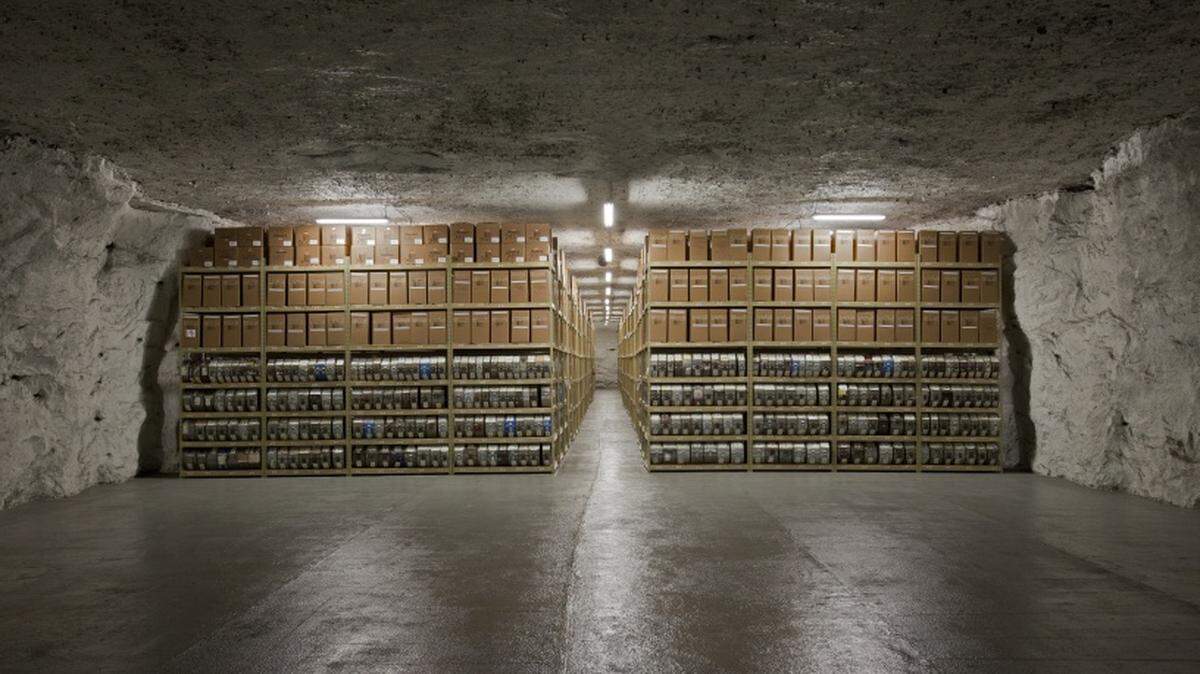
Since 1987, the Baker collection has shared space with the storied film libraries of Hollywood movie studios in a 45,000-square-foot storage vault carved out of a played-out limestone mine in the Northland.
All the original films are stored on shelves within a secure area some 160 feet beneath the surface of the bluffs that tower above the Missouri River’s north bank.
“The ceilings are 16- to 17-foot, and they’re rock and they are painted, so, you know, everything’s white,” said Brian Corwin, manager of the Kansas City records center at UV&S Inc , short for Underground Vault and Storage, a multi-national company that got its start by leasing storage space in a Hutchinson, Kansas, salt mine.
The temperature at UV&S’s facility at the Subtropolis business complex in Kansas City is kept at a constant 45 degrees. The humidity is carefully monitored to prevent deterioration of all the films in that vault.
“We have a mechanical company (that) comes in every other week in order to go through the equipment to make sure it’s in good running condition,” Corwin said.
And every so often, staffers from the American Jazz Museum sign in and retrieve several film reels from the vault so they can work on them back at the museum. Recently, they needed some Louis Prima films for a special exhibition that runs through May 4.
Museum staff say they are doing their best to finish the job that was set out for them, but acknowledge that it has been a long slog.
It took a dozen years after the museum’s opening to do the work and raise the money to open an exhibit where some of the films are now available for public viewing on a regular basis.
“The John Baker exhibit…was the first and only addition we’ve had to the permanent gallery since we’ve opened,” current museum executive director Dina Bennett said.
All the greats are there
Those films are shown on small screens in an area of the museum designed to look a little bit like a movie theater. Museum-goers push a button to see performances of jazz greats transferred from fragile 16 mm strips of acetate.
Push a button, and there’s Bessie Smith from 1929 belting out the St. Louis Blues, or Ella Fitzgerald singing “Lady Be Good” in 1970, backed by Duke Ellington.
Many of the greats from the last century are represented, from Hoagy Carmichael to Bill “Bojangles” Robinson, to Cab Calloway, Gene Krupa, Lionel Hampton and Billie Holliday.
But there could be so much more to see at the museum and online in the age of video streaming.
“What are they going to do with the collection? What a huge asset it is,” said Tom Alexios, who once wrote articles for DownBeat Magazine (the jazz bible) and has worked for both the Thelonious Monk Foundation and currently the Duke Ellington family.
Alexios and other jazz fans worry that the bulk of the collection may never be seen. Are the original films still in good condition? Or are they wasting away?
“We’re worried about this priceless collection that John Baker assembled all through his life,” said Bob DeFlores, an 89-year-old jazz film collector in Minnesota who kept in touch with Baker until his death in the 1990s.
“He ended up selling his archive to Kansas City with the intention that they would use it in schools and for teaching and what-have-you. And that was never done.”
Bennett says the films are not dissolving into a smelly chemical stew in the steel containers they arrived in, as Alexios fears. They are in good shape and being stored under ideal climate conditions, she said.
A sense of urgency
A dozen years ago the films were inventoried and repackaged in vented plastic storage sleeves that lets them breathe, past and present museum officials have said. Still, they won’t last forever, and staffers feel a sense of urgency to make the entire collection publicly accessible.
“There’s currently a push to get as many of the films digitized as possible so that they can be made available to researchers and documentary filmmakers and to do some educational programming,” said Rodney Thompson, a local filmmaker who has done some of that work for the museum under contract when grant funding allows.
The estimated cost to complete the job? About $2 million, Malhiot said. Of that, half or more is needed to scan and digitize. The rest would go toward finishing the job of cataloging the collection and paying for the programming and everything else it would take to get them out before the public, including on the internet.
Bennett’s message to foundations, government agencies and private donors that the museum has been hitting up for assistance to get that done through its never-ending capital campaign:
“Give us whatever you’ve got,” she said with a hopeful laugh.
At the rate the cash has been coming in so far, however, the museum will need more than a few sugar daddies.
Allegations of financial mismanagement at the museum raised some concerns at City Hall several years ago, scaring off some donors. But the museum’s reputation for sound fiscal management has improved since then, and Bennett hopes that will give confidence to potential benefactors.
“People are coming around,” she said. “We are back stronger now, and we’re looking forward to engaging with more foundations and other grants.”
Hernandez hopes local philanthropists will get on board and focus some of their charitable support toward the Baker collection.
“People who back the Nelson (Atkins Museum of Art) and that are always giving a million dollars for paintings that nobody can understand, they ought to say, ‘You guys do this and we’ll let you have access to (the films),’” he said.
And his fellow taxpayers ought to kick in, too, he said.
“The city ought to contribute, because they (the films) are really ours,” he said.
The Star reached out to Mayor Quinton Lucas and City Manager Brian Platt through their spokespersons on Dec. 16. They did not respond to our requests for comment.