
Ariana Grande saw Satan there? Legend of Stull Cemetery in Kansas is dying a slow death
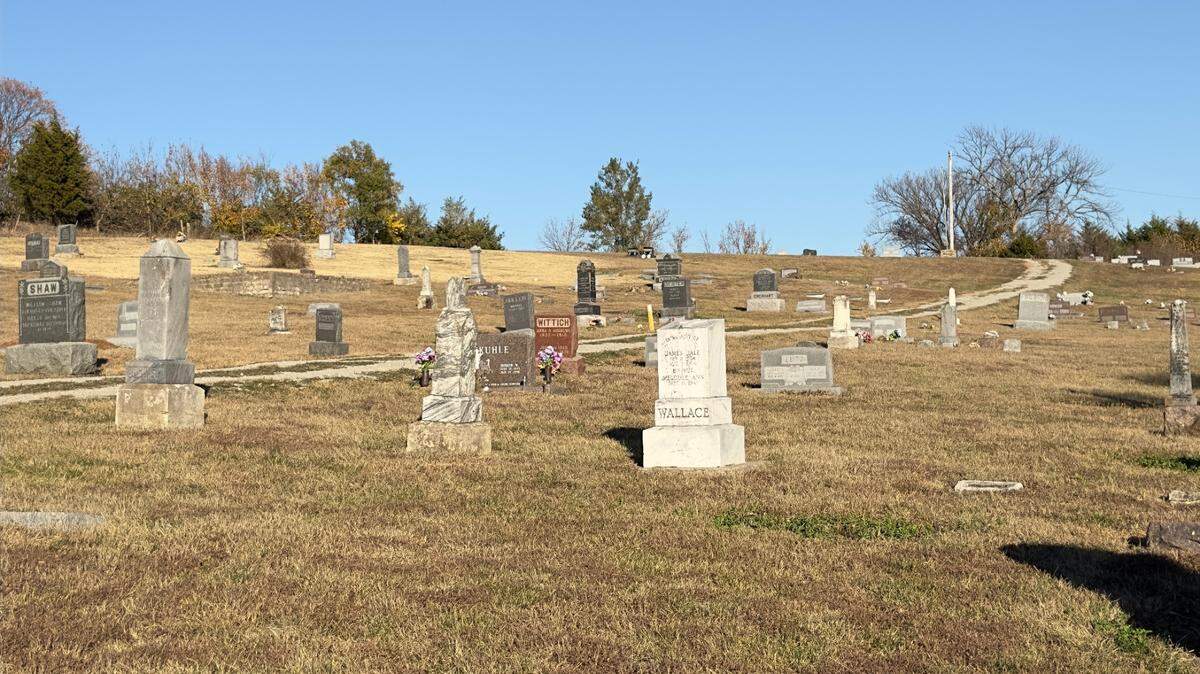
When Ariana Grande brought her first concert tour to Kansas City in August 2013, she made a side trip to nearby Lawrence, Kansas, and the story she told of what happened at a cemetery there made national headlines.
The star of the upcoming “Wicked” movie said she had an encounter with the devil himself at spooky Stull Cemetery.
Yeah, that guy.
Like generations of mischievous high-schoolers, beer-drinking college students and even other celebrities, Grande heard the urban legend that a gateway to hell existed at the cemetery, a portal to the fiery underworld that only opened twice a year — including, of course, at Halloween.
The cemetery was recently named one of the scariest places in the United States by travel website Thrillist.
For years, trespassers searching for a thrill tromped through the tiny, private pioneer cemetery dotted with headstones honoring rich and loving marriages, much to the annoyance of the sheriff and families who have loved ones buried there.
The story of Stull Cemetery became so outsized and overblown — the Pope refused to fly through its airspace? — that it inspired one of the longest-running fantasy shows in TV history, a movie by Guns N’ Roses guitarist Slash, a rock album and song, and a visit from the late Kurt Cobain and his Nirvana band-mates.
“We went there one night, I swear to god there’s some kind of scary stuff going on,” Cobain insisted in a 1992 interview.
When historian Paul Thomas wrote about local ghosts and specters in his 2017 book, “Haunted Lawrence,” he began with the story of Stull Cemetery.
“I try to look at ghost stories from a balanced perspective. I try to see the mystery in it, the fun in it. I also try to poke some holes where I think holes need to be poked,” said Thomas, a library specialist at the University of Kansas Libraries.
“But with Stull, the more I read the more I realized, ‘Wow, this is just kind of a gigantic urban legend that spun out of control.’
“The more I researched it just became obvious that this isn’t really some sort of demonic playground of the devil, it’s something that was created by hearsay. And it just sort of took on a life of its own.”
Douglas County Sheriff Jay Armbrister, born and raised in Lawrence, has dealt for many years with the Halloween tradition of “kids and people running around out there.”
“It’s just kinda run the gamut. But it really has quieted over the years. We’ll get a little bit of traffic just here and there,” said Armbrister.
“It seems to be when the KU freshmen come in, we’ll have a group or two who have heard about it or maybe their parents went to KU and they would talk about Stull church. So they would go out there.
“And we scare them off and run them off and give them a stern lecture and then they don’t come back because they get out there and realize there’s nothing to it.
“But then again, around Halloween, we always have a little bit of traffic. It’s just the way it is.”
No trespassing
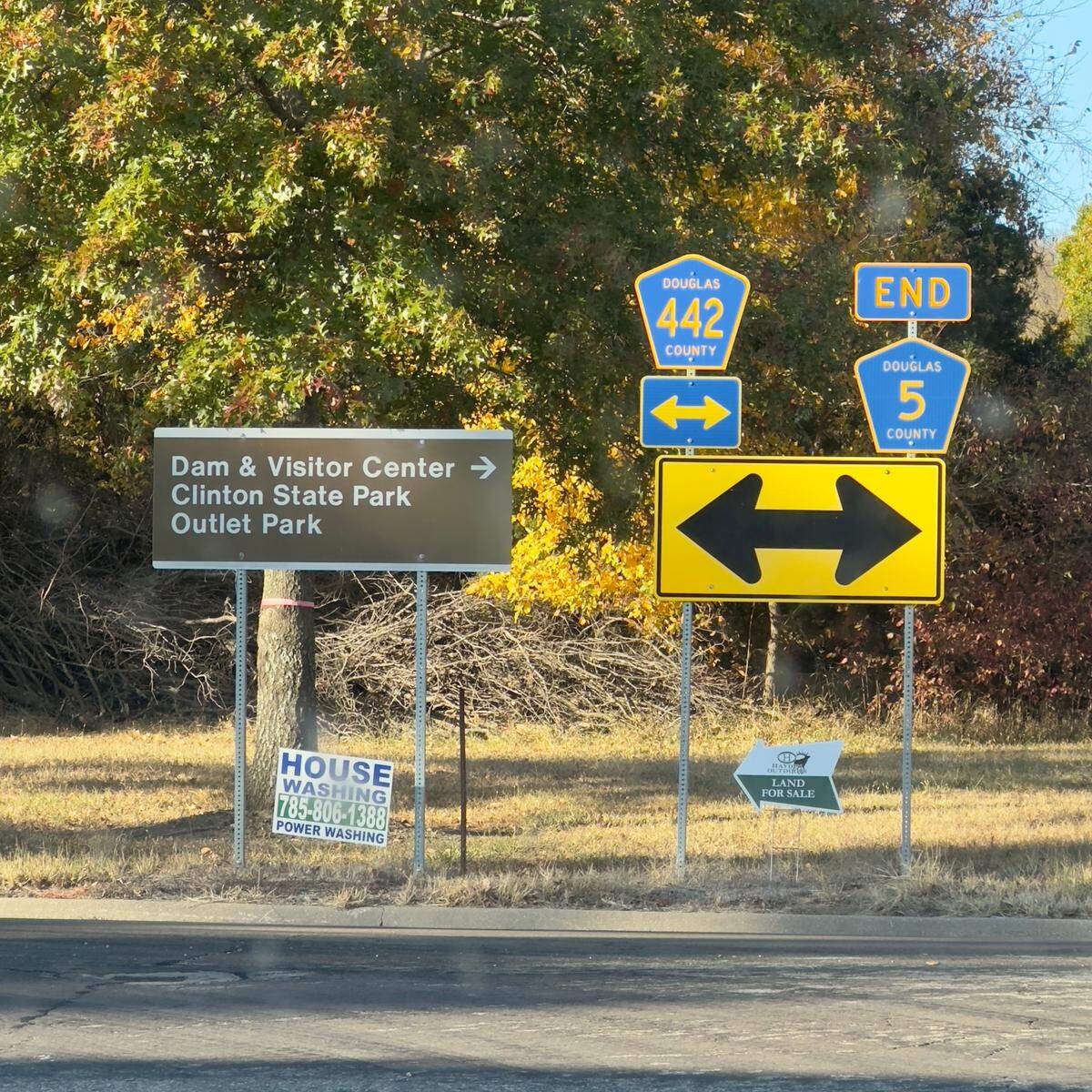
This time of year, with the trees showing out in autumnal oranges and golds, the drive to the cemetery down two-lane, numbered county roads between Lawrence and Topeka is a beautiful journey for leaf-peepers and commuters.
Don’t blink or you might whiz right past the cemetery in the unincorporated community of Stull, which today is a handful of houses and assorted buildings and Stull Community of Faith Church. Its official population is unknown, though Armbrister guesses maybe 20 souls, not including those in the cemetery.
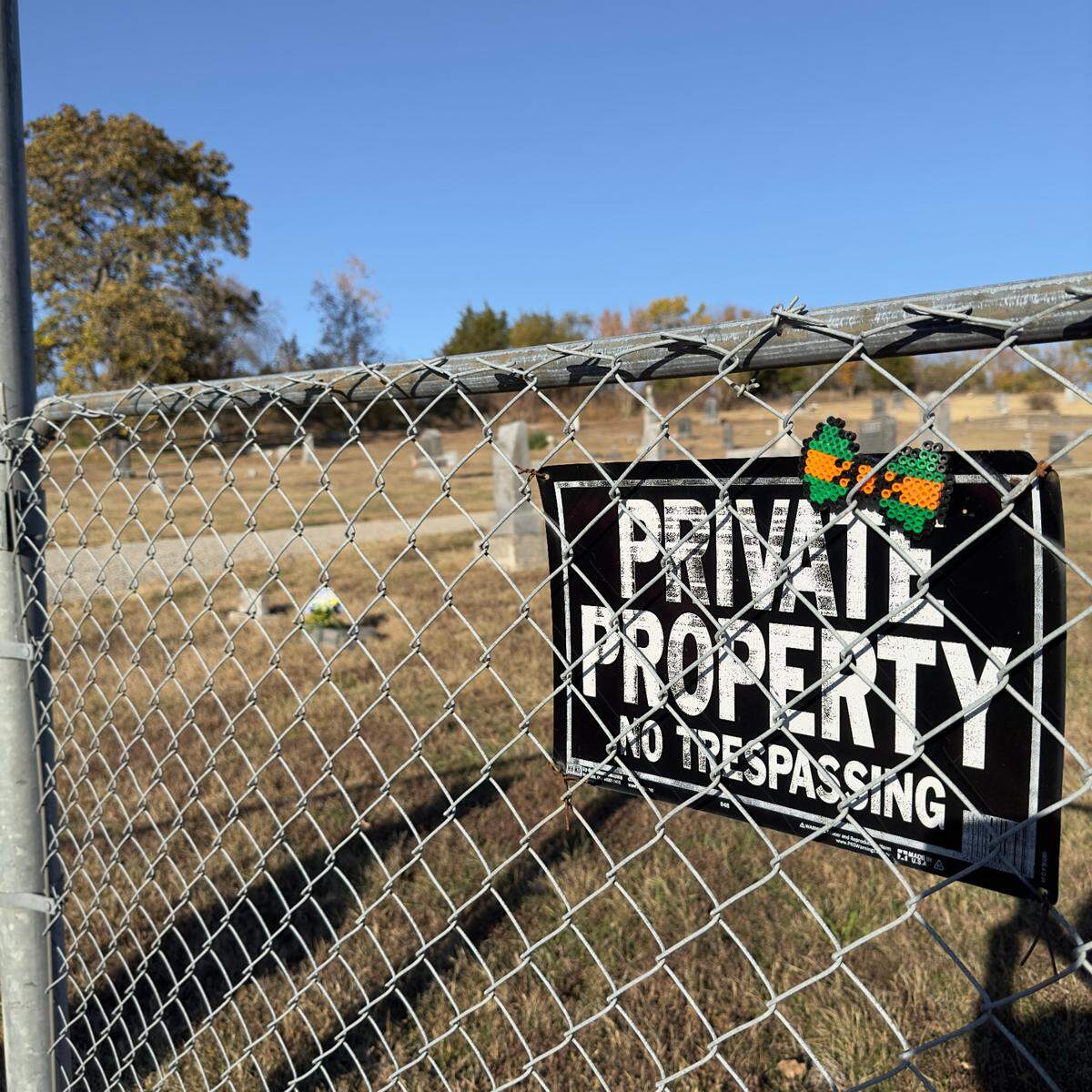
The cemetery is locked, surrounded by a chain-link fence and “No Trespassing” and “Private Property” signs that make it clear that — unless you have business with the dead — you’re not welcome.
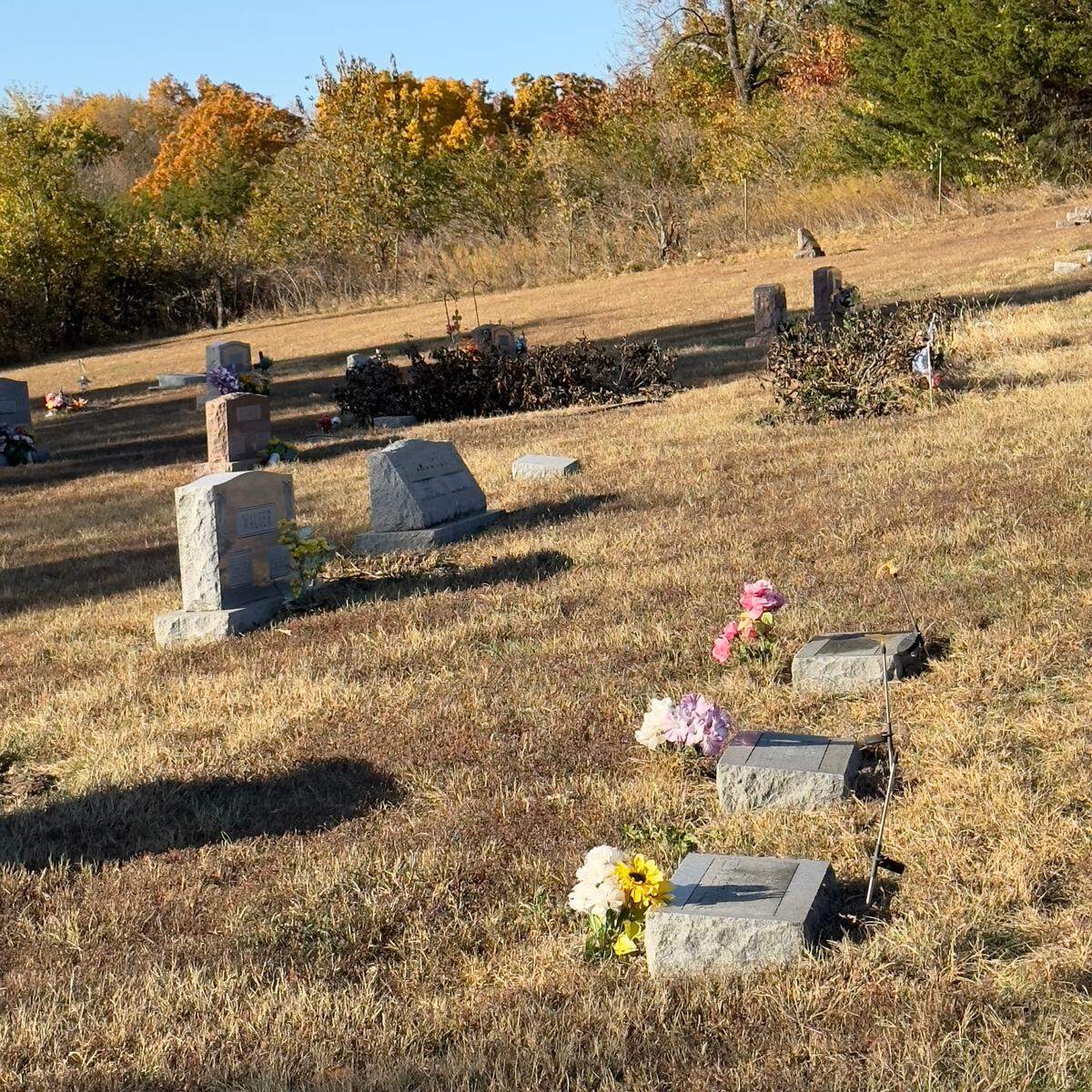
Burials still happen there, evidenced by colorful plastic flowers decorating some of the graves. There is nothing remotely demonic about the neatly mowed grounds.
The town of Stull, originally called Deer Creek, was founded in 1856 by German immigrants. That ancestry is reflected in the older, 19th-century headstones. Wulfkuhle. Bahnmeier. Deister. Eberhart.
“Of course the question becomes, ‘How did Stull, Kansas become the gateway to hell?’” said Thomas. “Of all the places in the world, you’d think the devil would pick something maybe a little more either ostentatious or at least closer to civilization.”
Blame it on a couple of KU students.
A story that ran on Nov. 5, 1974 in The University Daily Kansan — KU’s student newspaper — is often cited (blamed?) as the legend’s source, said Thomas.
“It seems pretty obvious from reading the article that it was meant to be a Halloween story,” he said.
But because of a paper shortage, the story got bumped and wasn’t published until after Halloween, which made the tale of a hellish portal sound more fact than fiction.
“People were like, ‘Whoa, I never really heard about this.’ And then people ignored the context of it being probably being a Halloween feature and it kind of went from there,” said Thomas.
“And then what started as I guess you could say sort of an innocent sort of like hillside folklore spun out of control into something completely else.”
Satan and witches, too
Over the years, as happens with urban legends, word of mouth embroidered the original tale.
Witches became part of the legend, which is sort of ironic given that Grande plays Glinda the Good Witch in “Wicked.”
“So a lot of people kept saying ‘oh it’s cause there are witches there, which isn’t true. There’s no real evidence of that,” said Thomas. “But there are several factors that have led me to kind of suspect where this story may have come from.”
There is a headstone, for instance, bearing the surname “Wittich.”
“So a lot of people were saying oh that’s where a witch was buried, but they didn’t want to spell it out so they wrote it in some sort of weird code,” said Thomas. “Which of course raises the question, why did they even mention it if they were just going to spell it wrong? It was just someone’s family name.”
One story that might be true is that someone hung him- or herself from a cemetery tree around the turn of the century, Thomas said.
“So this tree, if the legends are to believed, grew into a very, very, very, big tree that sort of grew into some of the tombstones up there and they got embedded into the tree, which is pretty spooky,” said Thomas.
And of course — didn’t you hear? — one of the tombstones belonged to a witch, Satan’s beloved.
“So Satan, the gateway to hell. One little bit led to another and it spiraled into this wild story.”
.jpg "IMG_0016 (1).jpg")
Even the pope said, nope
Armbrister recalled how when he was a Lawrence kid back in the ‘80s, Pope John Paul II came to the U.S. on one of seven trips he made to the country.
“It was this big grand deal, he was flying on this TWA jet being piloted by a man from Lawrence. So there was a lot of coverage about this whole thing,” the sheriff said.
“But the urban myth, legend, that came out of that story was that the pope allegedly asked that the plane not fly over Stull, Kansas, for fear they would be treading over the one gateway to hell or whatever it was.
“My guess is it’s not true. It’s completely false. But somehow it got traction.”
The rumored gateway to hell, inside the church, became the marquee attraction.
“Back in the day, there was a chapel on the hill at Stull that everyone was kind of obsessed with,” said Thomas. “You heard a lot of stuff about there supposedly being these mysterious stairs.
“Originally the legend focused on the graveyard, but then as the years went on it started to kind of shift and focus on that old church. That was the real spooky thing, according to everyone.
“People were saying, ‘Oh yeah, I went up there and there was a stairway that led all the way down to the depths of the earth.’ And you can’t find it unless it’s Halloween or whatever. People saw weird shadow figures and strange ghosts ... they heard things.”
One story that popped up said that if you threw a bottle at a wall inside the church and it broke, it meant you were going to die soon. The other story was that if you threw a bottle against the wall and it didn’t break, you would die soon.
The tale just got taller, the stories more ludicrous, drawing lookie-loos.
“And while all of this was happening, the people of Stull, the few families that live out there, were like, ‘What the heck? Where is all this stuff coming from?’” said Thomas. “A lot of those people have lived there for however many decades and they never heard any of these stories.
“So a lot of people went from, ‘Huh, this is weird,’ to, ‘This is annoying,’ once the kids started showing up ... a lot of people showed up drunk and caused a lot of property damage. Knocked down fences, that sort of thing.
“It just became a lot for the poor community because this is a graveyard. People were burying their families there.”
TV finds Stull, Kansas
As much as the urban legend is nonsense, said Thomas, “it is an integral part of Douglas County folklore and it has entered into the public consciousness because of that.”
In an interview with Complex magazine, Grande described driving there with other people and experiencing “this sick, overwhelming feeling of negativity over the whole car and we smelled sulfur, which is the sign of a demon, and there was a fly in the car randomly, which is another sign of a demon.”
“I was like, ‘This is scary, let’s leave.’ I rolled down the window before we left and said, ‘We apologize. We didn’t mean to disrupt your peace.’ Then I took a picture and there are three super distinct faces in the picture — they’re faces of textbook demons,” she said.
“The next day I tried to send the picture to my manager and it said, ‘This file can’t be sent, it’s 666 megabytes.’ I’m not kidding.”
She also said the weirdness followed her home, where she heard loud rumbling and someone whispering to her in bed. And a dark cloud-like presence appeared next to her, she said.
To which Complex responded: Alrighty then.
“I don’t know what the heck she’s talking about,” said Thomas. “I’ve been out to Stull many times. I’ve been out in the evening, I’ve been out in the day. There’s no demonic energy, there’s no spooky faces. Imagine that.
“It just felt like she was playing into the sensationalism. I understand that, from an entertainment perspective.”
But others before Grande had already pushed the cemetery into the pop-culture zeitgeist.
The band Urge Overkill released an album called “Stull” in 1992. The album’s cover features a picture of a cemetery tombstone and the chapel — an image that is fairly well-known in alternative rock circles, Thomas said. There’s also a song called “Stull” on the album.
The cemetery also inspired the WB/CW fantasy drama, “Supernatural,” which ran for 15 seasons from 2002 to 2020. In the final show of Season 5, the Archangel Gabriel and Lucifer fight an epic showdown between good versus evil in the cemetery.
The show’s creator, Erik Kripke, has recently talked of a reboot.
Guns N’ Roses guitarist Slash called his 2013 movie inspired by the cemetery “Nothing Left to Fear.”
The law says do not visit
Early in his career with the sheriff’s office, Armbrister signed up to work a Halloween shift at the cemetery. He’d be deterring unwanted visitors.
Other deputies would sit in their patrol cars with their headlights on in the cemetery driveway, “so that anyone who was thinking about coming out there would just keep on driving,” he said.
Armbrister had other plans.
He hid his car and sat in a folding chair, in the dark, near the church, night-vision goggles at the ready, to catch trespassers in the act. He knew the drill: People parked in the church parking lot across the street and scuttled across the highway to the cemetery.
For four or five hours he sat in the dark, hearing cars turn into the lot and car doors slam, then watching flashlight beams coming toward him and the church.
About 25 or so kids got the jump-scares of their lives that night.
His night ended around midnight when he caught a group of kids that scattered in the dark, leaving one boy behind.
Armbrister made the boy yell out to his friends that he was headed to jail if they didn’t come out of hiding.
“He no more than said, ‘They’re going to take me to jail,’ you hear all four of the doors shut on a car down the road, the engine fires up and they peel out of the driveway,” Armbrister said. “Me and this kid are just standing there looking at each other and I said, ‘You need better friends.’”
Deciding how to legally handle trespassers is admittedly “a weird place, in that we as a sheriff’s office would prefer, ‘Hey guys, don’t come back. Tell your friends don’t come out here. This is not your property.’
“What I think happened, it was in the ‘90s, there was actually an incident where some headstones got kicked over and that was kind of the bridge too far.
“The church that owns the property got very stern. They’re like, ‘No, we want anyone who’s caught out here, we want them charged.’ And when a victim demands that, then we do that.”
Armbrister might prefer to “catch and release” young scofflaws — and most caught out there have been been teens and young adults in their early 20s — and send them on their way with a stern warning.
“But throughout the years the church has had to take a very tough stand. It’s trespassing. And if you’re arrested for trespassing in the county, not in the city, you have to spend the night in jail until you can see a judge,” he said.
“So it’s a very serious charge that we don’t normally do. But, there is potential for somebody to have to spend the night in jail.”
A church comes tumbling down
The legend of Stull Cemetery began to lose steam when its spooky church, so pivotal to the lore, was torn down in the early 2000s, shortly after Armbrister spent Halloween there scaring the bejesus out of people.
Built in 1867 of native Kansas limestone, the church was a forlorn shell of itself with no roof, crumbling walls and busted-out windows by the time the hellbent smear campaign began.
Only its foundation remains today.
“Once that chapel went away, I think people kind of, I don’t want to say lost interest, but the myth of it sort of lost some of its power,” said Thomas.
“And I’m sure the folks in the area, while they were very sad to see that church go, were probably happy that some of the attention was taken away from the supposed demon story.”
That doesn’t mean Armbrister and his deputies won’t be watching the place with Halloween around the corner.
“We’re definitely stepping up our presence in that area and there is no good reason for anybody to be in that cemetery after dark. And we take it pretty serious because the church has asked us to and that’s what we do,” the sheriff said.
“I want to stress the importance of ... if you want to drive by and slow down and look, have at it. But don’t get out of your car, don’t go into the cemetery and don’t go on the church property because they take it very, very seriously.
“It’s just a little bit disrespectful to be walking through a cemetery just out of pure gross curiosity for something that does not exist.”
Thomas knows the stories of Stull Cemetery are now part of forever folklore, deserving of research “rather than perpetuating sort of just nonsense stories about demons and the devil and all that sort of stuff, which may be fun to tell around the campfire.
“But when it comes to a small community that didn’t ask for this, whose founding members and generations of family members were, from what we can tell, just good, hard-working country folk, it seems pretty rude to insist that it’s real and encourage people to go out there and trespass.
“Of all the other ghost stories in the area that I’m more sympathetic to and I think are more interesting, this is one that I find fascinating from a historical point of view. But I do not believe it at all to be truth, and you shouldn’t, either.”
.jpg)