
Despite promised change, students again protest racism in KC-area school. Has it improved?
Park Hill School District’s track record handling racism made its way back into headlines after the district suspended a Black student who said he was defending himself against a white student hurling racial slurs earlier this month. The district came under fire three years ago when a racist petition went viral.
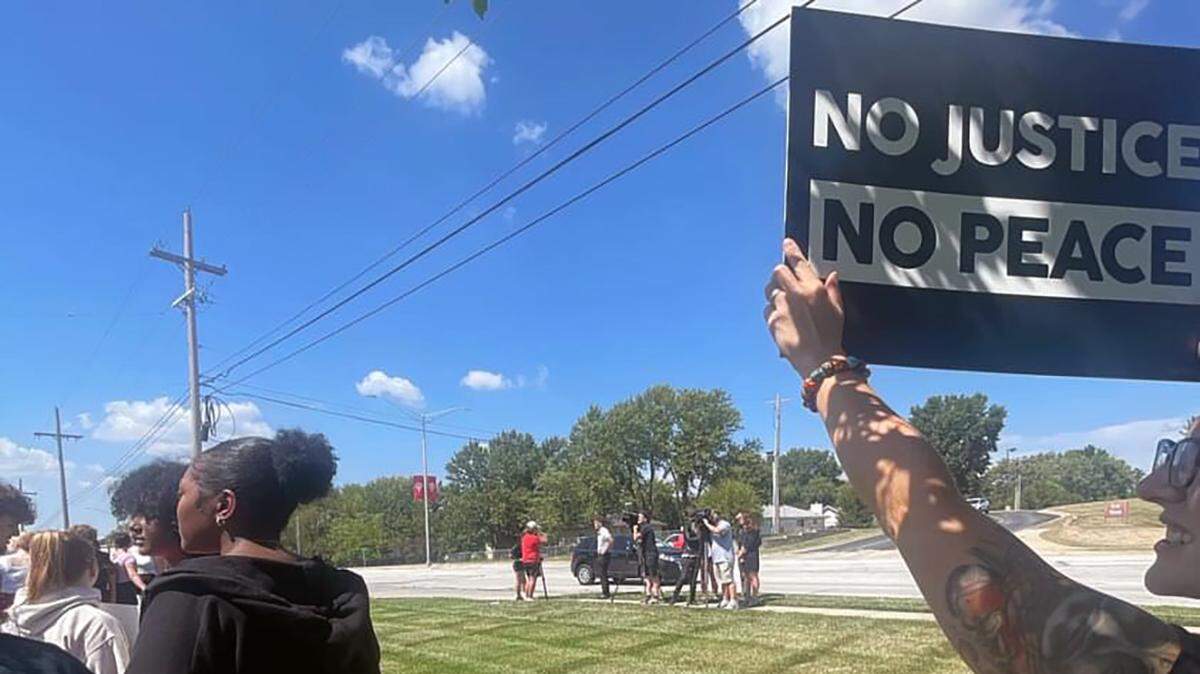
The recent incident, first reported by the KC Defender, prompted students to lead a protest starting from the school’s auditorium last week, calling for justice for the Black student, Colby Barker, who they said was unfairly punished.
Barker’s mother, Lauren Weathersby Seaman Mitchell, said her son has received death threats following the suspension and protest. He declined to comment for this story.
The protest mirrored concerns Park Hill students have been raising for years: that staff weren’t proactive in addressing racial discrimination and harassment, and they weren’t doing enough to make nonwhite students feel safe and supported at school in a district that is 65% white.
In 2021, Park Hill South students circulated a racist petition calling for the return of slavery. Later that school year, a math teacher and basketball coach at Park Hill High School, repeated the N-word while questioning a Black student for saying it.
Facing criticism, top district officials promised to work to make their schools safer and more inclusive. The district vowed to hire a diversity expert and create a plan to better combat racism.
Almost three years later, the district finds itself in a similar position. But officials say it’s making strides toward creating a more inclusive culture for its diverse students and faculty.
Park Hill promised to do better. Has it?
In 2021, Terri Deayon, who was already working for the district, stepped into the new role of director of access, inclusion and family engagement.
“It is no secret that we, in the fall of 2021, had a very huge incident at Park Hill South,” she said. “That helped to shape where my role was going.”
Following the racist petition, Deayon said the district collected over 700 pieces of feedback from students that shared themes of wanting a greater sense of belonging at school, more accountability for discriminatory behavior, and safe spaces for all.
While local and national media outlets criticized the district for “only listening,” Deayon said the district took its time to strategize its next steps.
From the feedback came the Diversity, Equity, Inclusion and Belonging Council, which is comprised of students, guardians and faculty across the district. The council meets once a month to discuss ways to improve belonging. It leads programming for diversity months and days, creates newsletters and gives awards to students and teachers who show they’re committed to diversity.
Kai Soo, a junior at Park Hill High School and DEIB Council member, said his work on the council has led to the creation of safe spaces for students of different religions to pray throughout the school day. He’s also helped to conduct school climate surveys for students.
One of the council’s biggest projects so far, Deayon said, has been to craft five guidelines for the district to follow to stay on track to make sure staff and students feel like they belong. One of the statements includes promoting a “culture of accountability.” They can be seen on posters in the school boardroom and classrooms throughout the district.
At a school board meeting last week, the district shared data evaluating culture in its schools, including student belonging. According to its data, the district is at risk of not reaching its goals for categories labeled “student climate”, “student safety” and “sense of belonging gap.” It’s “on track” to meet its goals for the categories “student belonging” and “respecting and valuing identities.”
‘It has to happen over and over and over again’
But some who have been calling for improvements in the district think it still has quite a ways to go.
Nicole Price, a diversity, equity, inclusion and leadership consultant who lives in the Park Hill School District, said she’s watched schools like Park Hill become stuck in a cycle of promising to improve after a racist incident.
Her son graduated from Park Hill in 2017, and when he heard about the incident he said, “Yeah…it tracks.”
Price said it doesn’t have to be this way.
While she’s seen Park Hill’s strategic plan, she thinks the district could be doing more to make students feel safe and supported. The plan is solid, she said, but the district can’t just stay at a strategic level without providing training on antiracism to staff and students — not just training on discrimination.
The district partnered with Sophic Solutions, a change management and consulting firm based here in Kansas City, in 2021. The firm continues to help the district run the DEIB council and professional development for staff, and it consults after specific incidents related to diversity or racism, said Kelly Wachel, the chief of communications for the district.
But Price said to really address racism within schools, particularly those in suburban areas, antiracism should be incorporated in curricula, not just taught to select students. She said this kind of accountability starts with teachers and faculty.
“At some point, who is going to take the responsibility to say, ‘I am going to be the one to teach this next generation of students what it looks like to recognize that race is a completely made-up concept that we have built an entire system around,’” she said.
“People have to be held accountable,” she said, “It has to happen over and over and over again because kids rotate out 100 percent every year.”
Park Hill is not the only district grappling with these challenges. In July, the Shawnee Mission school board unanimously voted to specifically name the use of slurs as a punishable offense in the student code of conduct. Price criticized this outlook, pointing to how suspensions can contribute to the school-to-prison pipeline.
“How do you hold children accountable for things you have not taught them?” she said. “We’re gonna say you should just know you shouldn’t use a pejorative. Should they?”
Instead, she believes antiracism should be taught, not assumed it’s learned at home. And she thinks the consultant already working with the district could do it.
In 2018, Price attended an “exceptional” program by Sophic Solutions that focused on the history of systematic racial inequalities and how they impact the present day.
She thinks conducting similar antiracism training with students and faculty would be more successful in challenging the district’s belief systems, stopping the cycle and preventing harassment in the future.
Channeling frustration
Following Barker’s suspension, the student’s use of racist slurs and the protest, Deayon spoke to the students and families involved as well as any students who wanted to talk.
She said the events have been the most challenging situation the district has faced since it created the diversity council in 2021, testing the limits of its new initiatives, and that her role continues to evolve.
Chloe Woodin, a junior at Park Hill who participated in the protest and serves on the DEIB council, said she has felt conflicted in recent weeks about her school.
She said she wants to hold district leaders accountable, but she also doesn’t agree with some comments calling her school a racist place. These statements don’t feel right, especially since she’s among those working to make schools more inclusive.
She took her frustration to Deayon to talk about how to channel it into the diversity council’s work in the future.
Wachel said student voices matter to the district and their voices deserve to be heard.
“Our job at this point is to ensure that we’re still having difficult conversations and that we embed our diversity, equity, inclusion, and belonging work to ensure we recover, we restore and we take care of people along the way from here,” said Wachel.
The district often posts video communication of the DEIB council work as a part of its efforts to become more transparent.
This story was originally published September 19, 2024 at 6:00 AM.