How did suspended cop steal gun he used to kill his KC family? Lax security at the VA

Federal investigators concluded lax security allowed a suspended Veterans Affairs police officer to access a secured area and steal the gun he used to kill his wife, 12-year-old son and himself at their home in Kansas City’s Northland earlier this year, according to a newly-released investigative report.
Even after police took Jerel McGeachy Sr.’s law enforcement credentials away because of a court order that barred him from having a gun, he retained access to an arms room where his gun was stored at a Leavenworth VA site, investigators concluded. Just before the April 1 shooting, he slipped into the arms room, retrieved the gun and went to his family’s home to commit the crime, the report said.
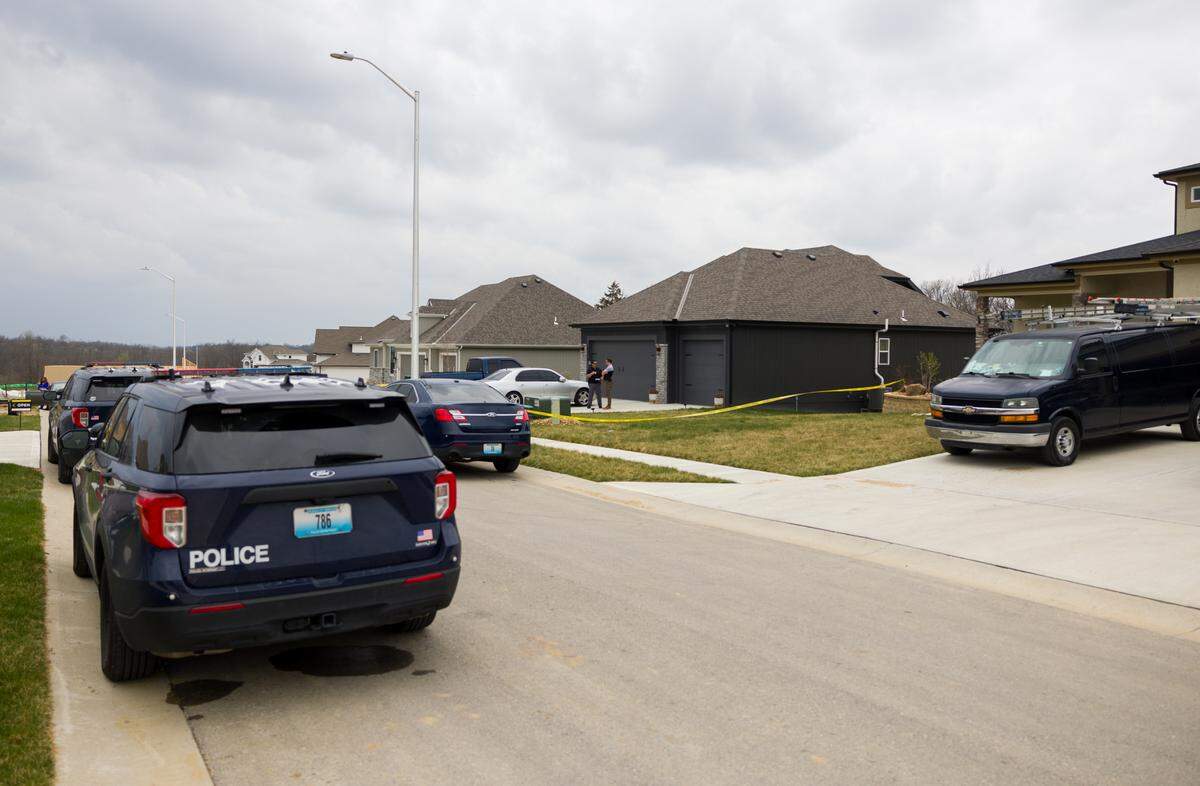
Domonique McGeachy, 38, Jerel McGeachy Jr., 12, and Jerel McGeachy Sr., 38, were found dead in their home in the 8300 block of Northwest 90th Street a few hours later in an apparent murder-suicide.
Domonique McGeachy, whose obituary described her as passionate about the issue of domestic violence and who “wanted for herself and others to be whole and healthy,” was remembered as an Army veteran and a loving mother. Even at a young age, her son Jerel Jr. was an accomplished public speaker known for commanding a room during dramatic recitations of Martin Luther King Jr. speeches.

New details from the VA’s investigation into the incident were released this month through a Freedom of Information Act request from The Star.
The report criticized police with the VA’s Eastern Kansas Healthcare System, which has campuses in Leavenworth and Topeka, for their response to a pair of protection orders against McGeachy Sr. in the days leading up to the fatal shooting, and faulted them for allowing him access to his gun. The report said even after police learned of the first protection order, they failed to look into previous abuse allegations from the family’s time in North Carolina, and relied on personal experiences with the officer to assess the situation.
The incident was significant enough to prompt armory access and firearms removal training for VA police nationwide in June. Investigators in the firearm probe highlighted a series of security issues locally they said created a “climate of risk” surrounding weapons, and a slide deck for the national training released by the department under The Star’s FOIA request went further, saying it was designed to address “systemic” gaps in the security of VA firearms. Investigators even questioned McGeachy Sr.’s hiring after they learned he’d been fired from a previous law enforcement job in North Carolina.
The report said prosecutors declined to file charges in the aftermath of the incident, and nearly six months after the shooting that left an entire family dead, it remains unclear what discipline anyone will face.
In a statement provided to The Star, Terrence Hayes, a VA press secretary, said the department suspended credentials, arrest authority and firearms access for the region’s police chief, deputy chief and the local officer overseeing the armory in the wake of the shooting. All three remain employed.
“Each have been detailed away from law enforcement responsibilities,” Hayes said. “While the disciplinary process is ongoing, VA cannot comment further – but we will take all appropriate action in this case.”

Court orders
About three weeks before the shooting, on March 12, police officials learned McGeachy Sr. was the subject of a Platte County court order that protected his wife and son, investigators wrote in their report. The protection order directed him not to contact or threaten them.
That day, McGeachy Sr. was seen at the VA’s Leavenworth campus, near where his wife worked as a nurse practitioner, with flowers and a drink for her. Police stopped him, and he met with department officials to discuss the order.
Documents released by the VA include a copy of the March 11 petition for a protection order filed by Domonique McGeachy against her husband. While details supporting the petition are redacted, one portion of the form asking the petitioner for a description of “immediate and present danger” included a brief summary: “Our (redacted) recent report of (McGeachy Sr.) beating him and weapons in the home.”
Talking with police at the VA campus, “McGeachy Sr. told them that the strife was caused by (redacted) mother (redacted) and that a similar situation had happened when they lived in North Carolina,” the report said.
McGeachy Sr. said SWAT officers had entered the family’s home after similar allegations of abuse and said that the Department of Child and Family Services was involved with the family in the days leading up to March 12, according to the report.
At that point, McGeachy Sr.’s arrest and weapons authority were not suspended, and while department officials considered moving him to work at the Topeka campus, they elected to have him continue work in Leavenworth and shift his work schedule to nights, opposite his wife’s schedule.
When police involved in the situation were interviewed, they pointed to the fact that the order didn’t prohibit the officer from possessing a firearm as a major factor in the decision not to suspend his arrest and weapons authority, investigators wrote. They also found no effort was taken to investigate McGeachy Sr.’s reference to previous abuse allegations from the family’s time in North Carolina.
Investigators concluded police “relied on their personal experiences with McGeachy Sr. to assess that the risk did not warrant moving him to Topeka or suspending his arrest and weapons authority.”
On March 29, three days before the shooting, McGeachy Sr. was served with a second court order, a juvenile protection order, that prohibited him from possessing firearms, according to the report. He was reassigned to administrative work answering phones and working as an “observer” and his badge was confiscated.
A Platte County sheriff’s deputy served McGeachy Sr. with the order that day at the Leavenworth site, and investigators wrote the deputy reported McGeachy Sr. failed to appear at a hearing, which resulted in the full protection order prohibiting him from having a firearm.
Court documents released by the VA include a finding by a Platte County judge on March 25 that McGeachy Sr. “represents a credible threat to the safety of the protected child.” He was prohibited from having firearms through the end of the order in March 2025.
Someone in the department took his badge and credential set and placed them in a lock box in an arms room, behind a door that required a card, code and key for entry, the report said. But McGeachy Sr. was given his key ring back, which included his gun lock box key, and kept his access card, with no one having changed its permissions, investigators wrote.
McGeachy Sr. worked a shift doing administrative duties the night of March 30 into the early-morning hours of the next day. According to the report, he returned that evening and left at 4 a.m. April 1, after using his card, code and key to enter the arms room with a bag. He took his gun, investigators wrote, and then presumably drove to the McGeachy residence, where he allegedly fatally shot his wife and son and then himself.
‘This fact... proved catastrophic’
Prosecutors reviewed the incident and declined to file charges, according to the VA’s report. The documents describe the involvement of one person, whose identity is redacted, as being limited to “failing to adhere to established policies” and not as being criminal, as determined by state and federal prosecutors.
Investigators faulted police for not keeping McGeachy Sr. from accessing his gun by failing to take his keys and revoke his card access. They also concluded he would have had access to long guns in an operations area and in patrol vehicles, as well as weapons and ammunition stored in an evidence room.
They also found the arms room did not meet security standards. A key for a police administration room also opened the arms room, which went against a policy that states arms rooms must have special keys. Because McGeachy Sr. was assigned to the administration area, he kept his key.
“This fact, coupled with (redacted)’s failure to revoke arms room access on McGeachy Sr.’s PIV card and take McGeachy Sr.’s gun box key proved catastrophic,” investigators wrote.
They also found that a key that opened the administration area could be used by someone to override the card reader for the arms room and enter the room with only a key. Under policy, that act should set off an alarm, and investigators found it didn’t.
They also found that a computer in the administration area used to assign access levels to cards was always logged in, which could have allowed anyone to change access levels.
Investigators also faulted department officials for not investigating the North Carolina allegations against McGeachy Sr., and not considering the proximity of the area where he worked to his spouse’s work area. They said officials focused on the terms of the initial order, which did not prohibit McGeachy Sr. from having firearms, and didn’t pursue information regarding the allegations against him.
“Although the order did not prohibit firearm access, the state court does not determine VA policy matters, or the obligation to act in agency interests,” the report said. “Investigators recognize that personal experience with McGeachy Sr., described as an excellent employee factored in the decision-making of (Eastern Kansas Healthcare System) police leadership.”
McGeachy Sr. had been a police officer with the district since January 2023. Investigators probing the gun theft questioned his hiring, as they determined he had been fired from a previous law enforcement job in North Carolina in 2017. That department also indicated he had been previously investigated on a domestic violence matter in 2017, but the allegations were deemed “unfounded.”
Investigators wrote an internal affairs investigation found he had lied in two incidents, which led to his firing there, and the report said he was “potentially a Giglio-impaired individual unsuitable for a VA Police position,” referring to law enforcement officers whose credibility can be called into question.
They said he had supplied a retired supervisor as a reference during his application process for the VA job, and investigators concluded he did so to “conceal a suitability issue,” knowing the reference would speak favorably about him.

‘Devastated by this tragedy’
In his statement, Hayes, the VA spokesperson, emphasized the investigative findings that police did not follow existing policies and procedures for gun security and said the department responded through training, additional oversight and enhanced pre-employment screenings for VA police “to ensure that something like this does not happen again.”
“The officer should not have been able to retrieve his firearm while suspended, and we deeply apologize,” he said. “We have immediately taken action to make sure that this does not happen again — in Kansas and at VA facilities across America.“
“We at VA are devastated by this tragedy, and our hearts go out to the impacted family members, friends, and co-workers,” he added.
The firearms security training for VA police nationwide happened from June 10-14.
Topics emphasized included internal steps for making sure only authorized people could have access to firearms and steps to take when an officer’s weapons and arrest authority were suspended for any reason, Hayes said.
The slides released by the department said the VA was conducting a “safety standdown to address systemic gaps in the security of VA firearms and long guns. VHA Police leaders and staff at all levels will discuss, explore, and identify concerns, barriers, and commitment to improving the culture of safety.”
The slides include a number of questions designed to prompt discussion. Among the final queries: “Are we too lax with weapons security?”