Kansas City’s plan for park over I-670 stalled out. Is help from feds enough to pull it off?
Months after progress seemed to have stalled on the South Loop highway lid project in downtown Kansas City, city officials are hoping a federal loan will signal that things are moving forward once again and the lid will be built as promised.
“I think it’s fair to say that, yes, it’s going to happen, because there’s been some skepticism,” Mayor Quinton Lucas told reporters Tuesday after the City Council finance committee recommended that the full council agree to borrow up to $65 million from the the feds.
Should that line of credit be approved by the U.S. Department of Transportation, it would bring the total amount of money raised for the project up to $175 million. That’s about $40 million shy of the $217 price tag announced almost a year ago for a project that would cap four blocks of Interstate 670 so that a park could be developed on top.
The city had hoped to have the park done in time for the 2026 World Cup. Although making that timeframe is ambitious.
Could new loan reboot project?
City officials are hoping that private donations will fill much of that gap. Contributions slowed over concerns about the project’s seeming lack of progress after a burst of public activity last year.
The last of four promised public forums that was to have taken place last winter never happened. Fundraising sputtered, and then the project suffered a major blow in March when the city’s application for a $75 million “reconnecting communities and neighborhoods” grant fell through.
“I think most of the skepticism came from one grant application that perhaps didn’t bear fruit,” Lucas said. “That being said, I think you have seen very substantial recovery in a number of different ways.”
He said the U.S. Department of Transportation has shown interest in seeing the project built. Last fall, the DOT picked Kansas City to be part of its Build America Bureau program, which gives cities special help with complex projects like the city’s plan to cap I-670 from Grand Boulevard to Wyandotte Street.
The transportation department says the South Loop Link project is eligible for a $65 million low-interest loan. The city could take as long as 75 years to pay it off, if it wanted to string it out that long, Assistant City Manager Mario Vasquez told the finance committee. And there’s no penalty for paying it off earlier, nor would the city need to borrow the full amount.
It would be a line of credit that Kansas City could draw on as needed. The city would use restaurant sales tax revenues to pay it off, Finance Director Tammy Queen said.
Needs more private investment
Downtown business interests and the city port authority had been the driving forces behind the project until early this year when Port KC handed it off to city government.
Nearly two decades after it was proposed, the project got its first big boost two years ago when then-U.S., Sen. Roy Blunt secured a $28.6 million federal grant. The state of Missouri matched that, then committed $20 million more in appropriations and tax credits. The city kicked in $10 million last year, and corporate donors pledged $22.5 million.
The total now stands at $110 million, which is little over half of the projected cost, not counting the potential federal loan.
Private fundraising stalled last winter as state highway officials and the project engineers at HNTB Corp. worked on some of the complexities involved in building a tunnel that would connect to the current highway lid supporting Bartle Hall.
Vasquez believes private donations will resume now that the city can prove it will have enough money to start construction, which Lucas has said could be as early as next year.
According to Vasquez, the line of credit and the money raised so far should be enough to cap the interstate, which would also involve building new retaining walls and installing ventilation and fire suppression systems within the tunnel.
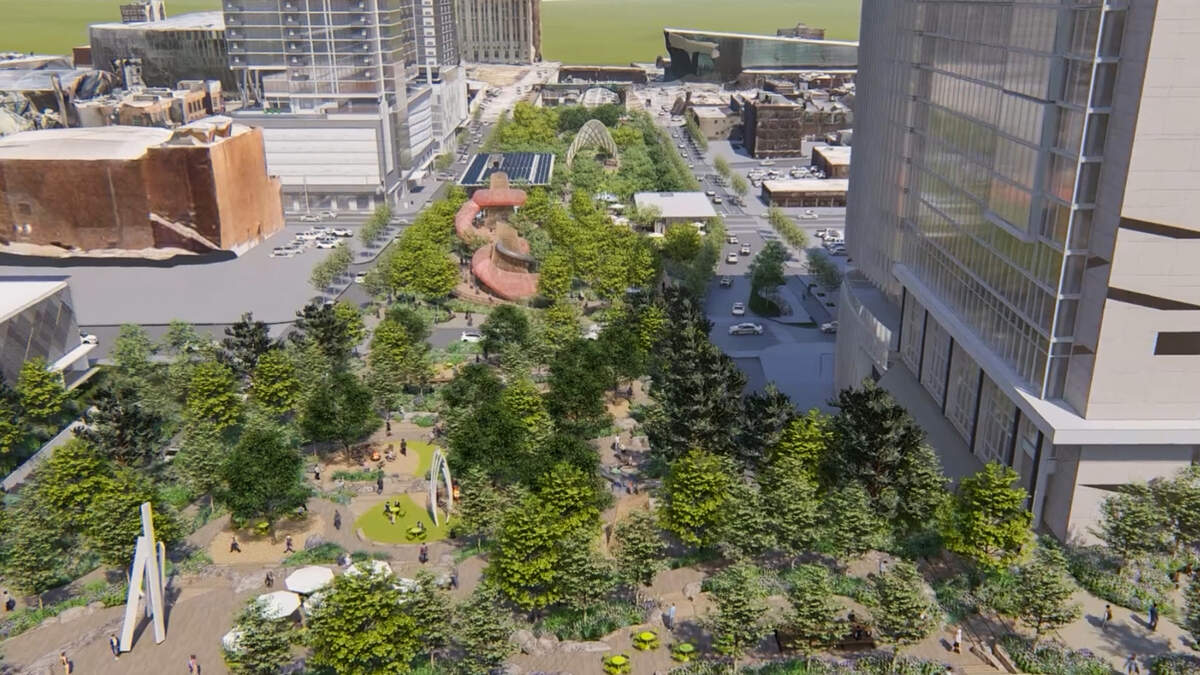
New private dollars would go to pay for the park on top. The last designs made public last fall imagined trails lined with trees, picnic areas, ponds and gathering spots for concerts and play.
“This is one of the few projects of late where we have seen that true public-private partnership at every level of government, which is something that I think is special for us,” Lucas said.
When the Royals announced plans for a new ballpark in the Crossroads area nearly six months ago, the renderings showed the South Loop park extending another two blocks further east from Grand Boulevard and alongside the new stadium.
Team executives said the ballpark would be “a catalyst” for the extension, but the Royals had no plans to pay for it. Voters defeated the sales tax that would have paid for the ballpark.
This story was originally published July 31, 2024 at 6:30 AM.