Josh Hawley is warning about AI dangers. But regulations languish in Missouri
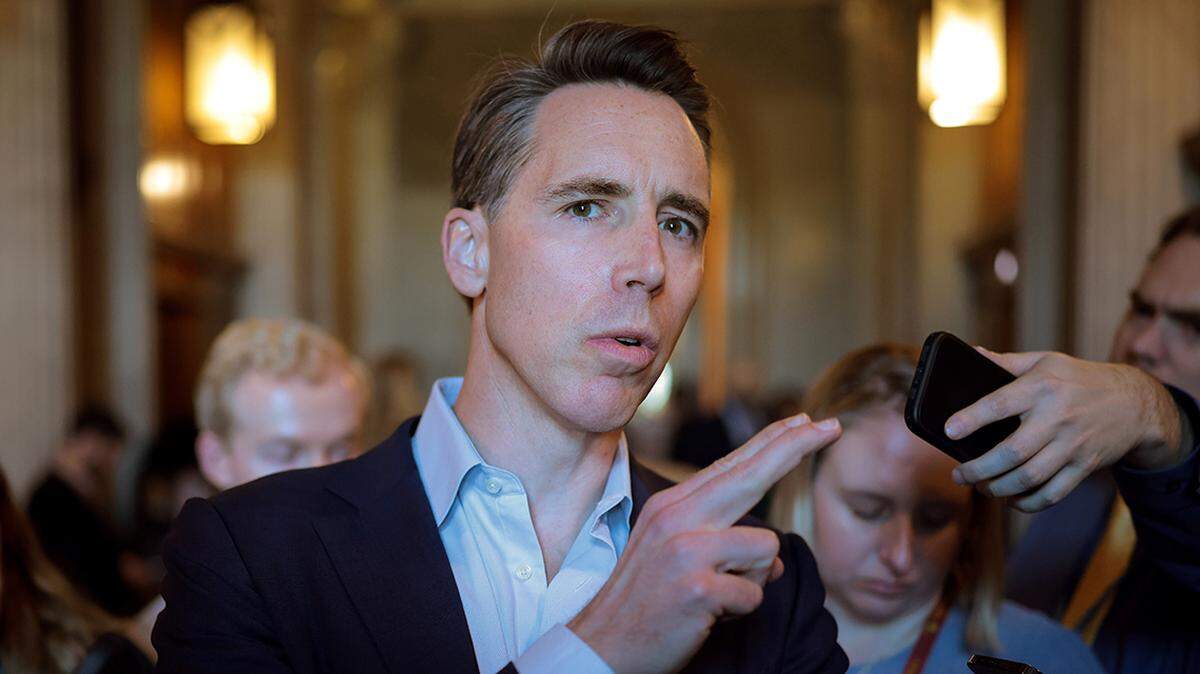
Standing at a podium in Washington last week, Missouri’s senior senator called on Republicans to regulate the artificial intelligence industry in a searing speech that cast the dangers of AI as a moral dilemma.
“Left to itself, artificial intelligence will not choose moral liberty,” said U.S. Sen. Josh Hawley. “It will choose the appetite. It will gather power into the fewest hands the world has ever seen and call the result progress.”
Hawley’s address at a gala hosted by the conservative think tank American Compass underscored the Missouri Republican’s attempts to carve out a populist, pro-worker stance on AI regulation. Harkening back to America’s founding and what he calls its moral covenant, Hawley has framed AI as an unprecedented and fundamental test of society.
Over the last several months, Hawley’s position on AI has echoed his populist stances on other issues, such as overtures to organized labor. Fights over the future of the AI industry and the massive data centers that power it have been at the center of politics nationally and across Missouri, sparking fierce voter backlash in local elections in Independence and across the state in Festus.
“We must regulate, and yes, I did use that verb — regulate — artificial intelligence in the economy to ensure that it aids the worker, but does not displace him,” Hawley said during his speech last week.
As President Donald Trump and national Republicans have promoted a hands-off approach to AI, Hawley — rumored as a potential presidential candidate in 2028 — has pushed a more hard-line stance on regulation. That position has put him at the forefront of an issue that some of his Republican colleagues have struggled with.
“The Republican Party has a choice of its own to make — perhaps the defining choice of its next half century,” Hawley said.
Trump last year unveiled a wide-ranging plan aimed at boosting the AI industry, rolling back some of the Biden administration’s guardrails and speeding up the permitting process for data centers.
“We’re going to make this industry absolutely the top because right now it’s a beautiful baby that’s born,” Trump said last summer. “We have to grow that baby and let that baby thrive.”
But in a notable shift last week, Trump quietly signed an executive order that asked technology companies to voluntarily provide the government oversight of new AI models before releasing them to the public. While viewed as Trump’s biggest step towards regulation, it remains unclear whether a voluntary order will make any significant changes to the industry.
When asked about Trump’s order, a Hawley spokesperson directed The Star to comments the Republican senator made last week in support of it as a safety measure. However, Hawley suggested there should be stricter regulations.
“I would go further. I think we ought to enact my legislation that I have with Senator [Richard] Blumenthal that would make that sort of reporting and monitoring mandatory,” Hawley said, according to the Washington-based media outlet Roll Call.
The Missouri Republican was referring to bipartisan legislation he filed late last year that would require the federal government to conduct reviews of advanced AI systems instead of the voluntary order signed by Trump. Blumenthal, a Connecticut Democrat, and Sen. Marsha Blackburn, a Tennessee Republican, co-sponsored the measure.
Fights over AI and data centers have roiled local politics across the country. But despite voter pressure, legislation to regulate both has languished nationally and in Missouri.
This year, lawmakers considered a slew of bills to enact state-level guardrails for the AI industry, including legislation that would ensure humans or companies remain liable for harm caused by AI, banning AI from having legal rights, prohibiting the use of AI in prescribing medicine and age restrictions for AI chatbots.
State Sen. Joe Nicola, a Grain Valley Republican who pursued regulations, said he’s been frustrated at the lack of appetite for change within the Missouri Capitol. Nicola said his legislation received pushback from the Trump White House and he attempted to work with the administration to tweak it.
Nicola’s legislation failed to cross the finish line this year despite receiving bipartisan support.
“People want regulation on AI,” Nicola said. “But trying to get the legislature to pass something has been very, very difficult and it looks like it’s very difficult on a national level.”
Senate Minority Leader Doug Beck, an Affton Democrat who also sought to regulate the industry, said he viewed regulations as a way to protect kids and workers. He emphasized that putting up guardrails did not mean halting the entire industry.
“We need to do something. I’ve been saying this for quite a while,” said Beck. “My fear - and I don’t usually use the term fear - is that once this grabs hold more and more and these billionaires make even more money, you’ll never be able to stop it.”
Inside Hawley’s stance
Hawley’s predictions of the dangers of AI to American workers come as the Missouri Republican has, over the last several years, attempted to stake out pro-worker stances and eschew the traditional, business friendly positions espoused by some Republicans. Many of his critics have framed those stances as symbolic gestures.
It remains unclear whether Hawley’s position on AI will put him at odds with Trump, but it would not be the first time. Last year, the Missouri Republican launched an anti-abortion dark money group that reportedly sparked blowback from the Trump administration, which has tried to distance the Republican Party from staunch anti-abortion stances.
Peverill Squire, a retired University of Missouri political scientist, said Hawley’s position on AI and other issues can be viewed through the lens of a potential run for president in 2028.
“I’m not sure whether he’ll decide to take the plunge or whether he’ll want to run for re-election,” said Squire. “But, certainly, I think he’s one of a number of Republicans who are beginning to look past the current administration and trying to figure out where the party is going to go in the future and where he might fit in.”
Hawley’s stance on AI may put him in a difficult position politically, said Squire, who pointed to the large sums of money coming from Silicon Valley that fuel elections. It’s also not clear how much appetite Congress has for strict regulations, he said.
“I think he’s happy to be part of the debate,” said Squire. “He’s probably not expecting to be able to resolve the issue anytime soon.”
In his keynote speech in Washington last week, just hours after Trump signed the executive order, Hawley went a step further than his recent overtures to American workers. He framed the growth of unregulated AI as a watershed moment — one that risks unraveling the nation.
“In deciding how to govern this technology, we are not merely writing policy,” Hawley said. “We are renewing — or surrendering — the moral basis of our life together.”