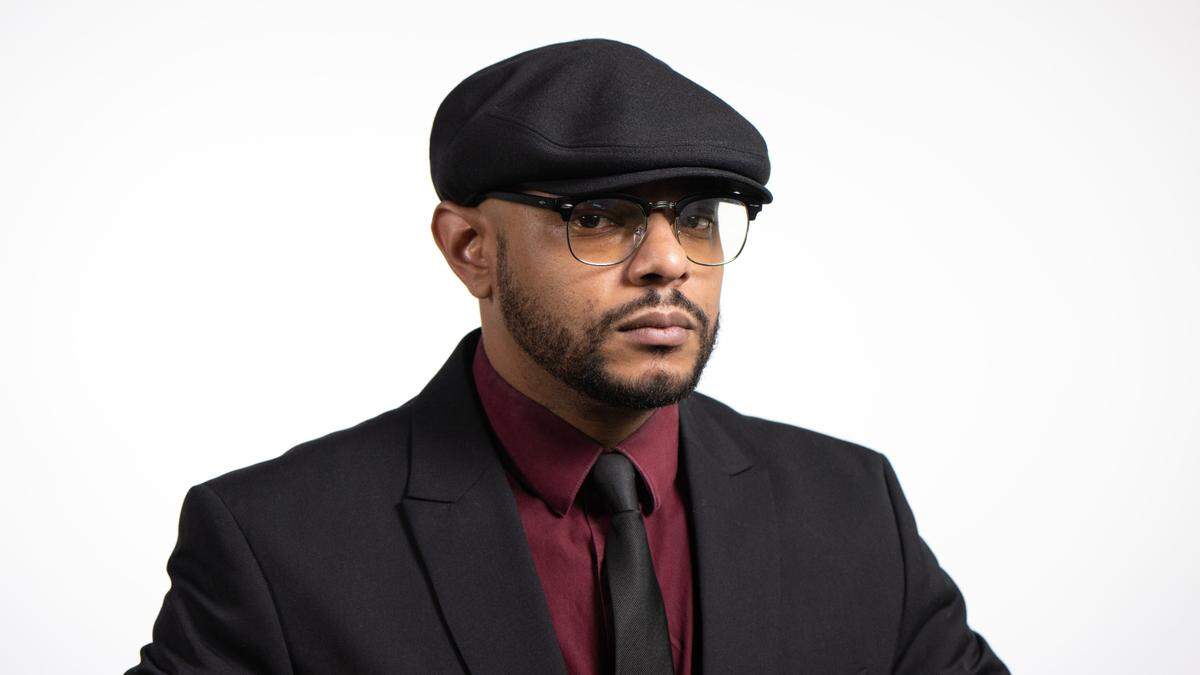
This young man learned to be ‘the strongest man in the room.’ Now he teaches others
This interview is part of the second season of Voices of Kansas City, a project created in collaboration with KKFI Community Radio to highlight the experiences of Kansas Citians making an impact on the community. All the episodes are available at the KKFI.org site https://kkfi.org/program/voices-of-kansas-city/ and listen to KKFI live on 90.1 FM, or at KKFI.org. Do you know someone who should be featured in a future season of Voices of Kansas City? Tell us about them using this form.
Ryan Harvey has used his platform as a public speaker, author and educator to break the stigma about mental health for Black men. He grew up in a community where emotions and vulnerability were seen as weaknesses and where “real” men dealt with their problems in silence. Harvey faced tough challenges as a teen and had few resources to manage internal struggles he’d had to navigate alone.
He healed with help. Harvey, 38, educated himself about the struggles of mental health in the Black community and started the “Strongest Man in the Room: Men Heal Conference.” A yearly gathering of Black men who participate in group workshops, panel discussions and hear from experts on the subject.
His passion for helping Black men better handle mental health issues is why The Star invited Harvey to join us in the studios of KKFI radio where he recently spoke to J.M. Banks, The Star’s culture and identity reporter. That interview, with minor editing for space and clarity, is published here in a question and answer format to share Foster’s authentic voice.
Meet Ryan Harvey
The Star: You are the founder of the “Strongest Man In The Room: Men Heal Conference,” and it deals with Black men and mental health. Before we get started, why don’t you tell us a little bit about yourself and your upbringing here in Kansas City?
I am Ryan S. Harvey. I am from 27th and Monroe, born and raised. I moved out south, maybe elementary or middle school. Around that time I got kicked out of school. I had to go to a military school and so I bumped my head a lot. My dad died when I was 5, Grandpa died when I was 13, older brother died a little bit after that.
So a lot of the men in my life died really early. I didn’t really get to understand what it really meant to be a man. So these Kansas City streets and my environment raised me a lot.
What do you think has started attention to mental health to come to the forefront of Black consciousness?
I think as men, we get ignored a lot when it’s dealing with how you think, how you feel, how you move, the things that you do, how you walk into a space, how you start your mornings, your rituals, your routines.
We kind of know that we have to get better in these areas. I believe that mental health for men has been becoming more of an important thing because we’ve also been committing suicide at a higher rate than anybody, going to jail, having unfortunate situations happen faster than anybody else. And when the chips fall, usually it’s the man that has to pick up the pieces. And so that comes with a lot of trauma, a lot of misunderstanding, a lot of unresolved feelings that men have to carry and still be able to hold the fort down.
Losing that many family members at a young age, what was the impact of that on you growing up?
It caused me to have to be in a position where a lot of the questions that I would have asked my ancestors or people that would have come before me, I had to find those out for myself. Generations pass down knowledge. So when the men in my family died before I could actually gain that knowledge, it was kind of put on my shoulders to become that man for the people that came after me.
What were some ways that you coped with those negative emotions you were feeling?
I got in a lot of trouble. I coped with it by fighting, by being destructive, doing everything that my mom would tell me not to do.
I got kicked out of high school, had to go to a military school. Military school was my first interaction with discipline and honor, and actually see it on another man.
At what point did you decide that you wanted to get involved with Black men’s mental health and start your work?
I would say when I got my child out of foster care almost ten years ago. Through that process I had to talk to a therapist. It kind of put me in a position where I started to think about what type of man I wanted to be.
Why don’t you give us a breakdown of what the “Strongest Man in the Room Conference,” is and how that all came about?
Okay, “The Strongest Man in the Room” is a concept that has everything to do with you being the strongest man in the room with the way that you think, the way that you handle opposition. We created the “Strongest Man in the Room: Men Heal Conference,” to give other men the tools that they need to rekindle that fire that they have when we are young; to dream, to think that this world is much bigger than our environment.
When you began to get involved with this type of work, what were some of the reactions from the people around you?
I got into this work when I was about 29 or 30. I met a guy on this cruise and he asked me the score of a basketball game.
That sparked a conversation. At the end of this conversation the guy says, ““Yo, I want to challenge you. If I had never spoke to you, I never would have been inspired by you. So after you leave this ship, I want to challenge you to just walk up and start speaking to people. Because the things that you say, I don’t really hear people saying.”
When I got home, I started making videos, just pulling out my phone talking about the things that I’ve gone through, the things that I’ve learned and I just start giving it out for free.
Of course all my family would say, “where’s this coming from?” Because I didn’t do anything close to this before. I was a liar, manipulator, a schemer. I tried to figure out ways to not have to be committed to anything.
Why do you believe there is such a stigma and taboo around Black men and their mental health and them being able to say, I need help. I’m not doing all right?
I think for men in general, not only just Black men, we don’t like feeling or being in the position of not being able to handle it. Or, looking like we can’t handle it, like we’re not strong enough.
I think we just got that thing of being able to lie to ourselves and say that we can handle anything when really we need help just as much as anybody else.
I think for men, we are expected to be the help, not ask for the help.
What misconceptions have you seen that people have about the Black mental health struggle?
That it’s over with quickly. I think we don’t really realize how long this healing thing takes. It’s a lifelong journey. So, if a man can have room to feel, take time to kind of rationalize and understand the things that he’s going through and the space to do that without being required to be anything for someone else, I think that would be extremely, extremely important for men. And he’ll be able to come back stronger for his family, for sure.
What are some things you wish you knew when you were younger that you could tell yourself that you’ve learned at your older age?
Don’t take yourself so serious. Love life. Understand that this thing is a big journey. Look at this thing like you would do a video game that you get opportunities. As long as you’re not dead, you get an opportunity to play that board again. And, if you are committed, resilient and have enough tenacity, you will win.
Take time to find out who you are and realize that that is good enough. Beyond good enough.
As a public speaker, you’re able to get up there and be very honest and candid in these talks. How long do you think it took you before you were able to get to that level of authenticity?
Before I got to a point where I could get on stage and do that, I had to do that with myself in a lot of ways. Before I could even be vulnerable with anybody I really had to look at myself in all facets and all shapes and forms of my life.
I know that my vulnerability is a strength. A lot of us in our culture, as men, we don’t like vulnerability. We have the thought of vulnerability as, it makes us look weak or soft.
I know from my experience that growth didn’t happen, the better me didn’t happen, if it wasn’t for vulnerability. So I tried to come from a place of showing that the strongest man in the room is vulnerable.
What is your favorite aspect of your work and what’s the most difficult aspect?
The most fun part of what I do is getting up there and being an inspiration.
I had a guy (homeless) that came and was like, “Yo, the things that we did in your class, I want to let you know that I’ve used those things and now I’m about to be in trucking school. I’m in a position to have my own place.”
That was probably the brightest spot that I’ve had since I’ve started speaking in for close to ten years.
The worst part of it is the planning.
Interacting with so many people on that deep of a level, do you ever get to a state where you’re emotionally burnt out?
Yes, that is hard, because for a lot of people, you look like an answer. You know what I mean? If it’s a speaking conference or anything, you’ll have people that will wait around and sometimes it’s cool. You know, I don’t want to make it like, he doesn’t like people waiting around for him. No, it’s cool. It’s just that it’s a time and a place for everything.
After I spoke for an hour, having a real deep conversation about something is not what I really want to do at that point.
What can folks expect in terms of seminars and speakers at the conference in June?
We have a group of men that are in different walks of life that we built the panel for. We have people ask questions from the audience. Here’s a place where you’ll have therapists, business owners, teachers, scientists, engineers. A long list of people that are maybe not represented as much as they should. You’ll get access to Black men in these fields and an opportunity to ask how you did that.
Then you get me. You get all of the game that I’ve learned. I just want people to come ready to change, ready to be molded, ready to be shifted into something that they’ve always dreamed of.
How can folks find you online if they’d like to attend?
My email is ryansharvey@thestrongestmanintheroom.com.
This story was originally published May 15, 2024 at 8:37 AM.