Are Royals’ parking estimates for new stadium too optimistic? Here’s what experts say

Editor’s note: This story has been edited to reflect that according to the Royals’ estimates, 21,000 parking spots are located within a 10-minute walk of the proposed stadium site, not 9,000. The 9,000 number initially reported is the number of spots the team had said it’s required to have within a 10-minute walk of the site.
As voters decide whether they want their tax dollars to help pay for a new Royals stadium in the East Crossroads neighborhood near downtown, the issue of parking continues to come into question. Mainly — will there really be enough of it?
The Royals have said there will be plenty of space for fans, citing 40,000 parking spots in the “greater downtown area” within a 20-minute walk of the ballpark, compared to 26,000 at Kauffman Stadium.
There are 21,000 existing, multiuse spots within a 10-minute walk of the new stadium, according to the Royals. The team said 9,000 spots is the required number of spots it would need for its 35,000-person stadium.
How did the team arrive at that number? Would it still be enough when concerts or other events coincide with game days? Here’s what we’ve learned so far.
How did the Royals decide how many parking spots for games?
At February’s press conference, the team highlighted that 9,000 parking spots were needed within a 10-minute walk of the proposed site, while 21,000 alreadt exist in that radius.
“The beauty is at the Crossroads site we can park all 9,000 people here that we need to park,” said Earl Santee, CEO of Populous, the design firm the team hired. “We’re not building new parking for this 9,000. And all within a 10-minute walk out of the ballpark.”
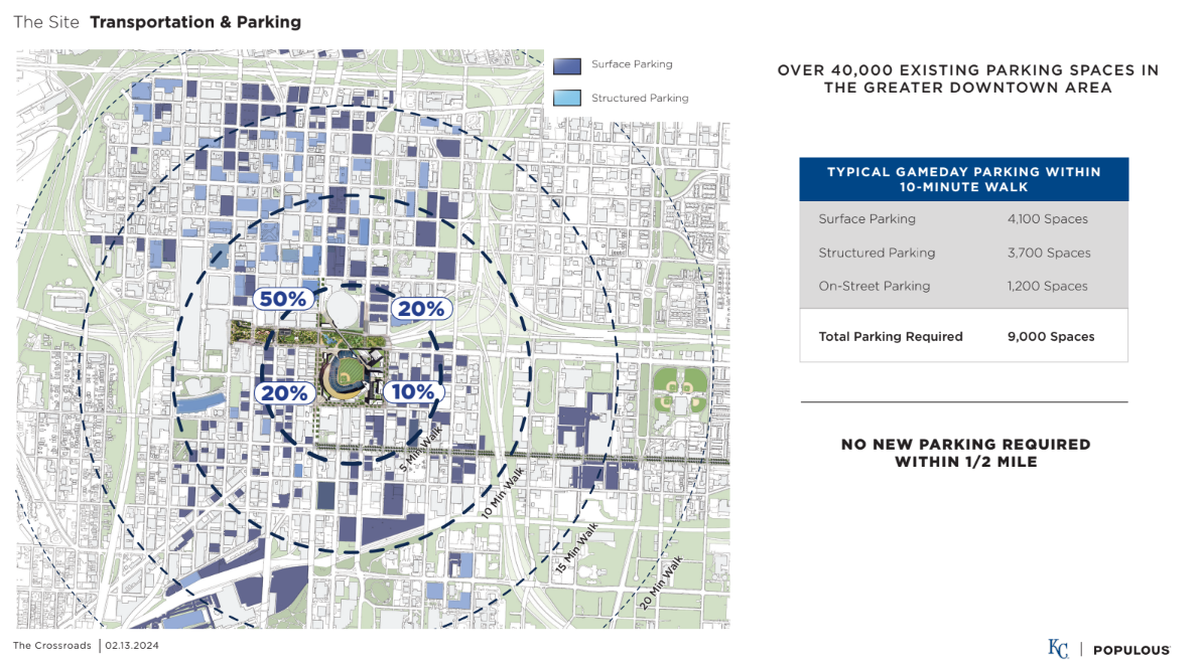
When asked how they got to this number, Sam Mellinger, a Royals spokesperson, said it’s “based on expected vehicles with an anticipated average of 2.5-3 people per car.” He said that the team also plans to have “1,500 spaces on site” but didn’t provide further information when asked if that meant the team would build additional parking, who that parking would be for or how much it would cost, because “the opening of the ballpark would be 4 years away.”
Just a few miles away, the development plan for the new riverfront KC Current stadium required the team to provide only 2,000 spaces for its 11,500 seats, according to city records. But the Current faced backlash from fans this week who learned they’d need to pay more than $50 a game to get one of the spots. The team is asking fans to use public transit and rideshare options.
Tim Kellison, an associate professor in the Department of Sport Management at Florida State University and an expert on urban stadium development, said that from a planning and environmental perspective, it is a good thing to limit on-site parking around a ballpark.
“That’s been a rallying cry for a lot of environmentally minded planners,” Kellison said. “That you don’t need these big concrete pads like what’s surrounding the Chiefs and Royals now if they are moving into an area with parking spots already there.”
He compared the proposed Royals stadium to Allegiant Stadium in Las Vegas, the site of the Chiefs’ Super Bowl LVIII victory on Feb. 11. Las Vegas’ county code requires a quarter-space per event attendee, or one spot for every four fans, which means 16,250 spaces for the stadium that has a capacity of 65,000.
That’s about the same ratio as the 9,000 needed nearby spots for 35,000 seats that the Royals proposed.
While the number of spaces didn’t surprise Kellison, he said it seemed odd for a team to want to build a big stadium and use already available parking around them, as parking is generally a good source of revenue for teams.
“I assume that there is going to be more to that story, whether that is they do have plans or that they have looked at some sort of study on how they will manage this,” Kellison said. “If you’re relying on parking spaces that are owned by other groups, that lack of control is unique I would say.”
Kellison said the Atlanta Braves could be a parallel situation after the team moved from Turner Field, which was similar to Kauffman, to Truist Park, which is 10 miles northwest of downtown. The Braves use both on-site parking spots and pre-existing spots within a one-mile radius for their 41,000-seat stadium.
What about when other events overlap with Royals games?
The Royals estimate that 40,000 parking spots across the downtown area will be available to use for game days, with the majority of spots in existing parking facilities.
When asked if it would be a problem that these parking spaces are used for a variety of reasons and events, Mellinger from the Royals said that most are “empty at night and on weekends, when the majority of games would be played.”
If you ask Stretch, the owner of Grinders in the Crossroads whose legal name is Jeff Rumaner, he’s not so sure. He said that even without a stadium, parking is already tight around his restaurant and venue on nights and weekends, especially when hosting a concert.
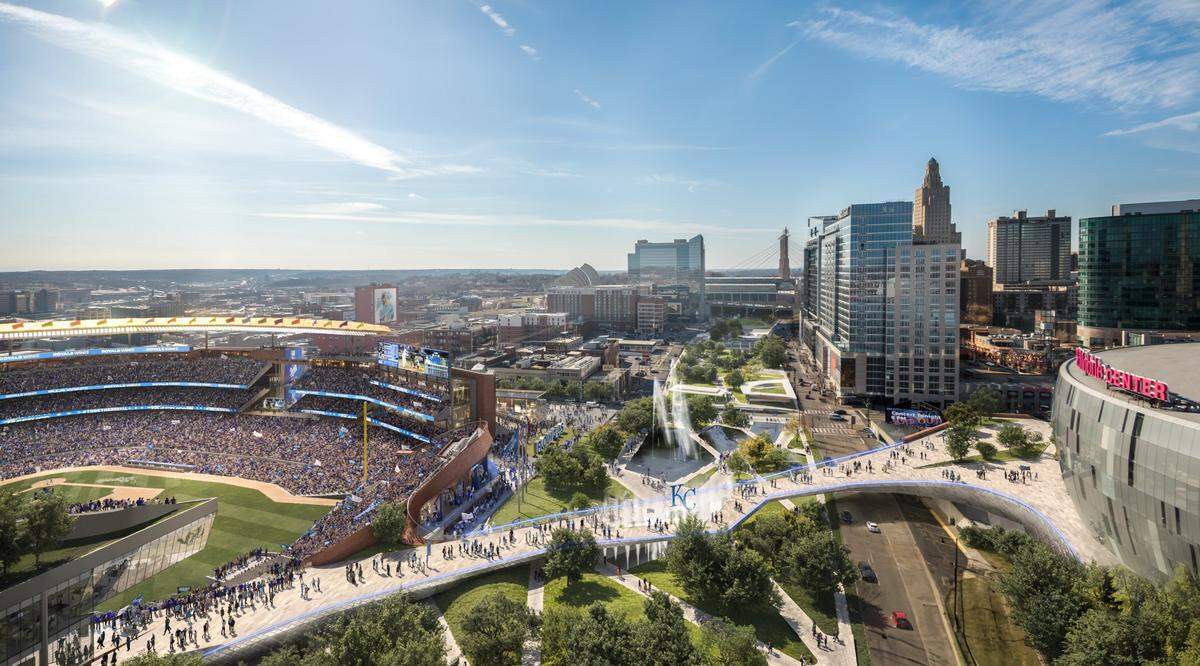
He’s even less sure about how parking would work if multiple venues, like the T-Mobile Center, the Midland Theatre and Grinders, had events at the same time as a Royals game.
“They are not the only show in town,” Stretch said. “Midland does 200-300 things a year, and imagine if the Kauffman Center has a symphony and then you have a bunch of baseball guys out there, and now their parking lot is gone. You can’t say you have 40,000, you have to look at the worst-case scenario.”
The Downtown Neighborhood Association said they support not building mass amounts of parking for a ballpark that would only be used 81 days a year. Peter Carnesciali, the association’s president, said in an email that existing lots “are not utilized 100% of the time” and said he wants to see the Royals and the city coordinate to make it work with existing parking.
What about public transit?
The KC Current is encouraging its fans to use alternate modes of transportation to get to games, like buses, the delayed streetcar extension to the riverfront, ride share services, bicycles or walking.
Limited parking was part of the women’s soccer team’s plan. The Royals are factoring public transit in too.
Mellinger said parking problems would be eased by “tens of thousands of people living downtown, and many more working there,” and said that the stadium would be easily accessible by multiple forms of public transit, including “33 existing bus routes.” He pointed out that a streetcar stop is two blocks away from the site, and the line would be extended to UMKC by the time the stadium opens.
Jackson County voters will decide in an April 2 election whether they want to support a 40-year, 3/8th-cent sales tax to help pay for a new Royals stadium and renovations at Arrowhead for the Chiefs.
The Star’s Mike Hendricks and Kendrick Calfee contributed to this report.
This story was originally published February 24, 2024 at 6:00 AM.