Meet the Black entrepreneur giving back to Kansas City, one cup of chai at a time
Editor’s Note: This interview is part of Voices of Kansas City, a project created in collaboration with KKFI Community Radio and Kansas City GIFT, a nonprofit supporting Black-owned small businesses, to highlight the experiences of Kansas Citians making an impact on the community. Hear the interviews on KKFI 90.1 FM, Fridays at noon, or at KKFI.org. Do you know someone who should be featured in a future “Voices of Kansas City” season? Tell us about them using this form.
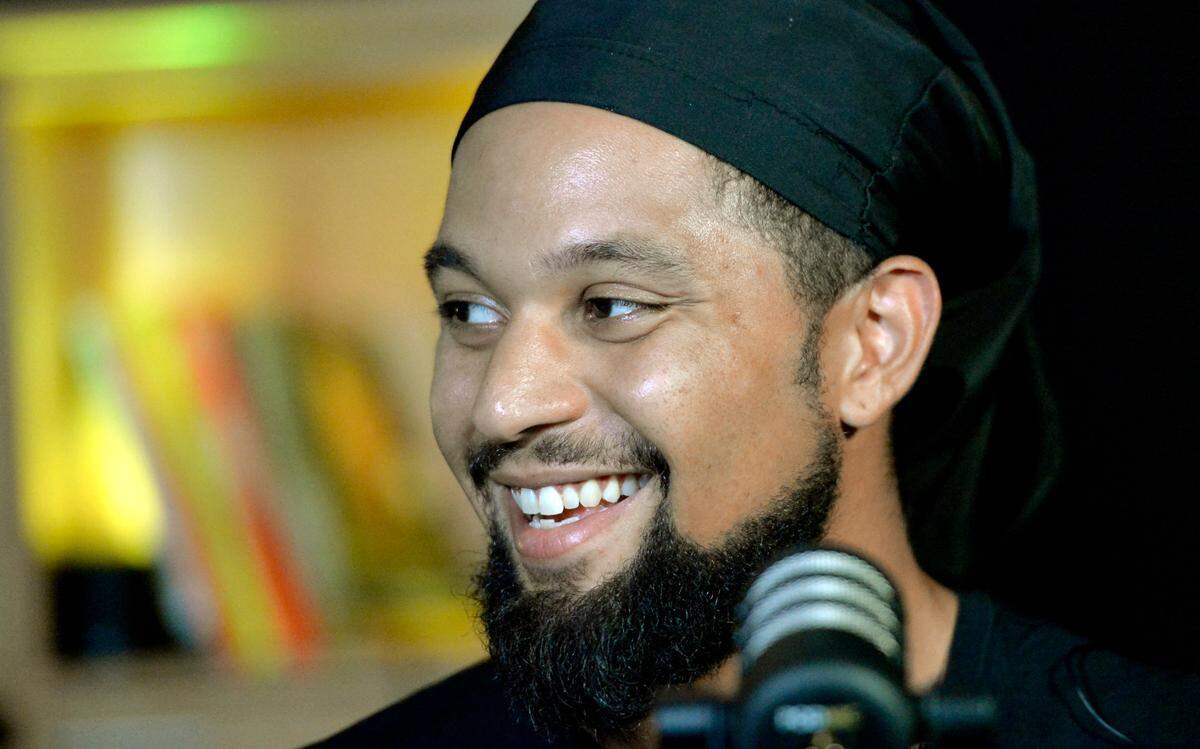
Dontavious Young, showed up to the studio at Kansas City GIFT flashing a big smile and carrying a jar of the chai tea he concocted at Equal Minded Cafe, the business he owns at 4723 Troost Ave.
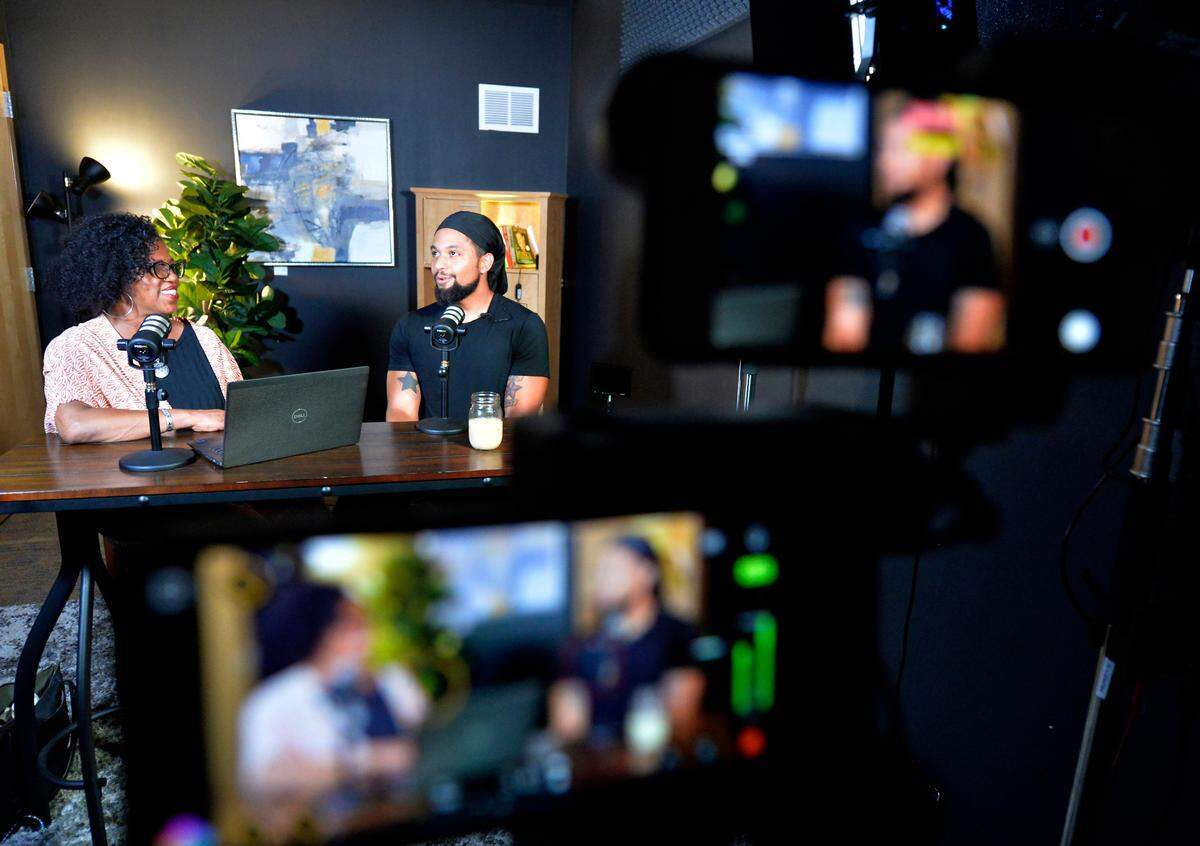
The Kansas City Star invited the 26-year-old entrepreneur to the Prospect Avenue studio, to participate in a new project launched in partnership with GIFT, a nonprofit that supports Black business in the city and KKFI Kansas City Community Radio.
With his shoulder-length locs tucked beneath a black nylon sleep cap, Young sat down for an interview with Mará Rose Williams, The Star’s assistant managing editor of race and equity issues, to tell his story – about growing up in Iowa and Kansas City, the death of a beloved cousin, and how he came to open his cafe on Kansas City’s East Side in 2018.
Their conversation, edited for length and clarity, is presented in a question and answer format to share Young’s story in his own words.
Meet Dontavious Young.
The Star: We’re going to talk a little bit about the man behind the business. So, Dontavious, are you from Kansas City?
Dontavious Young: Actually, I was born in Waterloo, Iowa, and I moved to Kansas City in about third grade for the first time. And then I moved back to Iowa. But a different part, about an hour away from where I was born. Cedar Rapids, Iowa, it is called. I moved there right before ninth grade, right before high school.
So what was it like being a young Black child growing up in Iowa?
Well, actually, Waterloo, Iowa, where I was born, has a lot more Black people than people would expect. It’s actually the high school that I would have gone to, Waterloo East, is actually a predominantly minority school. I think it’s somewhere upwards of 60% or more as minority students. And the town itself has a lot of Black people, of course, but also a lot of crime, a lot of issues that people wouldn’t expect in Iowa, such as gangs, such as violence, such as gun problems, etc., etc..
That place, honestly is not much different than Kansas City, other than the size and the population. That is about the biggest difference between the two. Now, places like Cedar Rapids and Marion, Iowa — where I went to high school — were a lot different. It was a lot more predominantly white. They judged me because of some of the tendencies I had from being from Waterloo and from Kansas City, a combined kind of thing.
And so they label me as like a thug and like an outcast and like the Black kid kind of thing. So it was a big switch-up.
So you started in Iowa and moved to Kansas City. Where in Kansas City did you move to when you left Iowa?
Well, my grandmother lives east of Troost. She lives off of Elmwood, somewhat close to the Blue Parkway Sun Fresh, if you know where that’s at. And so I lived with her for a while. But me and my mom, we have a long story. A long, long story. So you know, I’ve lived alone with my mom for most of my life, especially my teenage life.
We moved back and forth between different places. We were homeless at one point, you know, and living with different family members at different points. So, we went from living with my grandma in her house, to living in Overland Park with friends and family, to living in Lee’s Summit with friends and family, to moving back to Iowa. You know, really back and forth.
And so when I was here, I lived on the Missouri side the majority of the time. But I went to school in Overland Park because she wanted me to go to better schools, because Kansas City schools aren’t the best historically, as we know.
I moved to Kansas City in third grade. And I moved back to Iowa in eighth grade.
Your middle and high school years were in Iowa. What was that period like for you?
It was actually very interesting. Like I said, me and my mom moved a lot. So when I first moved back to Iowa, I moved back to Waterloo for about a year. And then after living there for a year, we moved to Cedar Rapids.
And so that was a big transition because moving from Waterloo where I was from, which I still went back to in the summers and regularly for family and stuff like that. I probably spent the most time there as far as leisure time. Going back there I was still hanging out with a bunch of friends who were doing stuff they shouldn’t be doing.
You know, every single one of my core friends from Waterloo that I grew up with — like as kids — before I moved away in third grade. Every single one of them has either been shot, been to prison, or they’re dead right now, every single one of them.
So that’s the path they were going down, that I luckily broke away from when my cousin was killed. That’s when I moved to Cedar Rapids, with my mom. I kind of got out.
When your cousin was killed? Can you tell me about that? How old were you when that happened? What kind of impact did that have on your life?
Yeah, I was about 13 years old. The impact it had, it really just motivated me to want to have a better future for myself, to create more of a legacy, more of a successful story that people would remember positively when I’m gone. Something we talked about a lot, me and him. Yeah it just really instilled a growth mindset, but also a dedication to myself. Really. And actually got his name tattooed right here (on his forearm) and got dedication right here within a year of his death.
So, you know, I really, really was serious about it. I saw the path that my friends were going down before. I saw that path coming for him. I was like, I don’t want to end up like that. I also looked up at the role models that we had, and I was like, wow, you aren’t really someone I want to end up like.
Tell me about some of those role models.
Yeah, I mean, it’s just guys that hang out on the block every day and they look cool because they got cool clothes on, cool shoes on. They got chains on. They might be driving nice cars, you know, toting guns, drinking all day, smoking all day. It looks like fun.
It looks relaxing. It looks like it’s the life, right? Not realizing all of the negativity behind it and the sad stories behind it that they’re going through and the cycle that they’re stuck in.
Were you just an exceptional child at 13 that you recognized the difference in what those so-called role models were and what was the better path to pursue? Or was there someone in your life at that time, aside from your cousin, who helped you to see that there’s a better way? Was there an inspiration that helped you turn the tide?
Yeah, my grandmother. Definitely my grandmother, Vickie Smith. Doctor Vickie Smith, you gotta put some respect on it, right? She has always been a huge influence in my life. She’s a great role model for me. She’s an educator. She was a principal in Waterloo, Iowa. She was a principal at one of the worst crime-ridden middle schools, where a lot of crime happened — sixth, seventh, eighth grade.
She was a principal there for a long time, but she also taught overseas in Saudi Arabia and in El Salvador during civil wars. She taught in Kansas City public schools for a while.
She’s always inspired me as an educator and someone who wants to do good for others. And you know, she’s a teacher, educator, so she’s always had me reading books. I was already on top of my schooling. So school was always easy to me and I met a lot of role models through school because of how well I did in school.
A lot of teachers noticed it, even though other people didn’t. And yeah, I mean, I also have very strong intuition. My entire life I’ve always just kind of understood things without having to fully research them or fully really be educated on them. I just kind of pick up on things quickly and I’ve always been a problem solver also.
I loved math as a kid because I could figure out processes instead of remembering specific answers. I can remember a process to figure it out, and if the process didn’t work, I could try another one.
I enjoy having to figure things out in a short amount of time, having to be creative, innovative in my solutions. And so, you know, it has a lot to it I guess.
It’s a great question, though, what made me different.
What about when you came to Kansas City? Were you going to high school in Overland Park?
No, actually for high school I was back in Iowa. (Overland Park) was elementary school and half of middle school.
If I would have stayed in Kansas City, Shawnee Mission West is where I would have went. So I have some friends, actually, who did go to Shawnee Mission West. One of which, actually coincidentally enough, one of the good friends I had growing up, he actually passed away in his senior year at Shawnee Mission West, and he was — rest in peace — on the football team. Like it was a really big story a while back (2014). So a lot of trauma in a lot of different areas as a kid, for real.
And I think the trauma is a huge part of what made me different as well.
Yeah, the childhood stuff, it was so back and forth.
But that part of you, that’s your foundation. And that intuition you were talking about, that makes you spontaneous to do the things that you are doing. We all have different backgrounds and different foundations. The foundation you had, as chaotic as you might think it was, and traumatic as it was, that’s what has given you your strength, right?
Yeah.
When and why did you come back to Kansas City? How did that happen?
Yeah. So throughout high school I got into some trouble that I didn’t expect, thinking I was smarter than other people and thinking I had the right plan. Right? So I was involved in things I shouldn’t be involved in, such as dealing drugs, such as out partying with friends, late night every night, such as etc., etc. Doing different things I shouldn’t be doing.
And I got caught up and got into some trouble a couple of times. I got on a couple of probations, and did some county jail time. Then finally I had a felony charge that I was facing five years prison for. I was put on a three-year probation. And before the probation started, I requested that the judge would allow me to move back to Kansas City to start new. Basically get out of Iowa. Get away from the people I was around. Completely remove myself from the situation.
And so Kansas City was my escape in a way from all of it. And I really almost, you could say, reinvented myself when I moved back to Kansas City. And I had a lot of help with that. Of course, my grandmother had bought the building that we’re in now. She bought that in 2011, so way before I moved back.
She bought the building foreclosed for like really dirt cheap, for like under $50,000 for three commercial buildings. It took her about five or six years to renovate those buildings because there was so much work that needed to be done. And she wanted to get it relicensed for a day care. The building had been used for a day care up until two years before she bought it.
It had been used for a Black-owned day care since the seventies. So her dream really was to get that back up and running. Just the day care is all she cared about. And in the process of her doing that, you know, I was a kid. In 2011 that was about when I was 15 years old or so.
And so I was like, Grandma, you’re crazy. Like, when she bought the building, I was like, I knew what Troost was as well, from my time in Kansas City and from my family living in Kansas City. And so I was like, yeah, it’s a lot of crime, you know Grandma there’s a lot going on on each of these corners.
Grandma, you sure? You sure this is the move? And she had the faith and the belief and then stuck with it over the years. And I think that really instilled what I have now for where we’re at. But yes, on moving back, I always knew I wanted to own a business. I worked multiple part-time jobs all over different industries, and I knew that I wanted to own my own thing because I had so much input to give and nobody respected my input.
Nobody saw me as a credible person to listen to. And so I really took that to heart, especially with how intelligent and intuitional I am, I was like, Well, OK, let me show you guys. It was that kind of thing. Like, I’m gonna do it one day and do it better than you’re doing it. And so I really took that to heart and stuck with that.
And so when my grandma bought the building, and after it was fixed up — after five or six years . . . She got a lot of help from the community with that. People who live in the community really just wanted to see that come to life. They saw her vision and loved it. They would donate their time and services for free and like she would buy the materials to do the flooring and someone would be like, hey, I know how to do it. I’ll do it for you. She’d buy the paint and 20 people would be like, oh, I’m down to paint. I’ll come out and we’ll get it done quick, in one day.
That’s very cultural for Black communities to do that kind of a thing, where somebody can do the work for you and so they jump in and do it. Was that something that you recognized?
Very much so. And she even discovered the philosophy of Ubuntu, which is a Ugandan philosophy. And it pretty much in my own paraphrase, means unity. It means we are who we are because of who we all are. A togetherness kind of thing. And so she learned about that and studied it more and really that was how this building was put together.
And honestly it was really cool to see because of the many people who helped. The village. The village style was so multicultural. You know, like, so many different types of people from so many places were like, I want to be a part of this thing. I believe in this. And so that was like the beauty of it as well. So those are all multiple reasons why I moved back and what brought me back and what my purpose was.
When I first moved back though, I just really started out helping her manage the building. She wasn’t really doing well business-wise and she doesn’t care about business. She kind of just dumped her entire savings and retirement into this and she was a teacher so you know that wasn’t much.
Do you have a business degree? Had you gone to school for some business education?
I had gotten my associate’s degree in business. I had actually just graduated in 2017 and then moved back at the end of 2017. Around all that time, all that stuff happened. And so, you know, not general business, really. Associate’s degree is really very general stuff.
But like I said, I’d always wanted to do this thing. I didn’t know what I wanted to do, though, but I had worked in a coffee shop in high school, and I had worked up to doing some management things there, in kind of a management role position and helping the business a lot with some innovative strategies and stuff like that . And, I really loved the chai that we made there and just went further and further with the chai and the different recipes, creating my own version of it.
And yeah, so I felt like having a place in the community that promoted positive vibes, promoted an inclusive space, that anybody felt welcome in and brought people together from the East Side and west side of Troost really was what I felt like I needed to do. Specifically because I have so many relatability skills. And I’m able to be the glue or be the mediator between different cultures a lot of times.
How did you discover that about yourself?
Well, that came really from me having a Black side of my family and I have a white side of my family, right? And on my Black side, we have white kids that are adopted into the family and on my white side we have Black and foreign kids who are adopted into the family. Really I don’t see color because all the colors of the rainbow are on both sides of my family. And so I really just see people for who they are. I don’t pass prejudgment on people and I don’t have a certain bias towards people when I first meet them.
I just really get to know who they are as a core person. And I want other people to be able to do that more often as well. And that comes through just having shared experiences with each other and having spaces like this where we can have shared experiences.
So I think in Kansas City, so many spaces are labeled as this is more for Black people, Or, this is more for white people or this is more for Hispanic people, Latinx people, right? And this is more for a Native American, right? So separated. So segregated, which is due to the history and the redlining in Kansas City. But I want to promote a space that kind of disrupts that.
Is that where you got the name from, Equal Minded Cafe?
That name, it was actually Equal Minded Studios originally and that was a name I had in high school for a little small business I did just selling T-shirts.
And you just carried that over to create, Equal Minded Cafe?
Yep.
So with the studio idea, were you already thinking about creating unity and this community magic that you want to see happening at Equal Minded Cafe?
Very much so, except I didn’t think of it in the fashion of a cafe. The reason I had put studios in there is because it actually has always been my dream, since a little kid, to own a community radio station, just a talk show radio station that I would retire into.
And so my long-term thinking — I’m always thinking 20 steps down the road — I’m like, if I name it studios now, it’s going to influence my friends to make it an actual studio. I’m actually in the process of building a small recording studio in the cafe right now. I’m really excited about that.
So where you are now with your cafe, are you satisfied? What is it that you want to see happening there and is that happening? I know that every time I’ve stepped into Equal Minded Cafe I run into somebody from the community that I know or that I need to know.
Is that what you are looking for?
I love that question. Thank you for asking that question because it’s evolving, right? It’s always evolving. I feel like when we first opened the goal, like I said, was just to promote a space that was inclusive and welcoming to all people and promoted people from both sides of the lines.
And over the first two or three years especially, I’ve learned so much about myself, so much about the community, what it wants and needs, and so much about who I want to serve and what type of customers we want to frequent our cafe.
And I think at this moment what it’s evolved into is really that I want to be able to serve the social justice warriors of the city, right? People who are making differences in the city and really, really making huge changes.
So it’s evolved into us serving those social justice warriors, but that’s not where we get the most money from. And so at this moment I’m thinking more scalable, opening locations in places where we can drive more revenue to do more things in the communities that we serve. I’ve developed a nonprofit organization that will help us to do more for the youth, something I’m a little bit more passionate about.
It’s something I can put a little more of myself into and continue to give, educate the youth and the community on the things I’ve done. Tell my story and how they can replicate it, how they can be great themselves.
So are you telling your story to young people who come into your space? And what is their response?
I would say with youth 18 and below, they’re usually brought in with their parents and they’re always inspired, always have questions, and I love it. I’m here for it, and I’m able to always give them knowledge that they really, really wanted on future, or business, or their own path, their own destiny. But where I really see the impact inside my coffee shop is probably 18 to 25, 18 to 37.
And so many of them come in and see me as a young man doing it, and they just say that that inspired them, that they believe they can do it now. So I think that’s where, where it hits me in the heart. And I’m like, Oof! I know I’m where I’m supposed to be.
Where do you want to go from here? Is there something else that you feel inspired to do? What’s the future look like?
The future looks promising. I have a lot of plans to influence educational policy and change the way we educate our youth and provide opportunities to our youth.
So the nonprofit organization I’ve started is called Big Ideas Foundation, and it stands for Before I’m Gone Innovatively Developing Education and Society.
What we do is we’re a community entrepreneurship incubator program for public high school students. We provide them with an experiential opportunity to learn more about business, entrepreneurship, entrepreneurialism, events and then marketing, etc., all these different strategies and apply it specifically to coffee.
They’re of course, going to go out into the world after that and do all types of ventures, but we’re going to give them a specific avenue that we know that they can replicate and be successful with. And then they’ll be able to gain college credits from that as well in the form of scholarships, as well as they’ll be able to have a residual income from the product that they develop.
So the future for me looks like counseling, mentoring. I plan to go back to school for a master’s degree or Ph.D. in educational policy or master’s in counseling education. And so that is one step for the business. Specifically, we’re looking at bottling our chai, enjoying it, I should say. And selling that on shelves and grocery stores and getting our business out there online a little bit more with e-commerce.
The next step with that is getting our liquor license and promoting more mixology, drinks made with our chai and our coffee espresso and selling it in the shop, as well as promoting a night lounge with a nighttime espresso place. So a little bit more things to drive revenue and put the brand out there more. But I do plan to stay involved with Equal Minded for a very long time. I also plan to put other people in charge once we get to a financially stable place.
OK, so I’m going to give you the start of a sentence. I want you to finish it for me in 10 words or less if you can. Dontavious Young, I am a…
Dontavious Young. I am a problem solver, an innovative change maker.
After concluding the interview, Young and Williams continued talking. With Young’s permission, we also are sharing some of that emotionally powerful and touching conversation.
The Star asked : Do you think about your cousin often?
Still very much so. He passed away on January 5th. And so every year you kind of like have a little vigil. And yeah, as well as on his birthday.
If you could talk to him, and I bet you probably do in those quiet moments, what do you tell him about where you are now?
Honestly, I think I use his voice when I need to motivate myself when I’m feeling down or feeling like, like I’m complaining a lot or, you know, there’s just no room for me to grow or something like that. I always kind of like hear him in my head, like, laughing at me, like just saying like, like, clowning with me, like, “shut up.” Like, almost smacking in the back of the head. Like, saying you sound stupid. You got this, this…” know what I’m saying?
He was just that type of person. He’s always laughing, he’s always clowning people, but like, he made people really think about themselves and really evaluate their actions and their opportunities. And if you were like complaining about something around him, he would either clown you on it and make you feel worse and you’d go home and be like, why am I even feeling like that? Or he’d cheer you up with his clowning on purpose, you know? And so he was just very motivational that way. His sense of humor is what I used to think of most.
Very nice to meet you, Dontavious. It’s been great, thank you.
Thank you. Very nice to meet you, too.