‘Get us out of purgatory.’ Inside the Royals’ faltering push for a downtown stadium
An east-facing window inside the office of Mayor Quinton Lucas overlooks several blocks of grass lots, bulldozed and ready for development. And for years now, he’s been led to believe it’s fit for one particular project: downtown baseball.
Until recently.
A few steps outside his 29th-floor office, another flank of windows offers a view northward beyond the Missouri River — to a different city, different county and apparently a potentially different site for a new Kansas City Royals stadium.
“We’re all big kids. So my view is if (the Royals) found a good area to go that’s separate from us, I would expect at least some notification that they’ve lost interest in downtown Kansas City,” Lucas said, “rather than this battle back and forth from press releases from public officials.”
Years into their exploration for a new stadium site, the Royals are still playing the field. And their recent flirtation with North Kansas City and Clay County has created an icy relationship with Kansas City and Jackson County officials.
But it was only lukewarm — at best — beforehand.
The Star spoke with nearly two dozen political leaders at the city, county, state and federal level, along with business and nonprofit leaders and others seated at the table during ongoing talks. Many spoke on the condition that they not be named because those discussions have not been public.
Privately, people inside those meetings expressed exasperation that while the Royals publicly portray progress on the stadium effort, there’s actually little momentum behind the scenes. Despite months of meetings, public officials still have no sharper picture of what the team wants.
They wonder: After all this time, do the Royals even know?
“Get us out of purgatory,” said one city official who has been in meetings with the Royals. “We’re all exhausted by this conversation.”
The Royals insist they are not hiding specific details, but rather have not settled on them. In an interview with The Star on Tuesday, team president of business operations Brooks Sherman said the team has narrowed to two possible sites and is on course to announce its choice by the end of the summer.
“We want to get it right,” he said, “so we don’t think it’s right that we should rush into anything.”
Local officials view that as contradictory to the team’s own rhetoric, which has implied urgency. The Royals continue to float looming dates for a public vote on the stadium — before they have secured the backing of the public.
Or the city. Or Jackson County.
As the Royals have tried to raise support, they’ve instead raised doubt — even from those who believe in the merits of the $2 billion project.
Some want better answers. Others just want any answers.
The team has commissioned multiple polls, which show less than half of potential voters support a move downtown, multiple sources tell The Star. Some political operatives blame that on the team’s public messaging.
That’s one obstacle. Another? One of their most accomplished former players.
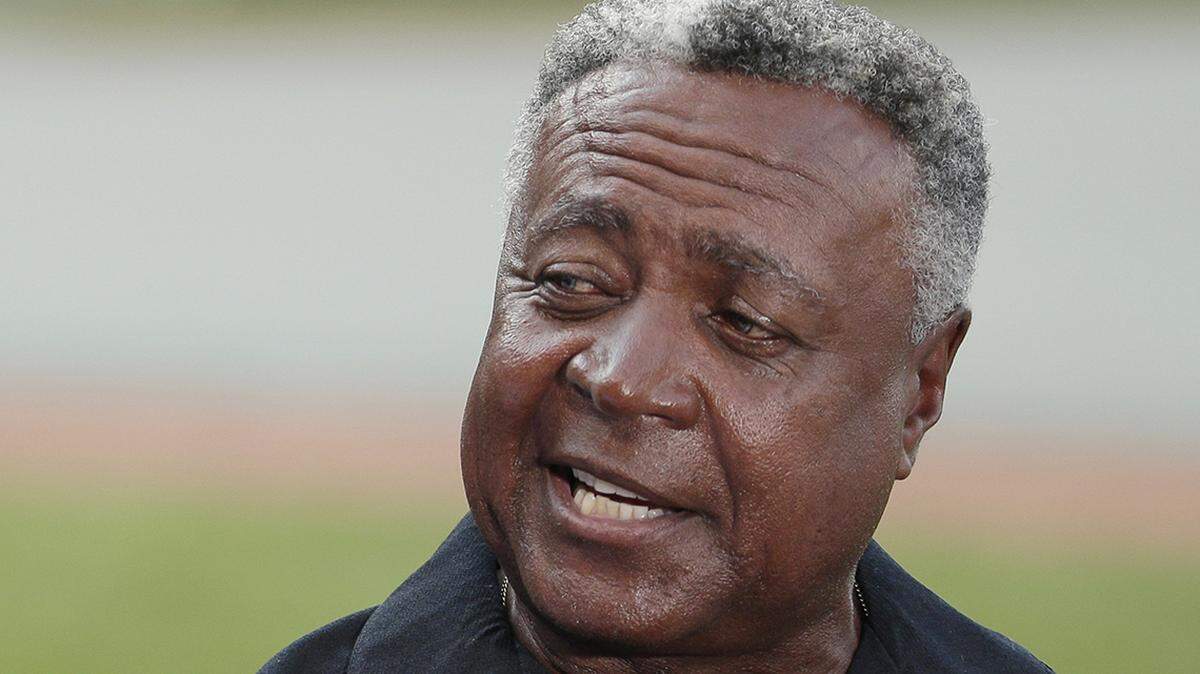
Frank White Jr., the Jackson County executive and one of only two players to have his jersey number retired by the team, is widely viewed as averse to committing tax dollars to professional stadiums. Should the project move forward, he would at least like to see the project serve a disadvantaged part of town.
Those challenges surrounding a downtown location — which existed when the Royals began this process — remain, and in some cases, have only compounded.
Unless they plan to go another route.
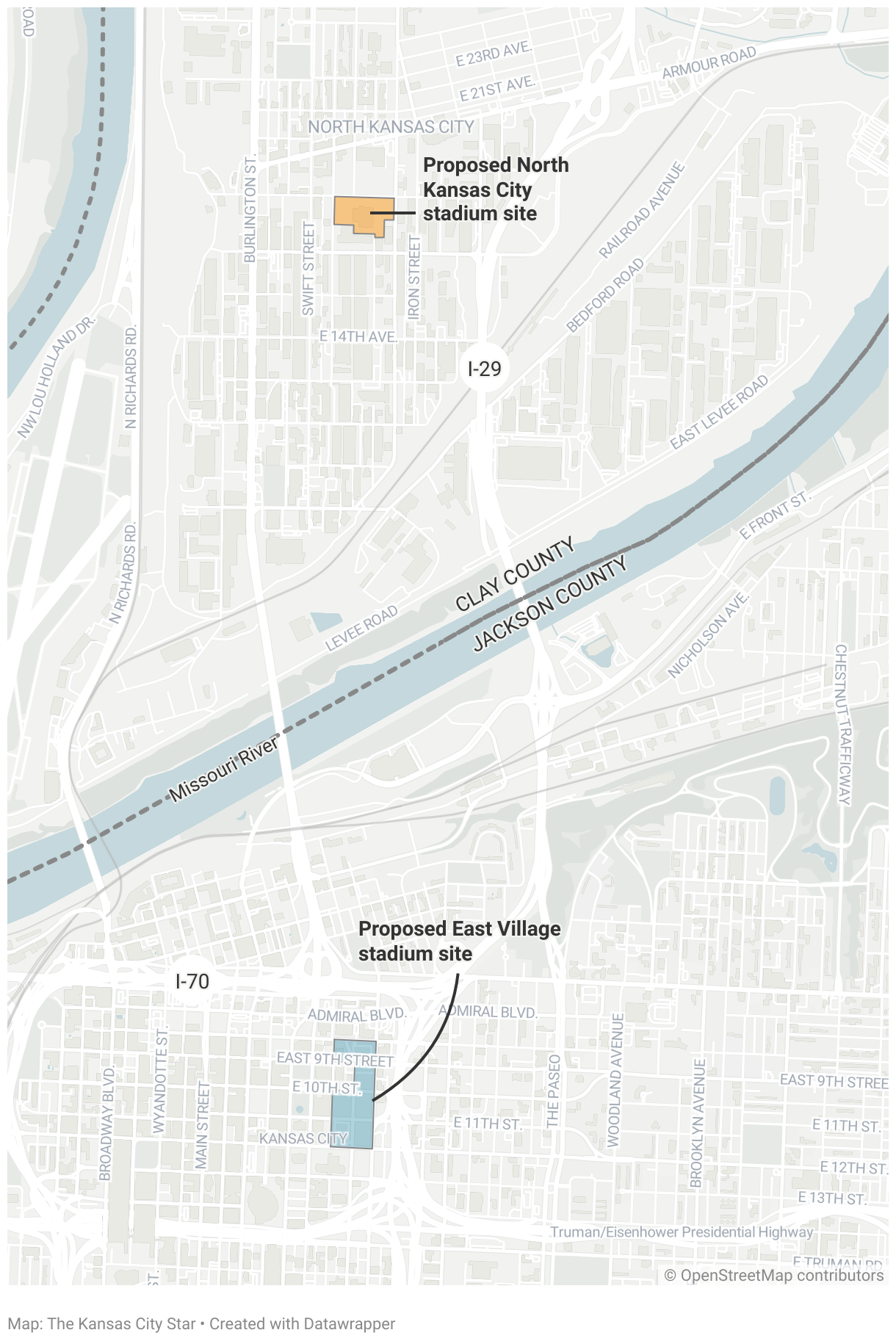
In North Kansas City, the team is exploring an option that would bypass most of those impediments. Many political leaders view that site as nothing more than an empty threat, highlighting the significantly smaller tax base in Clay County. But those familiar with the Royals’ thinking say it is a viable option the team is seriously considering.
The site’s public promotion, however, has amplified tensions between the team and Kansas City officials to the point of a near-standstill — for now, at least.
And while the Royals initially attempted to push a faster pace, today even those who believe downtown baseball will still happen — that it is an inevitability — wonder aloud:
How?
‘It’s time for specifics’
Inside City Hall, leaders say they have cleared an accommodating path for the team’s move downtown.
Literally.
The city has helped a single developer, VanTrust Real Estate, assemble multiple blocks of land in the East Village area, the site outside the mayor’s office window, for the purpose of a new stadium and a proposed surrounding ballpark district. That includes transferring city-owned property and making the police headquarters annex available.
Top city leaders have met with team leaders and their architects — meetings that, by the way, reinforced the East Village as the team’s preferred site. Renderings provided during those meetings show the ballpark exclusively in the East Village location, even as the Royals informed the public they were considering 14 sites and subsequently four or five finalists.
Sherman, who is not related to majority owner John Sherman, said Tuesday that East Village is one of two finalists, along with the Clay County site. He characterized Kansas City leaders as cooperative “partners.”
But there’s no commitment yet. And that has not only increasingly agitated city officials but left them confused as to what will bring the project to completion.
One likened it to “fighting with Jell-O.”
Even though city leaders are prepared to contribute financially — perhaps as much as $200 million — toward major infrastructure improvements needed for a new stadium, the Royals have not made a specific ask.
Publicly, Lucas even stopped using a well-known line from his first mayoral campaign — that the city needs a new ballpark “like I need a Maserati” — at the request of the Royals.
And still they wait.
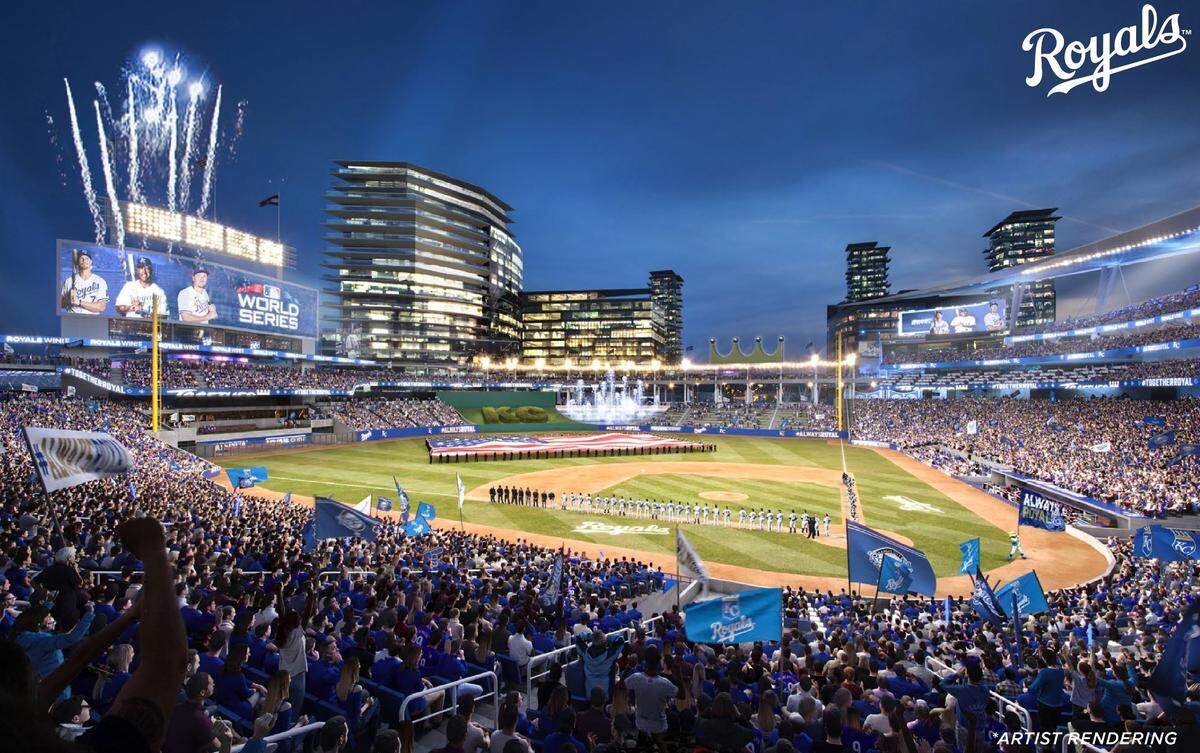
Despite the steps the city has taken, there have been no formal negotiations with the city, county or developer about the East Village site.
“It’s time for specifics for the people of Kansas City,” Lucas said, “rather than perhaps a new site every few weeks.”
Last month, Clay County officials issued a letter seen as campaigning for the Royals. They laid out a vision for a neighborhood-centric ballpark village similar to Chicago’s iconic Wrigleyville. After months of leading Kansas City Hall to believe East Village was their preferred location, the Royals immediately followed Clay County’s statement with one of their own, calling the Northland plan a “progressive and creative vision.”
If the Royals had hoped to be wooed, they got it from North Kansas City.
But not in their hometown, where City Hall subsequently ignored calls from the team. City officials are adamant that they have no desire to engage in a bidding war for a project they have viewed closer to a luxury than a necessity.
Should the Royals ultimately elect to choose downtown, two officials said they have risked weakening their negotiating position there. And they have strengthened the alliance between two important figures in the process — the mayor and county executive — bonded by their frustration with the Royals.
The hurdles in Jackson County
Frank White helped build Kauffman Stadium, and that’s not meant metaphorically. In his early 20s, before he had reached the big leagues, White landed a job on the crew that constructed the stadium where he would win a World Series, make five All-Star games, win eight Gold Gloves and eventually have his No. 20 retired alongside George Brett and manager Dick Howser.
That was the past.
Now? White is reluctant to build another.
White, as the Jackson County executive, is a central figure in the stadium conversation. And he’s viewed more as a hurdle than an ally for his former team.
Like the Chiefs, the Royals lease with Jackson County is tied to a ⅜-cent sales tax, which the Royals have said they would seek to renew through a public vote. That measure can only appear on ballots with the blessing of the Jackson County Legislature.
Some believe White’s opposition could be strong enough to veto a prospective ballot question from the county legislature.
White declined to be interviewed for this story. But the Royals’ “attempt to pit local communities against each other,” as he phrased it in a statement last month, did not land well at the county level, either.
“I will endorse a new downtown stadium only when I am convinced it serves the best interests of Jackson County residents,” he said in that statement, referencing an alignment with Lucas.
Should county taxpayers invest in a new venue, White has preferred a location in a long neglected part of town like the East Side — or at least provide it a tangible benefit.
None of that comes as a secret to the Royals, who have made generalizations about helping underserved communities, but still have not offered specifics as to how.
White has had a rocky relationship with the Royals post-retirement since his 2011 firing as a broadcaster for the team, but he’s said to be on good terms with John Sherman.
In fact, almost universally, local leaders like and respect Sherman, pointing out his involvement on Kansas City boards and his commitment to uplifting underserved populations. His family foundation has pumped millions of dollars into the region through various charities and nonprofits.
It’s one reason many are open to the idea of a new stadium, if not excited about it. Before backing the undertaking, though, they’ve told the Royals they need answers to the most basic questions.
When? Where? How much?
And what’s the public benefit?
The Royals have not yet supplied those exact answers, which has baffled some, angered others and shaped both political and public sentiment.
“Anytime you go through a process like this there’s complexities, perhaps frustrations, but we’re not going to ... look to air any of that publicly even if there were,” Brooks Sherman said. “We, again, have good relationships and expect to get this worked through and end up with a great project at the end of the day.”
The Royals consider the twist and turns to be part of the process, and their peers across Major League Baseball have encountered similar push-back.
Brooks Sherman said the project could go to a public vote as soon as November of this year, but after adding “maybe that’s pretty quick,” he mentioned April 2024 as a possibility.
He acknowledged that voters must be equipped with more information before the question appears on a ballot, including exact cost and location. The team has estimated the entire development would cost $2 billion, split evenly between the stadium and a surrounding ballpark district, the latter funded by private investment.
It’s still unclear, though, what kind of ballot language the Royals would seek — the team and the county have not yet reached that stage in the discussion. Some county leaders view this as their best, if not only, chance to renegotiate leases with the Royals and Chiefs they’ve long considered unfavorable.
Whatever deal they strike on a new lease would also ostensibly need to be approved by the Chiefs — and, logically, therefore benefit the Chiefs — who tout more fans, money and political heft. The two teams are tied together in leases that expire in 2031, and the Chiefs say they’re content to wait until that date.
The Royals want to act sooner.
Their ongoing talk about potential ballot dates — they initially mentioned August 2023 as a possibility, but that deadline already passed — has irritated those involved in the process who view it as glossing over important details that must be sewn up first.
“There are so many different layers to this that aren’t anywhere close to even a proposal,” said Manny Abarca, a member of the majority faction in the county legislature. “I wouldn’t feel comfortable putting this to a vote of the people.”
Why downtown KC?
Three-plus seasons after John Sherman took over, the Royals are stuck in the rebuild he inherited, barreling toward the worst record in franchise history. A fan base starved for postseason baseball has been fed two playoff appearances in the past 38 years.
Last December, the Royals began a sales pitch for a brighter future centered on downtown baseball, which appeared to please the hundreds in attendance for a public listening tour. But they aren’t the only people who need convincing.
“I don’t think that that represents the entire population. In fact, I think it kind of gives people a false sense of security,” said former Mayor Sly James, who attended the tour. He added: “The general public, I think, is much more divided.”
At those meetings, the Royals tested various arguments for moving downtown in the first place. But anecdotally, on occasions in which The Star spoke to prospective voters, each argument has been met with some degree of skepticism.
Among them:
▪ The Royals said the price tag of renovating Kauffman Stadium would be just as steep as building new, citing repairs needed in the underbelly of the venue, a difficult sell to those who sit in the stands.
▪ They pointed toward the success stories of downtown venues in other cities, but many fans are drawn to the easy access of The K, including its vast parking lots and ample tailgating space at the Truman Sports Complex.
▪ They insist they plan to reinvest windfalls from the new stadium and its surrounding ballpark district to build a winning team; but many fans are waiting for Sherman to invest in team payroll first.
“I don’t think they have a clear vision forward,” Abarca said. “They’re just trying to see what sticks. It’s just an odd way of leading the discussion.”
Historically, Jackson County voters have been supportive of subsidizing stadiums and arenas, almost always approving ballot questions.
But as the team’s polling illustrates a lack of majority support, close observers have suggested the Royals bring in outside help to improve their public messaging — pointing out that they need to better underscore how downtown baseball not only benefits their team but prospective voters as well.
That type of messaging — what’s in it for the voter — is a prerequisite to winning at the polls, political operatives say, but it has been notably absent so far.
Those operatives have suggested the team should turn to someone like James to craft a more effective and consistent message. James, who ran 18 campaigns for local office and ballot issues, now works as a political consultant with his former mayoral chief of staff, Joni Wickham. Asked whether the Royals have been receptive to his input, James said, “I think the best I could say there is that discussions are ongoing. And that eventually, we may have a role. We may not.”
County leaders are unlikely to put a question on the ballot before they have confidence it will win.
That takes time — and potentially a lot of it.
James referenced the 2017 ballot measure that asked voters to approve the new Kansas City International Airport terminal — which was also an unpopular idea before a laborious campaign. Using a similar strategy to sway voters on a downtown stadium could require a year run-up, he estimated, but it could also have a similar payoff.
“The information you need to provide voters is increasingly important,” James said. “The time you need to do it is longer than people think. It takes a lot of effort to get the message across. I don’t know that the Royals have gotten there yet.
“If they go to a vote with no more information than what’s on the table now, then I think it’s going to be hard.”
This story was originally published June 14, 2023 at 11:02 AM.