Royals stadium in North Kansas City could replicate Wrigleyville, Northland leaders say
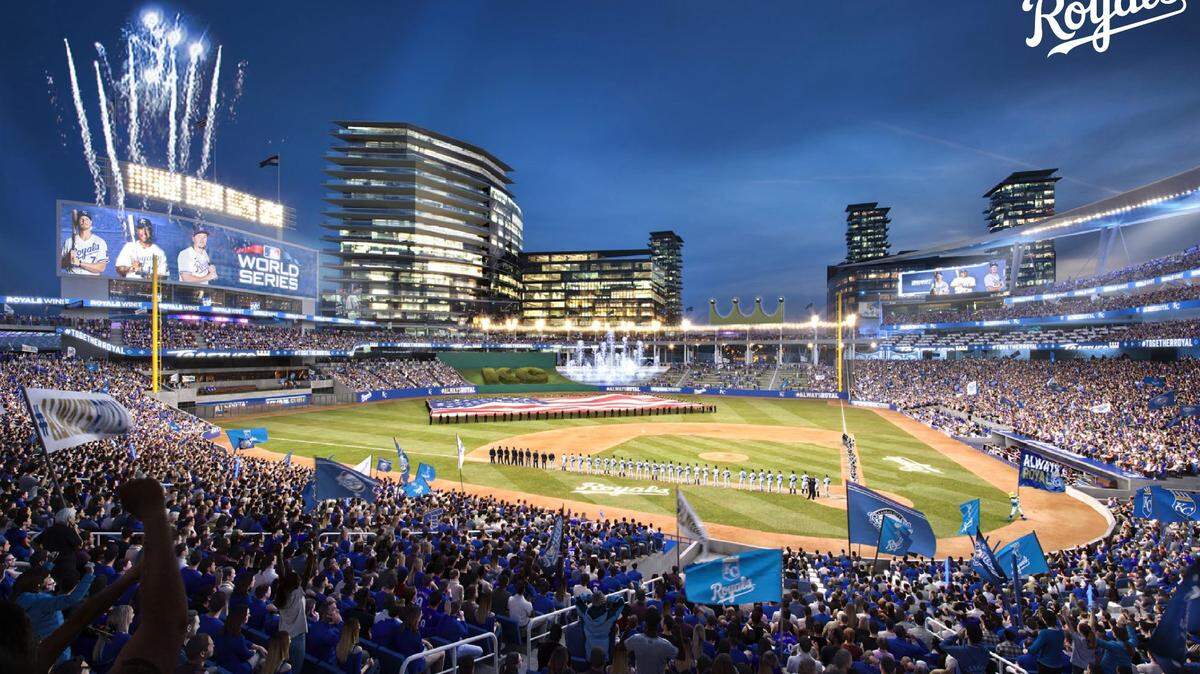
Elected officials north of the Missouri River say conversations are ongoing with the Kansas City Royals about the potential of building the team’s next stadium in North Kansas City.
On Friday afternoon, the mayor of North Kansas City and two Clay County commissioners issued an open letter about their efforts to move the team away from Jackson County.
For months, the Royals have been publicly discussing plans to relocate from Kauffman Stadium to a stadium in or around downtown Kansas City.
The team has spent most of its efforts studying the East Village neighborhood just north of City Hall in the downtown loop. But team leaders recently acknowledged that North Kansas City, a quick drive over the Missouri River, is among the finalists still under consideration.
In their letter, Northland officials described the possibility of a North Kansas City stadium that could replicate Wrigleyville, the iconic neighborhood surrounding Wrigley Field, home of the Chicago Cubs. A mixed-use development “that will take our city and region to the next level” could provide not only a new stadium, but a wider development with homes, offices and entertainment.
“All of this can be had while still viewing and being seconds away from Downtown Kansas City,” the letter reads. “We believe the benefits that this will bring to Clay County and North Kansas City warrants public support from the Northland.”
The letter makes clear that the county and city governments have not reached any agreements with the team, but says the officials “are striving to lay the groundwork necessary for a plan that is positive for the city, the county and our entire community.”
The letter is signed by Clay County Presiding Commissioner Jerry Nolte, North Kansas City Mayor Bryant DeLong and Clay County Commissioner Scott Wagner, a former Kansas City Council member who now represents the western portion of the county.
The Royals said in a statement:
“The leaders of North Kansas City and Clay County have presented a progressive and creative vision for a new ballpark and ballpark district in North Kansas City, aligning with the Royals’ vision as we strive to make the best decision for Kansas City. The potential development and public-private partnership opportunity this presents is one we take seriously.”
The statement said the team “continues to be actively engaged” in discussions with Jackson County, Kansas City and the state of Missouri. “We look forward to sharing more details about our ballpark district as we determine the best location for our fans, partners, and our community of fellow Kansas Citians.”
Kansas City Mayor Quinton Lucas responded on Twitter shortly after the letter was published.
The mayor said Jackson County and Kansas City have been strong partners of the ball club since its inception with taxpayers from both jurisdictions “investing mightily” in the team’s success.
Lucas referenced the economic development border war between Kansas and Missouri. Before a truce in 2019, both states used tax incentives to lure companies across the state line — a wasteful practice since most of those moves did not create new jobs for the region.
He said Kansas City “will not now engage in an intrastate regional race to the bottom that ultimately does little more than fleecing our taxpayers.”
“We encourage the Royals to timely resolve the many questions surrounding their future home,” Lucas said, “so that all involved can speak openly and transparently on any future public involvement.”
The Royals have considered more than a dozen sites in and around downtown.
Those include the former Kansas City Star printing pavilion at 1601 McGee St., which is owned by the Privitera family that runs Mark One Electric. Backers of that site — including Robb Heineman, a part-owner of Sporting KC — say it would place the new stadium in the middle of the action, much closer to existing draws like the Power & Light district than the sleepy East Village neighborhood.
In recent months, team leaders have said they’ve narrowed their search to a few finalist locations, including the East Village site and the the site of the former AMF Pro Bowl Lanes in North Kansas City. The Merriman family, which controls Americo Life Inc., has assembled more than 100 acres there, according to the Kansas City Business Journal.
Any move to North Kansas City would likely require public support from residents in all parts of Clay County, including Kearney, Liberty and Excelsior Springs. Clay County officials believe that, with more than 255,000 residents, the county could enact a half-cent sales tax to help finance the project. That population is far short of Jackson County’s more than 716,000 people.
The Royals currently lease Kauffman Stadium from Jackson County under an agreement that runs through the end of the 2030 season. Royals Chairman and CEO John Sherman said the team would not ask any more from Jackson County taxpayers, who currently are paying a three-eights-of-a-cent sales tax as part of a 2006 ballot initiative to fund renovations of both Kauffman and Arrowhead stadiums.
In a statement on Friday afternoon, Jackson County Executive Frank White noted the Royals’ contractual obligation to play through 2031 at the K and said the county had dedicated more than $50 million this year to the Truman Sports Complex.
“I echo the stance by Mayor Lucas: I refuse to participate in an intercounty bidding war that ultimately harms our residents,” said White, a former second baseman for the Royals. “I will endorse a new downtown stadium only when I am convinced it serves the best interests of Jackson County residents.
“My commitment to collaborating with Mayor Lucas, the City Council and County Legislature to determine justified public support remains firm. However, I won’t entertain this while the Royals attempt to pit local communities against each other. Our taxpayers deserve respect, transparency and loyalty.”
Over the course of three public meetings, the Royals have characterized the stadium as a $2 billion construction project — $1 billion for the new stadium and $1 billion for a surrounding ballpark district to include offices, restaurants and housing. Sherman has said private capital would fund a “bulk” of the stadium cost and the entirety of the ballpark village, and he later targeted 2027 or 2028 as potential opening dates.
Sherman, the club’s principal owner, has not threatened to move the team away from the region. And his own rhetoric has often pointed to a future site within Jackson County.
At the end of the team’s first public meeting on the stadium, Sherman was asked if he could promise to keep the Royals in Kansas City, Missouri.
“We can do that,” Sherman said. “We can do that.”
In terms of distance, North Kansas City sits much closer to the central city than the current sports complex. But the town of about 4,500 people lacks the kind of infrastructure found south of the river. Downtown Kansas City, for example, is home to more than 40,000 parking spaces. The Kansas City Convention Center and the T-Mobile Center regularly host thousands of visitors for events.
Aside from site issues, the team’s existing agreement with Jackson County would complicate any move across the river, particularly if the team looks to move out before its current lease expires. The current lease requires the team to play most home games at the K through its duration.
In their letter on Friday, the Northland officials said a stadium would complement “the amazing businesses and entertainment options that already exist in downtown North Kansas City today.” They said a stadium and surrounding district would provide year-round economic opportunity and and help the Royals compete on the field.
“We simply believe, therefore, that if a move is to be, then there is no reason why it can’t be to Clay County,” the elected leaders wrote. “As we continue to move forward, our intention is to present to our legislative bodies and our citizens the best plan possible. We are committed to that goal.”
The Star’s Sam McDowell contributed to this story.
This story was originally published May 19, 2023 at 1:39 PM.